

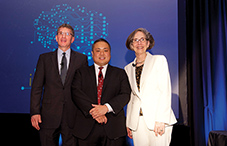

"Shake it off," urged Katherine C. Nordal, PhD, as she danced onto the stage to the sound of Taylor Swift's hit for her opening address at the 2015 State Leadership Conference.
"To be innovators, we need to shake off some of the old ways of thinking about practice models and shake off the negative attitudes of some colleagues about what's happening in health care," said Nordal, executive director for professional practice in APA's Practice Directorate and the APA Practice Organization (APAPO). "Too many psychologists are stuck in the traditional 50-minute therapy box, and that box is way too confining."
Practice innovation was the theme of the 32nd annual conference, which is sponsored by the Practice Directorate and APAPO. Held March 14–17 in Washington, D.C., the event brought together almost 500 representatives of state, provincial and territorial psychological associations; APA divisions and governance; the American Psychological Association of Graduate Students; early career and diversity delegates; and others.
Participants didn't just participate in educational briefings and networking opportunities. They also made more than 350 visits to members of Congress and their staffs to advocate for psychology's legislative priorities: repealing Medicare's Sustainable Growth Rate, halting declining Medicare reimbursement rates for psychologists, increasing Medicare beneficiaries' access to mental health care by allowing psychologists to practice independently and making psychologists eligible for Medicare electronic records incentives.
In his keynote address, Jason Hwang, MD, co-author of the 2008 book "The Innovator's Prescription: A Disruptive Solution for Health Care," repeated Nordal's call to embrace change.
Change happens in every industry and follows a predictable pattern of what Hwang called "disruptive innovation." New technology simplifies work that could once be done only by experts, making a service more accessible and affordable. TurboTax has replaced many accountants, for example, while online booking has replaced travel agents. That's bad news if you're an accountant or travel agent, said Hwang. "But for customers, it's great," he said.
In health care, disruptive innovation is creating a "decentralizing" effect. Instead of the traditional model of expensive, highly trained medical providers clustered in hospitals and other institutional settings, new technologies are allowing care to shift to other providers working in kiosks, retail venues and other convenient settings. Patients themselves — when equipped with new technology on their smartphones — can take on more of their own care.
"I'm not an advocate of replacing psychologists or medical doctors with software," said Hwang. "The question is: Are there tasks that could be uploaded so we as human beings could focus on things that require us?"
This trend makes health-care professionals uneasy, Hwang admitted. And regulations often lag behind innovations.
In Alaska, for instance, dentists fought the introduction of dental health aide therapists brought in to improve access to care in the state's remote areas. Arguing that the aides were practicing dentistry without a license, the dental society took legal action. The state's supreme court ruled in favor of the aides, telling the dentists that their success would deprive people of dental care.
What's key, said Hwang, is to put patients first and deliver the care they want the way they want it.
For psychologists, innovation brings both opportunities and challenges, said Nordal. She called on psychology leaders to exercise "vision and vigilance," defending psychology's interests while enhancing patient care. Thanks to recent advocacy efforts, psychology interns in Arkansas can now get reimbursed by Medicaid, a change that will help meet the growing demand for services prompted by Medicaid's expansion. And qualified psychologists in Illinois now have prescriptive authority.
"We need to think creatively about where psychology can best influence our evolving health-care system — how we practice, where we practice and what we practice," said Nordal.
Rebecca A. Clay is a journalist in Washington, D.C.