

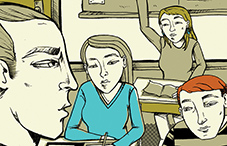

Aiming high: How can psychology educators ensure that psychology is taught in the most compelling, relevant and thought-provoking ways possible? That's the question capturing the time, talent and imagination of Div. 2 members. The division's 3,900 members include anyone who teaches or wants to improve the teaching of psychology, from high school teachers to community college educators to scholars at research-based institutions.
The division's goal is to support and inspire teachers of psychology at all levels. It does that by offering peer-reviewed teaching materials, including course syllabi, classroom activities, film guides and lab manuals on their websiteopens in new window.
The division also encourages members to share their own teaching tips and strategies, says Div. 2 President Suzie Baker, PhD, of James Madison University. "One of the great things about the teaching of psychology community is this sense of, ‘Let's share our stuff.' Teaching is something we all feel really passionately about, and people are incredibly enthusiastic and energetic about sharing resources and ideas," she says.
A changing field: Over the past several years, new classroom technologies and innovative models of teaching assessment have been helping to transform teaching and learning for the better, says Div. 2 Past-President Eric Landrum, PhD, of Boise State University. Div. 2 educators have also been interested in finding ways of addressing diversity issues through novel teaching interventions and course designs, he says.
In addition, the division is working on ways to get faculty members to adopt evidence-based classroom practices and to share the division's resources with the international community. On a national level, Baker is spearheading an initiative to provide resources to help psychology teachers prepare students for the behavioral science questions on the Medical College Admission Test, or MCAT. For the first time this year, those questions — added because medical admissions offices are increasingly aware of the importance of behavioral issues in medical practice — will make up a full quarter of the exam's content, Baker says.
Networking, grant and award opportunities: Div. 2 also hosts an annual conference that includes presentations on all aspects of psychology teaching, such as helping students to develop skills in critical thinking and in oral and written communications. In the last several years, the division also has begun to offer more grant opportunities for members to travel to relevant conferences, conduct education-related research and develop innovative classroom interventions. The division also provides awards for excellent teaching in psychology at all levels.
With the APA Education Directorate, the division also co-sponsors the G. Stanley Hall and Harry Kirke Wolfe lectures, popular talks held each year at the APA Annual Convention, with the Harry Kirke Wolfe lecture tending to focus on the teaching of psychology. This year's speakers are Michael J. Kane, PhD, of the University of North Carolina at Greensboro, Steve Joordens, PhD, of the University of Toronto, and Dana S. Dunn, PhD, of Moravian College. With the Education Directorate, the division also co-sponsors a consulting service to help institutions improve their teaching programs (see TeachPsychopens in new window).
Publications and resources: Teaching of Psychologyopens in new window, Div. 2's flagship journal, is considered the top journal in its area, according to Landrum. It covers the diversity of research related to the teaching of psychology — implementing new teaching techniques, using new technologies in the classroom, and looking at long-term professional outcomes among psychology graduates, to name a few of the topics.
The division also publishes a monthly newsletter written by Div. 2 Executive Director Ted Bosack, PhD, that announces new resources, upcoming events, awards and more, as well as a semi-annual newsletter by the division's secretary, Tom Pusateri, PhD. A Web-based resource called the Teaching of Psychology Ideas Exchange, or ToPIX,opens in new window provides links to books, films, news articles and other resources for teachers and professors. Project Syllabusopens in new window provides peer-reviewed syllabus resources with examples from a wide array of psychology courses.
A strong sense of community: There is a popular member listserv and a member-written blog on the professional and personal aspects of teaching called, "This is How I Teach"opens in new window. Members blog about favorite teaching topics, teaching philosophy and teaching styles, even the condition of their offices.
The division's passion for its subject is witnessed by the formation of subgroups within the division, including groups of graduate students and early career psychologists. The division's Early Career Psychology Committeeopens in new window corrals a wide range of resources, grants and awards for this group. Meanwhile, the Graduate Student Teaching Association offers a listserv, its own website, programming at the APA Annual Convention, and other services designed to help graduate student teachers improve their classroom moxie and reach their postgraduation goals.
— Tori DeAngelis
To join Div. 2, visit the "Membership" section.
Other division highlights
Div. 18 is reaching out to community hospitals
The Div. 18 (Psychologists in Public Service) section on Community and State Hospitals is contacting the nation's directors of departments of psychology in state hospitals to ask how the section could best serve them and enhance their work. To aid the effort or find out more, contact Will Newbill, PhD, Div. 18 Community and State Hospitals Section chair.
Div. 22 congratulates outstanding members
Div. 22 (Rehabilitation) presented awards to five outstanding members during its 17th Annual Rehabilitation Psychology Conference, held Feb. 27–March 1 in San Diego. The winners are:
- Barker Award: Tom Novack, PhD, University of Alabama at Birmingham.
- Lifetime Practice Excellence Award: Bob Karol, PhD, Karol Neuropsychological Services & Consulting.
- Div. 22 Mentoring Award: Barry Nierenberg, PhD, Nova Southeastern University.
- APA Presidential Citations: Monica Kurylo, PhD, University of Kansas Medical Center, and Kathleen Brown, PhD (for effective and collaborative leadership as chair and vice chair of the Committee for the Advancement of Professional Practice) and Angela Kuemmel, PhD, Louis Stokes VA Medical Center (for work with early career psychologists).
For information on next year's awards, go to the Division 22 websiteopens in new window.
Build your community practice skills at this month's Div. 27 conference
Div. 27 (Society for Community Research and Action — SCRA) will host its 2015 biennial conference June 25–28 in Lowell, Massachusetts. The meeting will feature presentations on immigration, sustainable communities, income inequality, civic engagement and more.
The conference will also feature the SCRA Summer Institute, a series of skill-building, interactive professional development workshops on community practice competencies. Four one-day workshops will be held June 24 on:
- Coalition Development and Evaluation."
- "Community Psychology in the Policy Arena: Policy Influence Skills, Strategies and Vantage Points."
- "Sociocultural Competence."
- "Community Leadership: Working with Citizen Groups."
Half-day workshops will be held June 28 on:
- "Strategic Planning and Organizational Development."
- "Starting and Building a Solo Consulting Practice."
- "Grant Writing for Community Psychologists."
- "Building Strong Community Organizations."
Register for the SCRA biennial conference or get more information on the Summer Institute onlineopens in new window.
Div. 39 announces its student, early career scholars
Div. 39 (Psychoanalysis) has selected 77 new scholars for the second year of its Scholars Program. The program exposes new clinicians to psychoanalytic theory and therapy and encourages students and early career clinicians who are interested in psychoanalytic theory and therapy to get involved with the division. Scholars earn a $500 travel award to attend the Div. 39 Spring Conference, held April 22–26 in San Francisco. Scholars also receive all division publications at no cost, as well as a free subscription to Psychoanalytic Electronic Publishing, an online archive of the major psychoanalytic journals. All Div. 39 scholars are also matched with a mentor they meet with once a month.
For more information on the program or to apply for next year's class, go to Div. 39opens in new window.
Div. 40 supports the Alzheimer's disease Pocketcard App
The Scientific Advisory Committee of Div. 40 (Society for Clinical Neuropsychology) is joining the Alzheimer's Association Chapter of Greater Illinois to promote the use of the new Alzheimer's Association Pocketcard Appopens in new window, a free resource that helps health-care professionals recognize the signs of Alzheimer's disease and dementia. The tool also offers health-care professionals guidance on when a referral should be made to a clinical neuropsychologist. Members of the Div. 40 Scientific Advisory Committee will be working with the Alzheimer's Association to spread awareness and use of the app, which includes interactive assessment tools and instructional videos. For more information, contact Terrianne Reynolds.
Apply for the Div. 43 Student Research Award
Div. 43 (Society for Family Psychology) students who are presenting first-authored posters at APA's 2015 Annual Convention in Toronto, Aug. 6–9, are encouraged to apply for the Society of Family Psychology Student Research Award. The winner receives $250 and the opportunity to publish a summary of his or her work in an upcoming issue of the division's quarterly newsletter, The Family Psychologist. The application deadline is July 17. For more information on applying, contact Galena Rhoades or Katie Wischkaemper.
Div. 37 resource offers insights on policy issues concerning children and families
Div. 37 (Society for Child and Family Policy and Practice) has a new policy brief series, Advances in Child and Family Policy and Practice. Edited by Barbara Fiese, PhD, who directs the Family Resilience Center at the University of Illinois at Urbana-Champaign, the series covers issues related to social policy and services for children, adolescents and families from a psychosocial perspective. Electronic access is free for division members and the general public can access the executive summaries of each brief for free. Read it onlineopens in new window.