

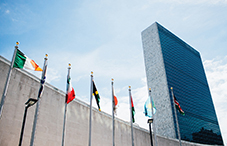

Psychologists have an important role to play in achieving the United Nations' post-2015 Sustainable Development Goals, which include promoting health and well-being and reducing inequality, Ambassador to the U.N. Ruben I. Zamora of El Salvador told more than 350 attendees at the eighth annual Psychology Day at the United Nations in April.
"Public health is not only for the body, it's for the mind," said Zamora, a political scientist who is also a father and brother to psychologists. Zamora's El Salvador permanent mission to the U.N. co-sponsored this year's Psychology Day, along with the permanent mission from Palau.
This year's event focused on how psychologists' work is helping to illuminate the toll that poverty, racism and other forms of inequality can take on health, and offer solutions to the problem.
Reducing those inequalities is among the 17 proposed Sustainable Development Goalsopens in new window that the U.N. General Assembly will consider in September. The goals, when adopted, will provide a framework for the U.N.'s post-2015 development agenda, replacing the eight Millennium Development Goals in place since 2000.
Two of the goals are particularly relevant to psychologists: goal No. 1 ("Reduce inequality within and among countries") and goal No. 3 ("Ensure healthy lives and promote well-being for all at all ages"), Zamora told the gathered psychologists and U.N. staff, member state and NGO representatives. In fact, among the specifics enumerated in goal number three is to "promote mental health and well-being." It's one of the first times, Zamora said, that "mental health" has appeared in an official high-level U.N. document.
The Psychology Day conference organizers chose to focus on inequality this year for three reasons, said chair Neal Rubin, PhD, a professor at the Illinois School of Professional Psychology and one of APA's representatives to the U.N. Department of Public Information. First, he said, inequality is a cross-cutting issue that affects social, environmental and economic sustainability. Second, last summer's Ebola crisis highlighted the dire effects that inequality can have on health. And third, 2015 is the launch of the U.N.'s International Decade for People of African Descent — a group that is among those most affected by racism and inequality.
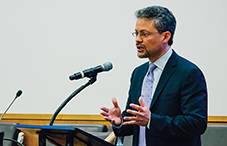
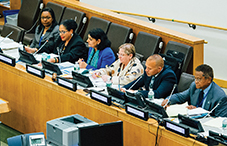
Left: Keynote speaker Dr. Brian Smedley discussed the health consequences of racism in the United States. Right: Speakers included (left to right) moderator Dr. Roseanne Flores, Dr. Barbara Wallace, Dr. Tahereh Ziaian, Dr. Bonnie K. Nastasi, Dr. George Ayala and Ambassador Caleb Otto of Palau.
Keynote speaker Brian Smedley, PhD, executive director of the nonprofit National Collaborative on Health Equity, began the session with a talk on the health consequences of racism here in the United States.
"People of color face poorer health across the life cycle — literally from the cradle to the grave," he said. "And these inequalities persist even when income, education and socioeconomic status are controlled."
For example, he cited research that found that babies born to African-American women with a college degree had higher infant mortality rates than those born to white mothers without a high school degree. And he discussed a recent study in Pediatrics of children's health, which found that African-American and Latino children were in worse health than their white peers of comparable socioeconomic status, at every socioeconomic level.
These disparities continue across the life span. For example, Smedley said, in the highest-poverty areas of New Orleans, residents have an average life expectancy of 55 — comparable to many developing nations. People who live in wealthier neighborhoods across the city, in contrast, can expect to live to 80.
"When it comes to your health, often your zip code is more important than your genetic code," he said.
These disparities have their roots in historical and institutional racism, internalized racism, and real estate and lending discrimination that result in continuing segregation, among other causes, Smedley explained.
He also offered several examples of programs that are helping to address these persistent health inequalities. Investing in high-quality early childhood education, for example, can improve health, economic and other outcomes for African-American and other children living in poverty. Some research shows that for every $1 invested in early childhood education, society reaps $17 in savings through developing healthier, more productive individuals, he said.
Programs that increase housing mobility and help people move out of high-poverty areas can also have an effect. An example of this was the Department of Housing and Urban Development's "Moving to Opportunities" study, in which some people using subsidized housing vouchers were randomly given assistance to move from high-poverty to lower-poverty neighborhoods. The study found that people who moved had lower levels of diabetes and obesity 15 years later compared with a control group who didn't move, Smedley said.
Following Smedley's keynote talk, a panel of four psychologists discussed their work in different areas of health inequality:
- George Ayala, PsyD, executive director of the Global Forum on MSM & HIV, spoke about improving the access of men who have sex with men (MSM) to HIV services. These men shoulder a disproportionate burden of the global HIV crisis (3 percent to 30 percent, depending on the region), but funding for the group is not commensurate with their need, Ayala said. "Structural violence" such as homophobia also reduces access to HIV services such as testing and treatment — for example, 82 countries still criminalize homosexuality. In a recent study in the United States, he found that perceived access to services and being able to access services through LGBT groups was correlated with increased use of those services.
- Bonnie K. Nastasi, PhD, a professor at Tulane University, discussed her work developing culturally appropriate community programs to improve mental health among children and families living through war, natural disaster and other stresses in places as diverse as New Orleans and Sri Lanka. Finding community partners and immersing oneself in the local culture is key, she said, because "the ultimate goal is to develop programs that are socially valid at the local level … and likely to be sustained." In Sri Lanka, for example, Nastasi worked with a local educator to develop and test culturally specific mental health measures and school-based interventions to help students cope in the aftermath of the 2005 tsunami.
- Barbara C. Wallace, PhD, a professor of health education at Teachers College, Columbia University, spoke about how the roots of global inequality extend back to the 1493 papal bull "doctrine of discovery" that authorized the mass appropriation of lands, territories and resources from indigenous peoples. The subsequent dominance of Western values is reflected in how "most psychologists are trained in Western models of service delivery," she said, as well as low utilization of mental health services and premature termination of therapy sessions by minorities. What is needed now is a new "global paradigm of non-hierarchical equality," she said, and a new unified health psychology that takes into account social determinants of health, the stress of perceiving and coping with racism and structural barriers to equitable access to opportunities, while valuing African and global indigenous perspectives.
- Tahereh Ziaian, PhD, a professor in the Division of Health Sciences at the University of South Australia, spoke about her research on the mental health of young migrants and refugees in Australia. She has found that these at-risk populations underutilize mental health services due to stigma, distrust of the services, poor mental health literacy and other factors. The solution, she said, is for mental health service organizations to build cultural competency and use alternative service delivery models and approaches to reach out to and educate those who could benefit from their help.
At the end of the session, U.N. Ambassador Caleb Otto of Palau — a physician who worked with psychologists at the U.N. to get "mental health" included in the new sustainable development goals — put the discussion in perspective.
"The world today has more riches than ever before," he said. "But there is more inequality than at any time since World War II. One percent of the world owns 40 percent of the world's assets ... in the midst of plenty, we still have disparities."