

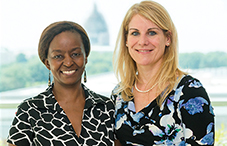

With efforts to repeal the Affordable Care Act (ACA) still active at this time last year, many Washington insiders believed there was little opportunity in the nation's capital for new health legislation. That didn't stop the two 2014–15 APA and APF Congressional Fellows. Both worked in Senate offices on some of the nation's most pressing health challenges, including an overburdened mental health-care system and last year's Ebola outbreak.
Each year, two psychologists serve as staff in congressional member or committee offices as part of the APA/APF Congressional Fellowship Program to promote an information exchange between psychologists and federal policymakers. Over the program's 41 years, 121 psychologists have served as fellows.
"It's critical that we empower psychologists to serve as the field's ambassadors to legislators and their staff," says Judith Glassgold, PsyD, former fellow and director of the program. "This cadre of psychologists also brings back key information for others in the field about how to take their work beyond academic and practice circles and inform policy at all levels."
Here are the latest APA/APF fellowship alumni and their work on Capitol Hill.
Amanda Clinton, PhD
Office of Sen. Chris Murphy (D-Conn.)
Clinton received her doctorate in school psychology with an emphasis on neuropsychology from the University of Georgia–Athens. She came to the fellowship from her position as an associate professor of psychology at the University of Puerto Rico Mayagüez campus, where her work focused on the impact of poverty, stress and immigration on child development, bilingualism and the neuropsychology of language-based learning disabilities. Her diverse professional experiences include serving as a Fulbright scholar in Colombia and developing and presenting workshops on positive skill development and democratic education on behalf of the United Nations Children's Fund (UNICEF) and the U.S. Department of State in Nicaragua, Venezuela and Iraq.
In Murphy's office, Clinton focused on developing comprehensive mental health legislation. Collaborating with the staff's senior policy advisor, she met with experts, advocates, family members and individuals with mental health diagnoses to discuss hospitalization, peer services, HIPAA regulations, early intervention models and collaborative care.
Clinton attended meetings with Murphy, Sen. Bill Cassidy (R-La.) and other staff on approaches to improving mental health in America. She also accompanied Murphy to the Senate floor to address health issues and participated in developing legislation.
Clinton says her training as a clinician and researcher greatly benefited her work on the Hill. Translating evidence-based practice into legislation was challenging, yet her psychology background helped her ask the right questions, clarify pressing issues and manage the legislative drafting process.
"Of course, understanding the quirks of human behavior is a plus when one works on the Hill, too," she says.
Clinton plans post-fellowship to focus on international psychology and policy, and hopes to serve in a leadership position and create change based on psychological science and practice.
Chisina Kapungu, PhD
Office of Sen. Edward Markey (D-Mass.)
Kapungu was the 2014–15 Jacquelin Goldman Congressional Fellow, a position APF funds to support psychologists with expertise in child development through a bequest by Jacquelin Goldman, PhD.
Kapungu completed her doctoral degree in clinical psychology at Loyola University Chicago and was an assistant professor of obstetrics and gynecology at the University of Illinois at Chicago. She has conducted community-based research on family- and faith-centered HIV prevention and health promotion, and has managed and coordinated maternal and child health projects with Population Services International/Zimbabwe, Save the Children Norway and the Millennium Villages Project.
Kapungu's experience in public health in Africa was an asset on Capitol Hill. In her first weeks in the office, she took the lead in writing bipartisan legislation, the Infectious Disease Hospital Hubs Act, co-sponsored by Sen. Rob Portman (R-Ohio), to help ensure the United States was prepared for the Ebola virus outbreak.
"It was just amazing how working in a congressional office opened doors to key leaders in the scientific and medical communities," she says.
Markey is the ranking member of the Africa and Global Health Foreign Relations Subcommittee, one reason Kapungu chose to work in his office. Although the bill did not pass, its provisions were included in the administration's plan for addressing Ebola that was put in place.
Once the Ebola crisis subsided, Kapungu worked on other health issues, such as meeting with various government and private stakeholders on biomedical research, implementation of the Affordable Care Act and improving global public health.
Kapungu used her clinical skills over the year to form partnerships with key private, public and nonprofit entities to improve maternal and child health outcomes.
"I'm in a unique position as a psychologist because my research, clinical and community experiences in schools, hospitals and churches have provided me with an informed perspective to form policy," she says. She plans to transition from academia to a role in global health within a nonprofit or federal agency.
"The fellowship was an amazing experience that only solidified my desire to work at agencies that promote international development and global health," Kapungu says.
Micah Haskell-Hoehl is the APA Congressional Fellowship Program administrator and a senior policy associate in the Public Interest Government Relations Office.