

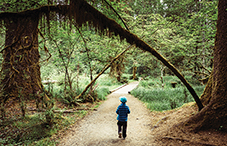

Taking an ecological perspective: Museums, corporate office spaces, disaster sites, schools, parks, hospitals, even the halls of Congress — these are just a few of the settings where members of Div. 34 (Society for Environmental, Population and Conservation Psychology) study, practice and advocate for healthier relationships between people and their natural and "built," or human-made, environments.
Many of the division's approximately 400 members are psychologists who fit traditional images of scientists working on environmental concerns — ecopsychologists and conservation psychologists, for example. Others apply their psychological expertise and interest in the environment as industrial-organizational psychologists, clinical psychologists, addiction psychologists, cognitive psychologists and more. Because of this diversity, Div. 34 members' research includes such diverse topics as finding the best ways to deliver messages about climate change to the public and designing hospitals to minimize patients' recovery time.
"When I say I'm a professor of psychology and a director of environmental studies, people cock their heads and go, ‘Wha-a-a-a-t?'" says Div. 34 President-elect Elise Amel, PhD, an industrial-organizational psychologist and professor at the University of St. Thomas. "But when we talk about how so-called environmental problems are really problems related to human behavior, they get it."
Projects and collaboration: The origins of the group's diversity lie partly in its history, says Div. 34 President Britain Scott, PhD, also a professor at the University of St. Thomas and author of the instructor resource, "Teaching Psychology for Sustainability" (see websiteopens in new window ). The division was launched in 1977 as a marriage of two areas of psychological inquiry with the initially distinct foci of population growth and human-environment interactions (see Psycnetopens in new window ).
This eclecticism means that Div. 34 members are often engaged in cross-disciplinary collaborations, Scott says. Members work together on research studies and other projects with the public as well as scientists in conservation biology, design and architecture. They also partner frequently with other APA divisions — in fact, 10 of the 17 sessions featured in Div. 34's 2015 conference at the APA Annual Convention reflect such collaborations. Panels included discussions of how consumers in different cultures perceive and categorize energy-saving products, how to use social media to promote sustainability, and the effects of bringing images of nature to prisoners in solitary confinement, to name a few.
"The fun piece about all of this is that once you start to get into it, there are so many interesting applications," says Div. 34 Past-president Thomas J. Doherty, PsyD, who co-founded and directs the Ecopsychology Certificate Programopens in new window at Lewis & Clark Graduate School. Because of this, the division is an optimal place for any psychologist or psychology student even tangentially interested in environmental topics to visit or join, he adds.
Div. 34 keeps members up to date on meetings, employment opportunities and other relevant information through an electronic mailing list, social networking sites and an active convention program.
Growth areas: Climate change has brought a new urgency to the goals and activities of some division members, says Div. 34/APA Council Member-at-Large Nancy Piotrowski, PhD, a clinical psychologist in San Francisco. Division members were a driving force behind the 2009 APA task force report on the interface between psychology and global climate change .
"Climate change is not a theoretical issue any more," says Piotrowski. "It is a real day-to-day stress that people are dealing with." Because of the California drought, for example, "people are having arguments with neighbors, getting stressed out about being fined [for using too much water] and worried about being able to sustain their businesses."
Piotrowski and other clinical members of the division are considering how to address this frightening reality in such ways as tracking people's stress related to climate change and working with clinical divisions to develop continuing education materials on managing it.
Despite the division's small size and its broad mandate, it is in a prime position to link psychology's knowledge and perspective with the world's increasingly pressing environmental and conservation concerns, adds Div. 34 Secretary John Fraser, PhD, a conservation psychologist and registered architect who is president and chief executive officer of the New York-based think tank New Knowledge Organization Ltd.
"The division could not be in a better place," Fraser says. "For the first time in history, people are recognizing that the environment and the mental processes we need to help us address our environmental problems are key concerns."
— Tori DeAngelis
Other division activities
Register now for Div. 14 conference
"Building a High Performance Organization: A Fresh Look at Performance Management," is the theme of the Div. 14 (Society for Industrial and Organizational Psychology) annual Leading Edge Consortium, to be held Oct. 2–3 in Boston. The meeting will focus on innovative strategies to drive high performance in today's complex and demanding work environment. Presenters will discuss which talent management approaches are effective in motivating and improving employee performance. Keynote speakers include John Boudreau, PhD, of the University of Southern California Marshall School of Business; Allan Church, PhD, of PepsiCo; and David Rock, PhD, of the NeuroLeadership Institute. Learn more and registeropens in new window.
Div. 15 announces 2016 theme
Div. 15 (Educational Psychology) President Nancy Perry, PhD, has established a 2016 theme of;"Bridging Theory and Practice through Productive Partnerships." Over the next few months, Perry will post a corresponding blog seriesopens in new window. The blog follows up on the successful blog of Div. 15 Past President Karen Harris, PhD, who wrote on "Impacting Education, Pre-K to Gray." Read those posts onlineopens in new window.
Save the date: Div. 22 to host annual conference in February
"Rehabilitation Psychology across the Spectrum of Care" is the theme of the Div. 22 (Rehabilitation Psychology) annual conference set for Feb. 19–21 in Atlanta. The meeting will offer programming for rehabilitation psychology practitioners, researchers and educators in a variety of areas including amputation, cardiac care, critical care medicine, pediatrics, psychiatric rehabilitation, trauma, traumatic brain injury and spinal cord injury.
Div. 22 promotes more student chapters
Div. 22 and the Foundation for Rehabilitation Psychology are funding a Student Leadership Network to help create more division student chapters on campuses nationwide. There are now seven Div. 22 campus chapters, which work to promote student interest in rehabilitation psychology and to expand funding and training opportunities for up-and-coming rehabilitation psychologists. For more information on starting a chapter on your campus — and for details about the work at current chapters — go to the Div. 22 websiteopens in new window.
Div. 33 changes its name
Div. 33 has changed its name to the Division of Intellectual and Developmental Disabilities/Autism Spectrum Disorders. The name change reflects the growing interest and emphasis on autism spectrum disorders within the broader field of developmental disabilities.
Div. 39 names new scholars
Div. 39 (Psychoanalysis) has chosen 72 graduate students and early career psychologists as scholars for 2015–16. Div. 39 Scholars received $500 toward attending the Div. 39 spring meeting, held in April in San Francisco; subscriptions to all Div. 39 publications; mentors for the year; and free access to Psychoanalytic Electronic Publishing, the online library of psychoanalytic publications. Twenty-two scholars are ethnic minorities selected by the division's Multicultural Concerns Committee. Find information on next year's scholars program onlineopens in new window.
Div. 40 seeks new fellows
Div. 40 (Society for Clinical Neuropsychology) is seeking applicants for fellow status. Apply by Dec. 1 through APA's application portal. For more information, contact Div. 40 Fellows Committee Chair John McSweeny, PhD.
Div. 10 offers free first-time membership
Div. 10 (Society for the Psychology of Aesthetics, Creativity and the Arts) is offering free membership to all first-time enrollees. Member benefits include a subscription to its journal, Psychology of Aesthetics, Creativity and The Arts, eligibility to apply for Div. 10 awards and access to the division's discussion listserv. Find more information at Div.10opens in new window. Direct questions to Steven Pritzker, PhD.