When psychology teacher Michael Sullivan was in high school, one of his teachers invariably gave him an A on his assignments. Sullivan's friend wasn't so lucky. In fact, he was convinced that the teacher would give him a C no matter what he did.
To test that hypothesis, Sullivan wrote a paper and let his friend copy it: Sullivan got an A, his friend a C.
"I had so many teachers and coaches whose whole style was labeling kids," says Sullivan, who considers himself lucky that teachers thought of him as a "smart jock." "And those labels just become self-perceptions."
Sullivan has never forgotten the lesson. "So much of how humans perform is about their expectations of themselves and the expectations of those around them," says Sullivan, who teaches Advanced Placement (AP) psychology at Hopkinton High School in Hopkinton, Massachusetts. "If teachers believe kids can't do something, so often it just becomes a self-fulfilling prophecy."
Sullivan's belief in the power of teachers' expectations of their students is backed by psychological science. It ranks as Principle 11 of the "Top 20 Principles from Psychology for PreK–12 Teaching and Learning" (see "20 key principles for teaching and learning" for more information and a list of the principles). Developed by APA's Coalition for Psychology in Schools and Education, the document translates the science of teaching and learning into practical information educators can use to learn more about thinking and learning, motivation, social and emotional factors, classroom management and assessment.
The Monitor spoke with Sullivan and several other teachers who embody those principles in their teaching.
Embracing ‘practice makes perfect'
 For Alan Feldman, a regular school day isn't enough time to help students as much as he wants to. An AP and regular psychology teacher at Glen Rock High School in Glen Rock, New Jersey, he is often at school at 6:45 a.m., meets students during his lunch hour and frequently stays late after school. Sometimes his students don't actually need extra help, he says. In this wealthy suburb of New York, where pressure to excel leads some students to take six AP classes at a time, some students may just need reassurance that they know the material.
In class, Feldman often puts into practice what he learned while working for former APA President Robert Sternberg, PhD, as part of research conducted at Yale in 1993: He finds ways to appeal to students whose approaches to learning go beyond the analytical. To engage those with a creative bent, he might ask students to use a variety of personality theories to explain Eleanor Roosevelt's life or make up a word for a concept that doesn't exist in a language to illuminate the Sapir-Whorf hypothesis. Exercises to engage students who are more practically oriented include explaining how hypnosis could benefit society or how the principles of sensation and perception could help make road signs or highways safer. Students might even explain how to design a fun house to show illusions of depth and motion.
Feldman also gives frequent tests, even if they don't count toward a grade. "The more they're tested, the better kids do," he says.
All that extra time and effort pay off, says Feldman, noting that Principle 5 of the "Top 20 Principles" — "Acquiring long-term knowledge and skill is largely dependent on practice" — resonated with him. Over the eight years that Feldman has been teaching at Glen Rock, the number of students who earn passing grades on the AP exam has more than doubled. But, says Feldman, "my major goal is to get them ready for college."
Feldman gets parents involved, too. Before school begins in the fall, he emails parents a quiz with 10 true or false statements, such as the false statement that Ivan Pavlov used a bell to trigger salivation in dogs. He then provides the answers at back-to-school night, encouraging the parents to get engaged and discuss such topics with their children throughout the year. He also emails parents whenever their children score above 90 percent or below 70 percent on exams.
And while Feldman describes himself as a hard teacher, he is also nice. He doesn't give homework during homecoming week, for example, and has been known to reschedule a test if he discovers that students have three other exams that day. "Some teachers give a test the day after senior prom," he says. "These are kids, and they still want to have fun." He even schedules what he calls "voluntarily mandatory" movie nights where students watch such films as "Secret of the Wild Child" and "Memory Masters."
Feldman, who also offers peer workshops across the country to train other AP psychology teachers in the course curriculum and the exam, isn't shy about seeking out extra help himself.
Feldman frequently turns for help to such renowned psychology educators as Charles Brewer, PhD; Elliott Hammer, PhD; Michael Domjan, PhD; and Barney Beins, PhD, all of whom he met either through APA or while working as an AP exam reader. "I've sent these wonderful professors maybe 200 questions by email," says Feldman, who won a Charles T. Blair-Broeker Excellence in Teaching Award from APA's Committee of Teachers of Psychology in Secondary Schools (TOPSS) this year and donated the $500 prize money to two deserving students at his school. "They always answer back."
Making learning fun
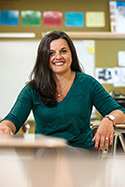 Walk into Jessica Flitter's classroom, and you might come across students doing a dance in which they become a classroom-sized eyeball or ear, holding props to represent each part of the organ. The student representing the cornea might be holding a piece of plastic wrap, for example, while the one representing the iris might hold a set of inflated water wings to represent the muscles around the pupil. Flitter then sings a song that encourages students to dance the process of light making its way through the eye to the brain.
"It gets them standing up and moving," says Flitter, another 2015 TOPSS award-winner and an AP and introductory psychology teacher at West Bend East High School in the Milwaukee suburbs for the last decade. "And it's fun."
Flitter has found a way to make even something as straightforward as teaching scientific terms engaging: She invites students to take the "Pepsi challenge," using the blind taste test of Pepsi and Coke to teach such terms as control group, experimental group and bias.
"Whenever possible, I walk through an experiment with props or a script so students can better understand and the experience becomes more memorable," says Flitter. But, she laughs, "It's getting a little trickier to do this experiment, because the students are more health-conscious these days and drink water instead of soda."
She also aims to connect learning to students' own lives whenever she can, in keeping with Principle 4: "Learning is based on context, so generalizing learning to new contexts is not spontaneous but instead needs to be facilitated."
To teach students brain anatomy, for example, she throws out a broad theme — say, "autumn" — and then asks students to talk about what parts of the brain are used in activities related to that theme. "They might say, ‘As I was telling my sister how to carve a pumpkin, my Broca's area — the part of the brain in charge of speech production — was engaged' or ‘As I was learning how to carve a pumpkin with my family, my hippocampus — which is in charge of forming new memories — was engaged,'" she says.
To monitor students' learning and get them ready for the AP exam, Flitter also draws on Principle 5 by giving students plenty of practice with multiple tests modeled on the AP exam, electronic quizzes, formative assessments and essay questions. Students then analyze the results of those assessments and create goals for the next unit.
"My students know that I am their biggest cheerleader," says Flitter, co-author of a 2014 study guide called "AP® Psychology All Access." "My students may not remember all of the specific material we covered when they graduate, but I feel my greatest accomplishment as a psychology teacher is when I help my students gain a passion for learning and feel empowered when they reach their goals and beyond."
Knitting the brain
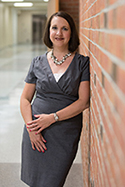 In the 16 years that Amanda Harmon has been teaching psychology at Zionsville Community High School in Indiana, the school's enrollment has jumped from 800 students to nearly 2,000. Where each class might have had 18 students before, Harmon now finds herself teaching classes with as many as 32 students.
But this explosive growth isn't the only reason Harmon and other Zionsville teachers have turned to technology for help. Requiring students to bring a laptop or iPad to school and shifting from a teacher-led approach to what Harmon calls a "student-led environment" doesn't just expand her reach but also engages students in learning. "It allows us to get to kids in a way that speaks to these technology natives," says Harmon.
In the abnormal psychology unit, for example, Harmon might present a case study and then ask students to explore treatment options online using a list of websites she knows are reliable. The students come up with behavioral, cognitive, humanistic and other approaches to treating the hypothetical patient, then come together as a group to share what they've learned. "Instead of me giving a lecture, each student has an opportunity to be an investigator," says Harmon, pointing to Principle 8 of the "Top 20 Principles."
That emphasis on individuality plays out in the creative way Harmon assesses students' learning, too. "I try to give them many ways to demonstrate their knowledge," she says. For an assignment designed to teach the parts of the brain, students wrote poems or stories with characters whose names — such as Thelma the Thalamus — reflected various anatomical features. "I even have a student who knit the brain," says Harmon, describing a colorful, mobile-like yarn artwork with labels dangling from each brain structure. "She could enjoy doing something she's really proud of and use that to demonstrate her knowledge."
Harmon's unorthodox approach to assessment continues when it's time to give grades. Although she includes tests similar to the AP exam at the end of every unit to "inoculate" students against testing anxiety, she tries to be flexible in her approach: She allows re-tests and counts only the highest score. "That's a more accurate assessment of the knowledge they're walking away with," she says, noting Principle 19: "Students' skills, knowledge and abilities are best measured with assessment processes grounded in psychological science with well-defined standards for quality and fairness."
Expecting the best
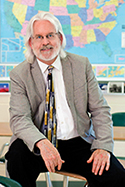 Ask Michael Sullivan what he's proudest of in his 24-year teaching career, and the answer is the inclusiveness of his AP psychology classes. "About 70 percent of our senior class takes AP psychology," says Sullivan, another 2015 TOPSS award-winner.
Sullivan attributes that fact to his belief in the potential of every student — a belief bolstered not just by an early job teaching preschoolers who had developmental disabilities but nonetheless had a passion for learning but also by Principle 11: "Teachers' expectations about their students affect students' opportunities to learn, their motivation and their learning outcomes."
To avoid the kind of bias his own high school teachers exhibited, Sullivan grades subjective work like essays without knowing whose work he is evaluating. He also tries to create a classroom environment in which every student can do well.
"If you keep placing children in situations where they can't succeed or demanding things without giving them the tools they need, the natural animal inclination is to quit trying," says Sullivan, who also chairs the department.
Instead, Sullivan works to build students' sense of accomplishment and self-esteem, but in an authentic way. "They have to believe you mean it," says Sullivan. "I want to give them a sense of ‘You can learn, succeed and enjoy this process and that it's not always easy, but that's part of what makes it fun.'"
Sullivan's collaborative, playful teaching style allows students to enjoy themselves while mastering complex content.
In a lesson designed to teach students about the power of conformity to group pressure, for example, Sullivan enlists the help of what he calls "student confederates" who are primed ahead of time to give incorrect answers to Sullivan's questions. "I'll ask, ‘Who was the first official president of the United States, putting that word ‘official' in there to put students off their guard," he says. While other students call out "Washington," the plants insist the answer is John Hancock. The result is a powerful lesson about how a little bit of doubt plus peer pressure can easily sway people, even when it's something as straightforward as the first president.
"You could tell kids about social conformity and they might remember it, but they internalize it when you conduct this experiment and they become part of it," he says.
Building relationships with students
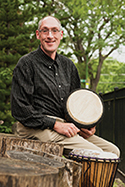 When junior high social studies teacher Ray Kinzie began to study African drumming six years ago, he shared that passion with his students and founded an after-school drum circle for his sixth, seventh and eighth graders at Rufus M. Hitch Elementary School in Chicago. The Unum Drum Circle now performs regularly for other students, at Hitch and beyond, and has performed three times at Chicago's House of Blues.
By exposing students to a fun environment in which personal achievement and expression are both respected and celebrated, the drum circle gives Kinzie another way to enhance students' intrinsic motivation to learn. And in doing so, he says, he's adhering to Principle 9 of the "Top 20 Principles": "Students tend to enjoy learning and perform better when they are more intrinsically than extrinsically motivated to achieve."
After earning a master's degree in psychology in 2010, Kinzie reaffirmed his commitment to practicing what he had learned about teaching and learning, customizing his teaching to suit the needs of each child in that particular moment.
"I'm not teaching to the masses," says Kinzie, who has taught in the Chicago public school system for 20 years. "I'm treating them as individuals."
That's a challenge in Kinzie's extremely diverse classroom in a school he describes as a "mini United Nations," with children from 20 countries. "We have students who come from very affluent families and students who just arrived in this country and are starting over," he says.
A key strategy is to get to know each student so he learns what kind of support — whether it's educational or emotional — students need to fill gaps in knowledge or simply thrive. In keeping with Principle 14, Kinzie might ask students about their weekends, discuss highlights or concerns of the day or launch an intense classroom discussion on controversial topics, such as race relations. One eighth-grade student came out to the class as bisexual — and was met with respectful silence.
"Lots of teachers don't want to get to know students or fear that building connections with students is akin to abdicating authority," says Kinzie. "Other times, teachers just don't have time because they're overwhelmed trying to serve 34 students in their classrooms."
That spirit of mutual respect comes out in the oral reports Kinzie requires of every student once a quarter. "They're front and center in the classroom, so it's a great moment to show what they know and show that everyone can do this," he says. "I like to make every child a star."
Kinzie also uses in-class debate, role-playing and art projects to showcase student learning, progress and achievement. "These methods often motivate students well beyond paper-and-pencil tests," he says.
Students' successes build on themselves, says Kinzie, explaining that once students see they can succeed, they can break bad habits and build new ones. Students start to understand the value of learning for themselves, not just to please a teacher or earn a good grade.
"They start to get hungry for learning," he says. "Once they get a taste of it, they want more."