
As a young person, James Campbell Quick, PhD, was fascinated by the tireless work of his grandfather Otto Alois Faust, MD, who devised creative ways to engage children with mental health problems including hyperactivity and depression. Faust helped launch the field of play therapy, and served as one of the country's first professors of pediatrics at Albany Medical College in Albany, New York.
Faust never imposed his professional interests on his grandson. Instead, he led by example.
"He showed me what it was like to be a great professional," Quick says.
The strategy paid off. Quick, a distinguished teaching and research professor at the University of Texas at Arlington, became an internationally known expert in leadership and organizational science. With his brother Jonathan D. Quick, MD, he also developed and promoted the field of preventive stress management, a precursor to today's workplace wellness programs.
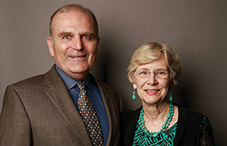
To honor the example his grandfather set, Quick and his wife, Sheri Schember Quick, a longtime educator of young children, became "Visionary Partners" with an unrestricted donation of $50,000 to APF, which allows the foundation to support talented early career psychologists and graduate students.
"It's important to identify top students [for the scholarship money]," says Quick, "but whatever they want to go after [in terms of research interests], they should go after those."
The Quicks' perspective mirrors the aim of the Transform the Future campaign, launched in 2012 to raise funds to help students and early career psychologists conduct innovative research that addresses such societal problems as violence, stigma, disasters and the effects of behavior on health. The campaign intends to raise at least $6.5 million by the end of 2016. At Monitor press time, it had raised more than $5.8 million, says APF President Dorothy W. Cantor, PsyD.
"The campaign is intended to provide grants to researchers whose projects might not be funded otherwise," Cantor says.
In particular, that means students and early career psychologists who have important ideas but may have trouble garnering federal funds simply because it's their first try.
Some of last year's recipients were busy developing a service-delivery model for underserved Latinos in rural areas; studying communication patterns among active-duty service members and their teenage children to help prevent future mental health problems; examining neural patterns related to suicide risk; and determining ways to recruit more parents into programs that address parental anxiety, for example.
The Quicks' donation needs the collective power of similar donations to be truly effective, adds Quick, who notes that because visionary funds are not restricted by topic in the same way as traditional research grants, they provide a unique opportunity to expand psychological science.
"Our contribution in the larger scheme of things is not that great," he says. "But when you put it all together [with other donations], it's significant enough to make sure that the best and the brightest of the next generation have the resources and financial support they need to advance psychology."
For more information on APF's Campaign to Transform the Future, visit APF.