


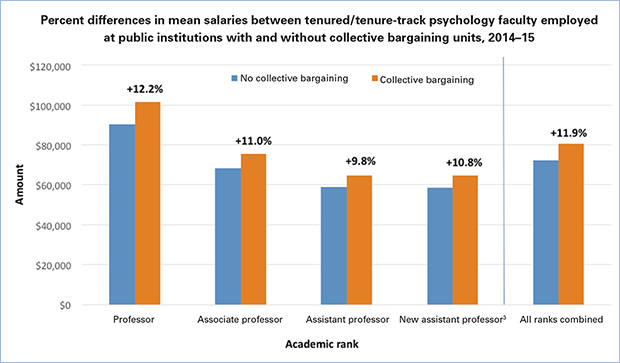
 Psychology professors at public institutions that have collective bargaining units earned more than those at nonunionized institutions, according to the results of a survey by the College and University Professional Association for Human Resources.1
The mean salary for psychology faculty at public institutions with collective bargaining units was $80,653 — nearly 12 percent higher than the mean salary psychology faculty earn at public institutions without collective bargaining units ($72,044).
In addition, the mean salary for psychology faculty2 at private institutions — which do not generally allow for collective bargaining — was $73,711, or 2.3 percent greater than psychology faculty at public institutions without collective bargaining units, but 8.6 percent less than faculty at public universities with collective bargaining units.
— Peggy Christidis, PhD, Karen Stamm, PhD, and Luona Lin, MPP
For more information, contact APA's Center for Workforce Studies.
1 College and University Professional Association for Human Resources [CUPA-HR], (2015). Faculty in Higher Education Salary Survey for the 2014-15 Academic Year: By Discipline, Rank and Tenure Status in Four-Year Colleges and Universities. Knoxville, TN: Author.
2Collapsed across all academic ranks, such as professor, associate professor, assistant professor and new assistant professor.
3CUPA-HR defines a new assistant professor as a new hire for the academic year being surveyed.