

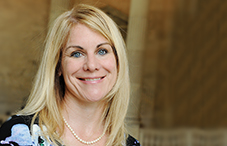

When Amanda Clinton, PhD, first visited Iraq six years ago, she discovered that the Iraqi school system Saddam Hussein had built was very much like his government. "It's a very dictatorial, punitive system," says Clinton, a member of APA's Committee on International Relations in Psychology (CIRP). "There's no chance to share your opinion, and divergent thinking is not in the least welcomed."
No matter what the age group, says Clinton, the typical Iraqi classroom consists of a teacher reading his or her notes at the front of the room as students try to copy down every word. "Teachers never talk with students, and it's very rare for students to ask questions," she says. Corporal punishment is common.
Now Clinton is trying to change all that, at the invitation of Kurdish colleagues. Since that initial visit, she has traveled to Iraq at least once a year to offer intensive, 10-day institutes designed to help transform schools in the country's Kurdish regions from being like "military schools for 5-year-olds" to ones that embrace socioemotional learning and democracy.
Grounded in the principles of socioemotional learning, the institutes teach teachers — who use vacation time to attend — how to help their students recognize their emotions, solve social problems and learn coping and resilience skills. Research shows a relationship between this approach and such outcomes as decreased depression and anxiety, enhanced social ties and even improved academic achievement, says Clinton. The institutes also emphasize inclusiveness and adaptations for children with special needs.
Promoting classroom democracy
Back home, Clinton studies socioemotional learning as an associate professor of psychology at the University of Puerto Rico in Mayagüez. But her life changed several years ago when she met two Kurdish refugees at an education conference in Lithuania: Ako Modiri and Karwan Aref had escaped Iraq's oppression of Kurds in the 1990s, but were still deeply involved in their homeland. Their goal? To reshape the educational system in a way that would model the democracy they hope to see in Iraq one day.
"When we came to Europe, we [saw] fairness and equality between men, women, religions and races," says Modiri, now a social worker in Oslo, Norway. "[That can be] achieved only by a real democratic society, and democratic society needs a fair educational system for everyone, with any background."
Struck by Clinton's presentation on socioemotional learning at the conference, the pair invited her to come to Iraqi Kurdistan to train teachers in the concept.
"There's an emphasis on democratic principles," says Clinton of her institutes. With the help of a translator, she teaches teachers, administrators and mental health professionals how to encourage children to participate in the learning process and how to help them make good decisions. The training also teaches educators to recognize the all-too-frequent signs of trauma, to understand how trauma affects learning and behavior and to refer students to mental health professionals if they need help. Clinton also explains the neuroscience behind behavior and academic achievement to help teachers better understand their students.
In addition, Clinton offers parents training on positive parenting. In these sessions, parents learn new ways to discipline their children that focus on helping children make good choices and understand the consequences of making bad ones.
The institutes also offer fun. Each day ends with a half-hour Zumba class for women and another for men, taught by Clinton, who teaches Zumba at home in Puerto Rico. "I'm trying to break down gender barriers," she laughs.
In years past, Clinton has traveled from village to village, bringing the institute to teachers, school administrators and mental health professionals around the region.
"When the initiative began, the government allowed us to pilot the program in a handful of villages — 10 days in one village, 10 days in the next," says Clinton. "As the government's leadership has shifted, there's been a reduction in the number of classrooms willing to work on democracy and rights for girls. And we realized that an isolated classroom here and there won't shift the broader environment for children and families."
As a result, Aref and Modiri have built schools of their own, and Clinton will focus her efforts on training educators in these new schools.
The pair have established three elementary schools in the towns of Ranya and Koysinjaq that serve more than 400 students, including children who have fled from attacks by ISIS. Now they're building a new school to replace one of the current schools. Slated to open in 2016, the new school will serve more than 500 elementary school students.
While the initiative once received funding from the United Nations Children's Fund and a Scandinavian nonprofit called KOMAK, that funding has fallen away as priorities have shifted from rebuilding the country to fighting terrorism. Now parents who can afford to pay make a contribution. But most of the funding comes from the money Aref and Modiri are able to raise among Kurdish refugees, including themselves.
Exporting psychology
Of course, says the widely traveled Clinton, being in Iraq is challenging. With the rise of ISIS, security threats have increased dramatically since Clinton's first visit in 2009 — to the point that once she's safely at a school, she doesn't go outside until it's time to head to the airport in Erbil to return home.
"I'm stuck in the building for 10 days," says Clinton.
Clinton sleeps on a plastic mattress in a classroom, with Aref and Modiri sleeping in another classroom so that she never has to be alone. War widows who work at the schools in exchange for tuition for their children cook Clinton's meals. There's even Internet service. In preparation for this year's trip to the school in Ranya, she and Aref and Modiri have discussed how she'll escape if ISIS takes over the area — a plan that involves hiking through the mountains to Turkey.
Still, Clinton downplays the security threats.
"When people think of Iraq, they think of Saddam Hussein and ISIS," she says. "My experience of Iraq is totally the opposite of what you see on the news: It's joyful and creative and generous, and people are very welcoming and really excited about creating change."
To Merry Bullock, PhD, who directs APA's Office of International Affairs, Clinton's work exemplifies the kind of role CIRP hopes more psychologists can play abroad.
"These kinds of experiences form the basis of CIRP's ongoing project to develop guidelines for the competencies that psychologists in the United States need to work abroad and that they believe need to be a basic part of 21st century psychology education," says Bullock.
Clinton, whose only remuneration for the institutes is her plane ticket, plans to keep going back to Iraq as long as she's needed.
"Increasing social justice in the world is a critical contribution of psychology," says Clinton, who just finished a year as an APA/American Association for the Advancement of Science Congressional Fellow in the office of Sen. Chris Murphy (D-Conn.). "My dream would be that in a couple of years, there's no more need for someone like me in Iraq."