


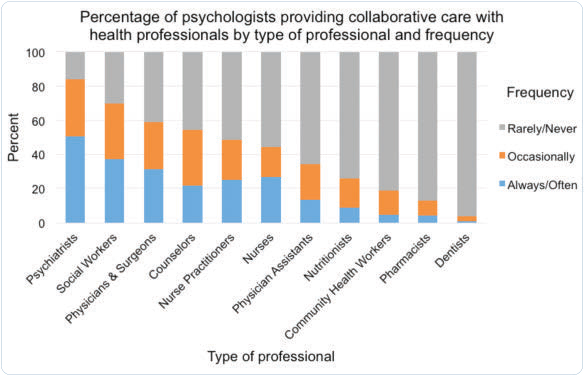
Most health service psychologists (74 percent) provide collaborative care, according to a new APA survey.1,2 Collaboration allows psychologists and other health professionals to improve patient outcomes.
The researchers defined collaborative care as collaborating occasionally, often or always with at least two other types of health professionals.
About 67 percent of licensed psychologists reported collaborating with behavioral health professionals, including psychiatrists, social workers and counselors, while 51 percent collaborated with all other health professionals, including physicians and surgeons (other than psychiatrists), nurse practitioners, nurses, physician assistants, nutritionists, community health workers, pharmacists and dentists.
The most common collaborative care activities were sharing waiting room space (50 percent), followed by using the same electronic medical record (39 percent), participating in multidisciplinary team meetings (36 percent), sharing clinical working space (35 percent) and using integrated treatment plans (33 percent).
— Karen Stamm, PhD, Auntre Hamp, MEd, MPH, John Yozwiak3, PhD, Cynthia Rolston3, PhD, William Robiner3, PhD, Gerald Leventhal3, PhD, Jason Washburn3, PhD, Nicole Hayes3, BA, Barbara Cubic3, PhD, Peggy Christidis, PhD, and Luona Lin, MPP
For more information, contact APA's Center for Workforce Studies.
1 American Psychological Association. (2015). Survey of Psychology Health Service Providers [Unpublished special analysis]. Washington, DC: Author.
2 Missing values were excluded prior to analysis.
3 Author is affiliated with the Association of Psychologists in Academic Health Centers.