


What does the psychology workforce look like? In July, APA's Center for Workforce Studies (CWS) released a report to address that question. The report paints a picture of demographic trends in the field from 2005 to 2013, using data from the U.S. Census Bureau's annual American Community Survey.
Though the report paints that picture in relatively broad brushstrokes, it provides an important first step toward a more complete understanding of psychology's workforce. Precise workforce data help policymakers, educators and the public understand the range of psychology's impact on society and can help determine the resources necessary to support them, says Ronald Rozensky, PhD, a professor of clinical and health psychology at the University of Florida and a longtime advocate of workforce analysis.
"Accurate workforce data are really important to use when advocating for education, training, scientific funding and reimbursement for practice," he says.
The new report analyzed data from the approximately 83,000 individuals who listed their occupation as "psychologist" and reported having a professional degree (such as an MD, DDS or JD) or doctoral degree (such as a PhD or EdD) in any field. From 2005 to 2013, the supply of active psychologists remained fairly stable, the authors found, with enough new psychologists entering the field to compensate for an increase in the number of retired psychologists over that span.
That workforce was not evenly distributed, however. California, New York and Pennsylvania have the largest numbers of active psychologists. In fact, those three states together account for a third of the workforce. Western and Southern states tended to have the lowest numbers of active psychologists.

Age and gender
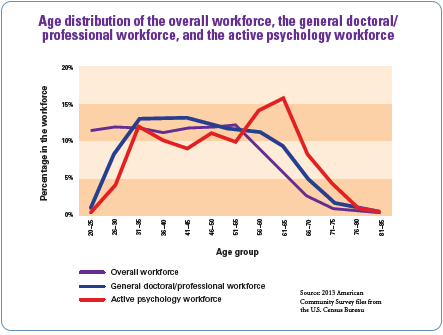
The report authors explored the ages of active psychologists, and found that the age distribution peaked at 56 to 65 — the "baby boomer" generation. A second, smaller peak appeared from ages 31 to 35. Those data will be helpful for predicting psychologist workforce numbers as baby boomers approach retirement, says Karen Stamm, PhD, a senior research officer at the CWS and a co-author of the report.
"The sheer number of baby boomers will impact the psychology workforce," she says. "Are they all going to exit the field at the same point and have to be replaced with younger workers?"
Stamm and her colleagues also explored gender, and found that women continue to outnumber men in psychology — in fact, the gender gap has widened. In 2005, 58 percent of active psychologists were women; by 2013, that number had risen to just over 68 percent. That increase occurred both because more women have entered the field, and because more men have exited it.
The gender imbalance was not unexpected, says Stamm. "This has been a long-standing trend going on for decades."
Both the causes and the implications of that imbalance are complicated, Stamm says. For instance, gender imbalance can affect average salaries in a field — a connection that Stamm and her colleagues hope to explore more deeply in future reports using data from the American Community Survey.
Meanwhile, other experts are also taking a serious look at gender composition in psychology. APA's Committee on Women and Psychology has been exploring the issue for a number of years, using data from a variety of sources including the National Science Foundation and the Department of Education. The committee plans to issue a report this year with its assessment and recommendations about how best to respond to the gender imbalance, says Shari Miles-Cohen, PhD, senior director of women's programs in APA's Public Interest Directorate.
Diversity matters
The CWS report also offers insights into the field's racial/ethnic composition, concluding that minority groups remain underrepresented in psychology. In 2013, 83.6 percent of active psychologists identified as white. But diversity in psychology is increasing. Between 2005 and 2013, the proportion of psychologists from racial/ethnic-minority groups increased from 8.9 percent to 16.4 percent.
From 2005 to 2013, the percentage of Hispanic psychologists increased by 47.4 percent; Asian psychologists by 79.5 percent; and black/African-American psychologists by 100 percent. Furthermore, active psychologists who identified as part of a racial/ethnic-minority group tend to be younger than white psychologists, suggesting that the field may be on the road to becoming even more diverse.
That increase was not surprising to Tiffany Townsend, PhD, senior director of ethnic minority affairs in APA's Public Interest Directorate. "We can see it in the APA membership," she says. "Many of the newer and student members are of color."
Townsend was also unsurprised that the psychology workforce remains less diverse than society overall. One reason for the mismatch, she suspects, is that minority students could have a harder time finishing doctoral programs due to the cost and lack of support in navigating the academic system. Anecdotal evidence suggests more minority students might end their training at the master's level, she says, and would not have been represented in this dataset.
These new workforce data are helpful, Townsend says. But as with the gender data, much more analysis is needed to fully understand diversity issues. "I'm glad APA is looking at ethnicity, but we absolutely need to delve deeper into the face of the psychology workforce," she says.
She'd love to know, for instance, where students of color are being trained, which training programs do the best job of retaining minority students and what programs and support systems help them succeed. "It's great we're seeing a slight bump [in diversity], but it's important for us to go deeper to see where students of color are getting hung up," she says.
More demographic information would also help identify where students from ethnic and racial minority groups are likely to practice — and what areas have the greatest unmet needs for their services.
"Research shows folks who seek services tend to feel more comfortable with therapists that look like them and understand their world view," adds Townsend. "The demography of the U.S. is changing, and we want to make sure that the psychology workforce adequately reflects society."
Imperfect definitions
Stamm and her co-authors point out that the CWS report is limited by the way that psychologists are classified in the American Community Survey. The survey does not collect information on an individual's field of doctoral degree, which means an individual's occupation may be classified as "psychologist" even if his or her professional or doctoral degree was in another field. Further, some psychologists who work in education or research may have been coded as "postsecondary teachers" or "researchers," rather than "psychologists."
"There's a mismatch between APA's definition of psychologist and the federal government's definition," says Stamm. Still, the data themselves are valuable and robust, she says. "The American Community Survey is a comprehensive data source, and has the strength of the census sampling procedures behind it."
Yet other experts have argued that psychology, as a field, should be doing more to collect accurate workforce data directly. Most health-care fields do extensive workforce analysis, Rozensky says. "The reality is we need better data based on our own definition of psychology," he says.
Accurate workforce data allow graduate students to choose scientific subfields or applied specialties that are growing in demand, and help psychology faculty plan curricula and increase training opportunities in those areas, says Rozensky.
Workforce data are also helpful for educating the public and other health and scientific professionals "about the role that psychologists play in a vast range of professional settings," says Helen L. Coons, PhD, clinical director and president of Women's Mental Health Associates in Denver, and an APA Fellow with a keen interest in workforce analysis.
But perhaps most important, Coons and Rozensky argue, workforce data play a key role in advocating for a profession. For instance, says Rozensky, consider the Association of American Medical Colleges, which collects detailed data on the medical workforce. "When they go to Capitol Hill, they can say, 'In five years, we're going to need X number of pediatricians to work in primary care. Given the number in training and the number retiring, this is the funding we will need to train enough pediatricians for the growing population,'" Rozensky says.
To argue for better funding and support for psychology, the field needs accurate information not only about the supply of psychologists, but also demand. "We advocate based on the fact that we do good work, but we don't have meaningful workforce numbers," Rozensky says.
Some of that information is likely to be found in an upcoming report from CWS, which will provide data on employment and practice patterns. The report, which draws from CWS's Health Service Provider Survey of licensed psychologists conducted last spring, will be released in late 2015 or early 2016.
There's also hope that the data from the American Community Survey could be made even more useful in the future. In 2014, the Federal Register solicited public comments in anticipation of the next update of its Standard Occupational Classification system, which is used by the Census Bureau as well as by agencies such as the National Science Foundation. APA submitted a proposal to change the way that psychologists are classified in that system, Stamm says. Specifically, APA recommended moving clinical, counseling and school psychologists into the health-care practitioners category, and changing the general "psychologists" title in the life, physical and social sciences category to "research and applied psychologists."
Such changes would help provide more accurate and useful data about subfields of psychology, Stamm says. Even if the proposed changes are accepted, however, the updated classification system would not go into effect until 2018. In the meantime, she's excited about digging deeper into the existing data.
While the new report is the first from the CWS to use data from the American Community Survey, she says, it won't be the last. The center plans to draw on the data for upcoming reports on earnings, work settings and other workforce topics. "The American Community Survey data contain a lot of information on a lot of topics," she says. "This is just scratching the surface."