

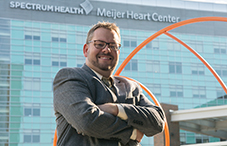

Jared L. Skillings, PhD, is a second-generation psychologist, but his practice couldn't be more different from his father Ralph's. While his dad owns a private practice in rural Ohio, Skillings spends his days with heart, lung and kidney transplant patients as part of a $5 billion health-care system with 2,075 beds and more than 23,000 employees.
Skillings conducts presurgical psychological evaluations of adults who need heart or lung transplants and children who need kidney transplants at Spectrum Health System in Grand Rapids, Michigan. He's also director of behavioral medicine there, with a goal of getting a behavioral health professional into every department in the system.
That's starting to happen. In 2011, just before Skillings joined the system, Spectrum had just four psychologists, a social worker and a psychiatrist. By the end of 2016, the system expects to have 46 behavioral health providers, including 27 psychologists and psychology trainees. Some provide traditional psychological services, such as treatment of post-traumatic stress disorder, while others are embedded in various medical clinics — sleep, pain management, geriatrics, neurology and more.
Skillings wants patients to have the option to see a psychologist whether they enter the system for a mental health problem or a medical problem, be it a heart attack, diabetes or anything else. His dream is that behavioral health becomes as ubiquitous within the health system as Starbucks is everywhere else.
"If you go to the grocery store, Starbucks is there," says Skillings. "Is Starbucks the reason you go? No, but it adds huge value."
Evaluating transplant patients
Spectrum used to outsource its behavioral health care. "Then the organization started looking at the data and saw that integrated care was superior in terms of outcomes and cost savings," says Skillings, who became the system's inaugural director of behavioral medicine in 2012.
He trained as a generalist while earning his doctorate in clinical psychology at the University of Toledo. But while he was on internship at the Jackson Memorial Hospital/University of Miami Medical School, he fell in love with integrated care. "You don't have to become a specialist right out of the gate," he advises. "There's some benefit to having a broad range of experience before you get into one of the integrated-care specialties."
At Spectrum, Skillings's original one-day-a-week work with the transplant team has grown into a full-fledged specialty, thanks to the growing demand for organ transplants.
His goal is to gauge whether the patient is a good candidate for a transplant based on his or her psychosocial stability and how likely he or she is to adhere to medical directions. Transplant patients, for example, need to be able to comply with as many as 40 medical tests and appointments before a transplant and complex medication and lifestyle regimens afterward. Most transplant programs won't give transplants to nicotine users, so would-be patients must stop smoking and get themselves in shape. And because Spectrum requires transplant patients to have someone who can care for them at home 24/7 for at least a month after the operation, patients must also have good social support.
Skillings also evaluates pediatric patients who need kidney transplants. With living donors, presurgical evaluations are even more complex as two different behavioral health providers must be involved — one to evaluate the child and the other to evaluate the would-be donor. It's just as important to take care of the living kidney donor as the child, says Skillings. "These kids are adorable; they're sick; and people feel bad for them," he says. "We need two providers so that the whole evaluation is objective."
Unlike many psychologists in integrated settings, whose work is fast-paced, Skillings has the luxury of spending a longer time with patients as he assesses whether they're appropriate candidates for transplants. "Unless it's a life-and-death situation, I have plenty of time to evaluate a patient and help him or her come to terms with the need for a transplant," he says.
Skillings also provides post-transplant support. "If the transplant doesn't go as well as expected or the patient is struggling to adjust after surgery, I go in and provide cognitive-behavioral therapy or other interventions," he says. Occasionally, a transplant patient will have concentration or memory problems and require cognitive screening or neuropsychological assessment.
The medical staff has reacted positively, says Skillings. "They're thrilled to have us there," he says.
That's because patient outcomes improve. In a 2015 article in the Journal of Clinical Psychology in Medical Settings, Skillings and co-author Amber N. Lewandowski presented a case study demonstrating how psychological assessment and interdisciplinary care helped a lung transplant patient thrive. Skillings helped the patient address the issues uncovered during his evaluation, including anxiety, marijuana use, problems with adhering to medical recommendations and the lack of a plan for postsurgical care. After his 2014 transplant, the patient was able to return to hiking and traveling, favorite activities he hadn't been able to enjoy for years.
As for Skillings's dad, he has been fascinated by how psychology has been transformed over the years, Skillings reports.
"Back in his day 40 years ago, you either went into academia or private practice," says Skillings. "These integrated care opportunities didn't really exist."