In the 2013–14 academic year, potential students submitted more than 110,000 applications1 to U.S. and Canadian graduate psychology programs, according to an annual APA survey of psychology departments.2 About 26,000 of the applications were accepted, resulting in an overall acceptance rate of 24 percent. But acceptance rates varied widely by subfield and degree level.
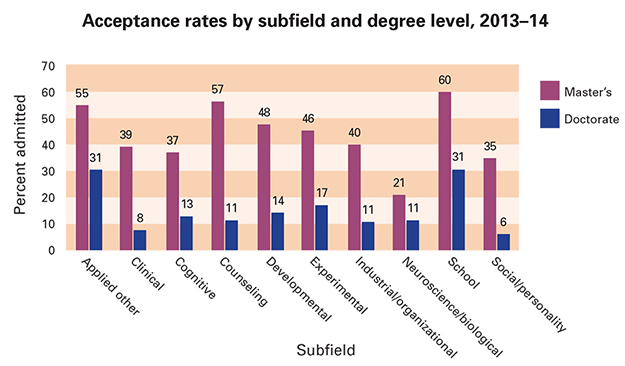
A total of 979 doctoral programs3 participated in the survey. They reported acceptance rates between 6 percent and 31 percent across subfields, with an overall acceptance rate of 13 percent. Acceptance rates were higher for school psychology and other applied psychology programs4, and lower for social and clinical psychology.
Acceptance rates for the 574 participating master's programs3 were substantially higher for all subfields compared with doctoral programs. School psychology master's programs had the most applications and acceptances, resulting in an acceptance rate of 60 percent.
To read more about admissions, applications and acceptances for graduate psychology study, go to APA Education.
— Karen Stamm, PhD, Daniel Michalski, PhD5, Caroline Cope, MA5, Garth Fowler, PhD5,
Peggy Christidis, PhD and Luona Lin, MPP
For more information, contact APA's Center for Workforce Studies.
1 Numbers were self-reported by departments providing graduate-level training in psychology or related fields and represent minimum value approximations.
2 APA surveys graduate departments of psychology to collect information for the annual publication of Graduate Study in Psychology — a print and online resource for prospective applicants to graduate psychology programs. For more information, visit APA Books.
3 Participation in Graduate Study in Psychology is voluntary; numbers do not represent the entire population of graduate programs in psychology.
4 This category includes applied behavior analysis, educational, community, forensic, sport, quantitative and behavioral psychology programs.
5 Author is a staff member of APA's Office on Graduate and Postgraduate Education and Training.