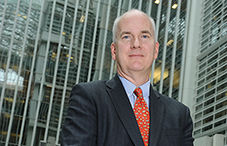

Fisher leads a team of mental health professionals who serve about 20,000 employees at the World Bank Group and the International Monetary Fund. Roughly 80 percent of the employees are from countries other than the United States.
What do you do?
I am surrounded by many people whose dream job was to work for the World Bank Group, which has as its dual missions the elimination of extreme poverty and the promotion of shared prosperity globally.
While staff come to us seeking help for a wide variety of issues, I do a lot of face-to-face counseling related to work stress. They all put in long hours, often in excess of 10 or 12 hours a day more than five days a week, partly due to the fact that they are often collaborating with people in different time zones.
In addition to counseling, my team — made up of two full-time and two part-time mental health professionals — trains managers on the benefits of promoting work-life balance and setting appropriate limits on working hours, among other work-related topics.
I also counsel employees who are facing cross-cultural challenges as they relocate overseas. For example, we provide resiliency briefings to emotionally prepare people who are moving into fragile and conflict-affected states like Afghanistan, Libya and South Sudan. I also travel overseas to offer face-to-face counseling and support. In the past year, I've traveled to Afghanistan, India and Mozambique. Argentina and Bolivia are next up for me.
Also, I'm the program manager of the Bank's Domestic Abuse Prevention Program, which provides case-management services, counseling and legal guidance for staff and dependents who have been subject to domestic abuse.
How do you use your training?
I am a cognitive-behavioral therapist (CBT), which I find to be an applicable skill because I work with a population that has high expectations for a quick return on their time investment. Quite a lot can be accomplished in a short time, and CBT is highly effective and appropriate given the need to be flexible with those who travel (which is nearly everyone). The structure of CBT allows for intermittent appointments and homework, and lends itself to remote counseling via telephone or Skype.
We also incorporate mindfulness meditation and relaxation training, and provide considerable psychoeducation related to parenting concerns, conflict resolution and marital difficulties.
Where did you get the training and experience for this job?
I maintained an independent practice for 17 years, but much of my professional identity is a result of my experience as a U.S. Navy psychologist. My career with the Navy began with my internship at the Bethesda Naval Hospital and concluded when I served as the department head of behavioral health at the Naval Health Clinic New England. That's where I learned to take a more holistic view of organizations.
For example, when a high-performing employee was referred to me because he or she was struggling and engaging in disruptive behavior, I learned that it was important to take a step back. I found out what was going on with the employee's work unit or manager rather than assuming the employee was the problem. I essentially learned to look at things from a broader perspective, and that is exactly what I do at the World Bank Group: I apply my clinical expertise and training within an organizational setting.
How did you learn about the job?
Before I came to the World Bank Group I had a great job with the Navy, but after five years I realized I was looking for new challenges. I saw an ad in APA's Monitor on Psychology and shared it with my wife. We realized that I had a lot of the necessary qualifications because the job was a blend of administration, leadership, management, and clinical and organizational psychology — all things I'd done in the Navy. I submitted an electronic application, and six weeks later I had been short listed. I had two interviews during the next several months and was offered the position six months after I had applied online.
What is difficult about your job?
With only four therapists covering such a large, publicly funded organization, we are perpetually trying to multiply ourselves. It is also challenging to respond to an ever-changing environment. Any time I read something in The New York Times about a terrorist incident here or a natural disaster there, someone working for the World Bank Group is usually affected. We need to respond quickly to offer support. We coordinate with our other colleagues throughout the world. This treatment coordination is critical because there is only so much a couple of psychologists — even very efficient psychologists — can do.
What do you enjoy most?
The multicultural aspect of my job is hugely rewarding. I've been stretched to apply my skills with staff from a wide array of cultures. Seeking out psychological assistance is an anathema in many parts of the world, and it's been critical for me to understand this to avoid making false assumptions or clinical errors. Someone may be referred to me and spend 45 minutes talking around the issue. There is a temptation to think everything is fine, but that would be a mistake. It is my job to ferret out what is really going on, and then to find a culturally appropriate method that will work for that individual.
Is there anything else readers should know?
When I was a graduate student in clinical psychology, I never imagined I'd later be working for the U.S. Navy, or that I would apply the skills I gained there to the World Bank Group. Graduate students are often narrow in focus during their training and this becomes their area of expertise, but anything is possible. I'm a generalist, and I see great value in being a generalist. It has opened every door for me.
— Heather Stringer