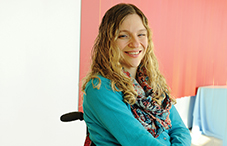

Angela Kuemmel, PhD, has firsthand experience with the same kind of injuries her patients in a Veterans Affairs (VA) spinal cord injury center have. At a high school swim meet in 1996, she dove into a pool, injuring her spinal cord. She has used a wheelchair ever since.
Today, Kuemmel is a staff psychologist specializing in spinal cord injuries and disorders at the Louis Stokes Cleveland Veterans Affairs Medical Center. Like many rehabilitation psychologists, she does psychological evaluations, individual therapy and group therapy for both newly injured veterans — most of whom were injured stateside — and those with chronic problems.
But she also collaborates with VA physicians, physical therapists, nutritionists and other clinicians to ensure that her patients receive comprehensive care that addresses all their needs. When veterans with spinal cord problems come to the VA for their annual check-ups, for example, she is part of the team that assesses their overall well-being. She has also pioneered a telehealth program on pain management that involves an occupational therapist and a physical therapist, plus a weight-management program that involves a physical therapist and nutritionist.
"For people with spinal cord injuries to have a high quality of life, it takes a village of teamwork to make that happen," says Kuemmel, who received a 2014 APA presidential citation for her leadership of and advocacy for early career psychologists.
As part of the team approach to care, Kuemmel might consult with a physician and then help a patient understand his or her medical problems and how to manage them. Or she might tackle a medical problem directly by persuading patients with pressure ulcers to get out of their wheelchairs and into bed — something many are reluctant to do. "For some people, life stops if they can't be up in their wheelchair," she says.
She also serves as a liaison between her team and health-care specialists. After a referral to a neuropsychologist, for example, she presents the results to her team and helps them interpret the recommendations.
"I feel very valued and very well-utilized," says Kuemmel, who works alongside another rehabilitation psychologist plus a psychology postdoc and intern. "Our input is highly sought after."
Kuemmel has launched some specialized interdisciplinary programs. One is the telehealth program on managing chronic pain. The 18-week program is designed for patients who have trouble getting to VA facilities because they live too far away. The program covers such topics as relaxation strategies and chronic pain's impact on relationships. A physical therapist talks about how pain affects participants' physical functioning, while an occupational therapist teaches the participants yoga.
Kuemmel also runs a weight-management program for patients with spinal cord injuries with a team that includes a nutritionist, physical therapist and recreational therapist. The 12-week program starts with the team evaluating patients, then providing individualized fitness and nutrition plans. Kuemmel helps participants set goals, curb emotional eating and overcome barriers to weight loss.
This kind of integrated care is nothing new for the VA, says Kuemmel, who points out that a psychologist has been part of the spinal injury center for decades. It's also familiar to Kuemmel.
While she earned her doctorate in clinical psychology from Nova Southeastern University in 2009, all her training in integrated care took place within the VA. She completed a rehabilitation psychology practicum at the Miami VA, her predoctoral internship in rehabilitation psychology at the VA Boston/Harvard Medical School and a postdoctoral fellowship in rehabilitation psychology at the James A. Haley VA in Tampa, Florida.
That training focused on team consultation, including building relationships with other kinds of providers, communicating effectively with those outside your discipline and sharing visits with patients. But another key skill is simply speaking up as a team member.
"Finding and using your voice in team meetings is important," says Kuemmel. "It's important to give both verbal reports to the team as well as documentation so they know what you're working on with a patient."
Kuemmel knows from her own experience that integrated care helps patients with spinal cord injuries. "I worked with a great team when I did my own spinal cord injury rehab 19 years ago," says Kuemmel, who also served as the public interest representative and chair for APA's Committee on Early Career Psychologists. "I definitely attribute that as one of the reasons why I am able to live successfully after my injury."