

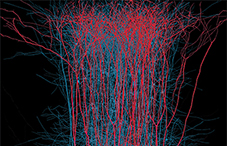

Imagine an exquisitely detailed computer reconstruction of the rat brain, with more than 50 layers of connected cells. This virtual microcircuit contains more than 200 different neural subtypes and nearly 40 million synapses. Its structure and behavior are governed by meticulous neuroscientific data, collected at the molecular and cellular levels. It can be used for experimental simulations to see what happens to communications among neurons when biological parameters are altered.
Sounds like something from a science fiction novel. But it's the first proof-of-concept model for the Blue Brain Project (https://bluebrain.epfl.ch/opens in new window), an ambitious initiative with the ultimate goal of building a digital reconstruction of the human brain. The project is based at the École Polytechnique Fédérale de Lausanne in Switzerland.
The idea for the project came from Henry Markram, PhD, who collected a massive amount of data from studying a circuit in the rat primary somatosensory cortex. He sought to pull it all together in a way that could further our understanding of how the brain works. This first model of a small circuit in the rat neocortex took 10 years to build, but experiments on the simulation are already providing key insights into connection patterns among neurons linked to aggression and emotion.
While the model still requires more work, many researchers are excited about its potential to help them better understand the brain in both health and disease, says Sean Hill, PhD, who co-directs the Blue Brain Project.
"As we get more data-driven definitions of disease, we can use those signatures to better understand what may be going awry in depression or schizophrenia," he says. "But the important thing is we give value to the data and create an ecosystem where that data is valued and used to better understand how the brain works."
Some researchers are less convinced of its value. The Blue Brain Project has been criticized for its data-driven, rather than theory-driven approach and narrow focus. But Andrew Rossi, PhD, of the Theoretical and Computational Neuroscience Program at the National Institute of Mental Health, says that the value of more computational, data-driven approaches (what's now called in silico neuroscience) is becoming more apparent.
Neurocomputational and data-driven approaches can help researchers to expand their thinking, Rossi says. "These approaches will allow us to ask better, more precise questions about the normal function of the brain and what occurs in disorders of cognition — and with luck, give us new leads about where we might look to find those answers," he says.
— Kayt Sukel