


Christopher Jacobs will never forget how he felt when he pulled up in front of Chicago's Cook County Jail to photograph its new executive director, psychologist Nneka Jones Tapia, PsyD, for APA's Monitor on Psychology.
"I pulled up to the triple barbed wire gate and a guard comes out and says, ‘Christopher Jacobs? We've been expecting you,'" recalls Jacobs. "I said to him, ‘Dude, I never want to hear that they were expecting me at a jail.'" But after getting to know Jones Tapia, Jacobs couldn't wait to spend more time at the facility.
"I was just blown away by her attitude and persona, and it inspired me to see if there were any volunteer opportunities available there," he says.
After several months of phone calls and emails, Jones Tapia invited Jacobs to oversee a photography class for inmates that began in September, with 26 men meeting twice a month for four months. (Twelve inmates made it to the end of the course, as participants were either released or convicted and sent to prison.)
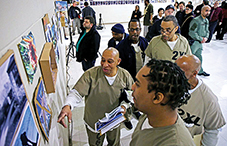
In February, Jacobs and his students hosted the first "Cook County Jail Mental Health Transition Center Photography Exhibit," where the inmates shared their photos with relatives, friends, local media and jail administration and staff, including Cook County Sheriff Tom Dart.
"Most of Cook County Jail's inmates — particularly those suffering from mental illness — come from communities beset by violence, poverty and distress," Dart says. "By teaching them to view the world in a different light through the power of art therapy, we're preparing them to avoid unhealthy triggers and maintain happy, stable lives outside of the criminal justice system."
During the course, Jacobs taught the history of photography and asked his students to critique photos by famous photographers such as Ansel Adams and Annie Leibovitz. But he focused most on helping the inmates take their own photos with digital cameras he provided.
"We had limited resources and a limited canvas — really just a classroom, a gym and a little courtyard area with some flowers and fruits and vegetables," he says. "But with those limited resources, it really was unlimited talent." He also brought in local artists, including a painter, to talk about their work.
"I was trying to teach these guys how to see things differently," says Jacobs, who is now teaching a second class at the jail. "But I ended up learning more from these guys, including that we're all human and we all deserve a second chance."
— Amy Novotney