

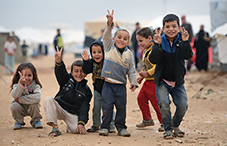

Health professionals, teachers, law enforcement professionals and others can find guidance on how best to provide culturally appropriate aid to those displaced by the Syrian civil war in the new online guide "Working with Refugees from Syria and Surrounding Middle East Countries."opens in new window Published by the Public Mental Health Initiative based in Manitoba, Canada, and edited by clinical psychologist Rehman Abdulrehman, PhD, along with six guest editors, the tip sheet includes advice from more than a dozen international contributors on such topics as how to build trust with this community and how to respect "gender courtesy" in Muslim and Middle Eastern culture — where men and women may avoid physical contact with a member of the opposite sex they don't know well.
The guide also lists best practices on working with Syrian refugee children and includes a section on issues unique to mental health care. Among the recommendations is to offer psychological care in primary-care settings alongside a medical team whenever possible, as a way to lessen the cultural stigma of mental illness. Another is to avoid assuming that all trauma experienced by refugees occurred in their home country.
"Racism, discrimination and Islamophobia in their new country can have a serious negative effect on the mental health of an individual," says Abdulrehman, an assistant professor at the University of Manitoba and a member of APA's Committee on International Relations in Psychology.
As Canada welcomes 25,000 Syrian refugees for resettlement, Abdulrehman and his collaborators have circulated the guide to all Canadian law enforcement agencies, as well as hospitals and many social service agencies. Now they are working to spread the guide beyond their borders. The hope is that more informed providers will improve immediate aid and increase access to mental health care over the long term.
"Within the immigrant population … it is so hard to access mental health care," says Abdulrehman, who works with immigrants in his clinical practice and immigrated to Canada from Tanzania when he was a child. "Often people in those populations don't have a voice, or anyone speaking on their behalf."
Find the guide at https://clinicpsychology.com/wp-content/uploads/2016/04/tip-sheets-final.pdfopens in new window. The Public Mental Health Initiative is a public education campaign that aims to increase understanding about mental health issues. For more information, visit https://clinicpsychology.com/pmhi/opens in new window or follow Rehman Abdulrehman on Twitter at @drrabdulrehman.
— Jamie Chamberlin