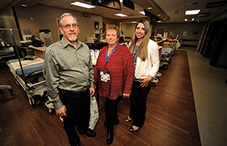

Most psychologists in private practice keep regular office hours. Not Sherman C. Slone, PsyD, founding partner of Emergent Care Psychologists, PA, in Pinellas Park, Florida. The five psychologists in his practice — three full-time, two part-time — can find themselves working after normal business hours, on weekends or over holidays as they assess individuals who have been involuntarily committed to see if they're safe to release. Slone's practice also assists other patients in psychiatric, medical and rehabilitation hospitals, helping them manage anxiety, depression and other problems.
The bulk of Slone's work focuses on patients who have been involuntarily committed by emergency room physicians, police officers or even neighbors who have convinced judges someone is dangerous.
"These patients may have tried to hurt themselves, taken an overdose or mentioned suicidal thoughts while intoxicated," says Slone, adding that many of these patients have substance use issues. He and his colleagues conduct "lethality" assessments to determine whether it's safe to release patients to a less restrictive level of care and also assess patients' wishes and competency to make decisions for themselves as they come up with alternative treatment plans.
While Slone typically doesn't have an ongoing relationship with patients, he says, "obviously, we want to do the assessment in a therapeutic manner." For patients with substance use problems, that could mean doing motivational interviewing, helping them set up a plan for staying clean and referring them to community agencies for further help.
Slone got his start in emergency care early in his career. After earning his doctorate in clinical psychology from the Illinois School of Professional Psychology in 1986, he spent almost a decade working at Magellan Behavioral Health in Tampa. Eventually, he became the area crisis director in charge of evaluating and treating patients whose psychiatric and substance use problems put them at risk of hospitalization.
In 1998, Slone and partner Emily J. Futch, PhD, founded Emergent Care Psychologists. The practice now contracts with half a dozen hospitals to provide care to all patients with psychological concerns in exchange for a per patient or capitated rate.
"As far as I know, we're the only group of psychologists in the private sector who are contracting with medical hospitals to provide psychological consultations," says Slone, adding that most local psychiatrists choose not to work with hospital patients because so many of them are either on Medicaid or lack insurance altogether.
What's in it for hospitals? Lowered costs and better care, says Slone. Take suicidal patients. Patients who have made suicidal gestures typically wind up in intensive care units or in beds with 24-hour "sitters" — both extremely expensive options. Bringing in Emergent Care Psychologists isn't just less expensive. Meeting patients' psychological needs also reduces what Slone calls "noise" on the wards — the agitation, combativeness and other behavior that make it difficult for nurses and other staff to do their jobs and other patients to rest and recover.
Slone, Futch and their colleagues also tackle such issues as anxiety, depression or grief in hospitalized patients. A physician in the intensive care unit, for example, might request a consult on how to help a patient who panics every time the physician tries to wean him off a ventilator. Slone might teach breathing techniques or provide cognitive-behavioral interventions to lessen the patient's anxiety.
And while Florida psychologists can't order, prescribe or dispense medication, Slone also consults with physicians and other prescribers about psychotropic medications.
"It could be that a patient has been on a psychiatric medication in the past, and the physician would like a mental health professional to review that medication and see if the patient needs to get back on it or continue on a medication," says Slone, who is board certified in psychopharmacology. "We have some credentials to recommend medications to the attending physicians or the neurologists or other physicians working with patients."
No matter what the problem, the process begins when a physician calls the practice's dispatch line to request a consult. During their assessments, the psychologists work with emergency room physicians, trauma surgeons, neurologists, infectious disease specialists and other types of physicians as well as nurses, trauma nurse practitioners, case managers and family members. There's also plenty of informal discussion with other professionals in the common "dictation rooms" where physicians and others write their consultation reports.
Working with hospitalized patients can be challenging, Slone admits. For one thing, most of his patients are in crisis.
"We sometimes see patients who have jumped off the Sunshine Skyway Bridge — the highest in the area — and survived or patients who have shot or stabbed themselves," he says.
He and his colleagues must also have the confidence to make decisions about releasing patients who have been involuntarily committed, with all the potential liability that involves. Plus, they must be willing to work very long hours, if necessary.
But this kind of work represents a big potential growth area for psychologists who can handle such pressures, says Slone, who hopes to expand his practice.
"We've been quite short-handed," he says, adding that bringing more psychologists on board could allow the practice to do more psychological and behavioral interventions with patients. "Right now, we don't have time to do as much as we'd like."