
What do you do as CEO of Fly Fleet?
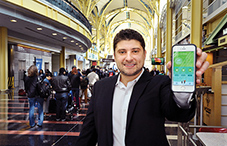
I'm in charge of guiding the company's vision, which is to improve the air travel experience for people using an app we designed called Fleet Travel Guide.
I wrote an Apple iOS app and algorithms that used GPS and motion data from users' phones to detect when they were waiting in line at airports and going through security. We combined that data with commercial flight and airline information to detect when people are delayed in an airport. The app gives users information about flight and security line delays and restaurants near their gate. It also alerts friends and family who are following someone about delays and the expected arrival time.
Now our goal is to find ways to alleviate the stress of delays by giving users special deals, such as a free drink at Starbucks from a friend or family member who gets a notification about the delay. We're seeking partnerships with airport businesses that are interested in offering perks, which could improve customer loyalty for those businesses.
The company was created in 2013 by one of my professors at George Mason University who taught task analysis and user experience. Earlier that year, he had formed a team of students that entered the Federal Aviation Administration software design competition to improve the air travel experience through the innovative use of FAA data. The team included myself, two other user experience researchers, two computer programmers and two designers. We started by thinking about the stress and anxiety created by flight delays and other uncertainties while traveling. We decided to design an app that could warn people of delays and help them when they were stuck at the airport.
How do you use your psychology training in your job?
My training in writing algorithms and measuring human behavior helped me figure out that people have very unique body signatures when they are waiting in a line and going through security. The intensity of movement, for example, slows down and the smooth motion of the phone on the security belt is distinct. My job also involves a lot of user experience research, such as think-aloud approaches in which I ask people to say what they are thinking aloud as they navigate through the app. I also use Nielsen's Heuristics of user interface design and the GOMS model [for goals, operators, methods] to predict how long it should take someone to use the interface. I believe that learning the scientific method in graduate school set me up for solving problems in general, which is critical for entrepreneurs. I am constantly going through the process of hypothesis, experimentation, failure and new hypothesis.
Where did you get the training and experience needed to get this job?
Applied cognition is making systems and software to help people on a large scale, and that is what I wanted to do. My first attempt to pursue my passion involved creating two sleep apps, Sleep-2-Peak and Proactive Sleep. Sleep-2-Peak uses a simple reaction time test to help users figure out when they are at their peak of alertness in a day, and Proactive Sleep gives people suggestions about the best time to go to sleep and wake up based on algorithms that measure the user's sleep patterns.
I've always been captivated by the idea that improving the efficiency of sleep could have significant health implications for the world. After undergraduate school, I applied to the human factors and applied cognition graduate program at George Mason University. There, I learned about usability and psychological tools to build good software. My adviser, Dr. Greg Trafton, was the section head of intelligent systems at the U.S. Naval Research Lab. Mason collaborates with the lab to make predictive algorithms of human behavior and artificial intelligence. This gave me a lot of engineering experience with the R statistical programming language, analyzing big data sets and modeling human behavior.
How did you start Fleet?
Once we won the FAA design competition, we formed the company Fly Fleet LLC. Dr. Robert Youmans, the professor at Mason who gathered the initial team, was the CEO. He recently took a job at Google and asked me to take over as Fleet's CEO. My six teammates work part time and I work full time, though we're not paid yet. I'm doing project management and Apple iOS development, improving the app and trying to find investors and business partners. I earned my PhD in March, and I am giving myself one year to find funding and build the company.
What is challenging or difficult about your job?
As an entrepreneur, you get a lot of rejections when you are trying to sell your idea. Right now, we are trying to team up with businesses like Ben's Chili Bowl at the D.C. airport, and if the idea takes off, then maybe businesses like Starbucks and Tumi. We're also working to get venture capital, and funding a company is more difficult than I anticipated. I've pitched my idea to investors or businesses more than 20 times and had some success with Ben's Chili Bowl so far. It reminds me of academia when grants get rejected. One of the things that's been helpful is joining the 1776 business incubator, which provides mentoring and connections with the D.C. startup community. I also use my network in LinkedIn to find contacts who may be interested in my idea.
What do you enjoy most?
One of the main things I learned from Rob Youmans was the iterative design process, which involves making a prototype of something, giving it to a tester, getting feedback and iterating again. It's creating something and figuring out what works and what doesn't, and I get a lot of enjoyment out of that process. I know that a bad airport experience can be isolating and frustrating, and I'm trying to make something that lets people in that situation experience their environment in an interesting, engaging and social way. When I see progress with the product and get a positive review on the App Store about Fleet, that makes my day.
Is there anything else readers should know?
It seems like a lot of psychologists don't know much about the practical applications of studying the user experience and applied psychology, and one thing I've seen is that people who get a master's degree in this area find really good jobs that are interesting and high-paying. I've also been surprised by how many entrepreneurs are cognitive psychologists. Both roles typically involve building and testing hypotheses and computer programming. I think it's pretty exciting to use these skills to create things that have the potential to help a lot of people.
— Heather Stringer