


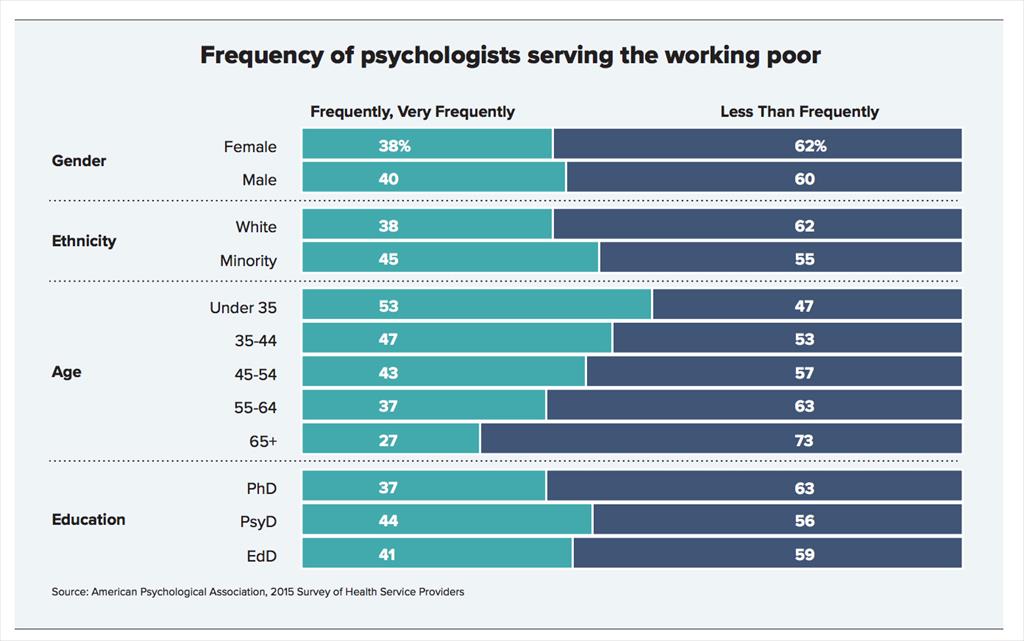
- More than half (53 percent) of young psychologists under age 35 served the working poor frequently or very frequently, as opposed to only 27 percent of psychologists age 65 or older, according to APA's 2015 Survey of Psychology Health Service Providers.1,2,3
- 45 percent of racial/ethnic-minority psychologists frequently or very frequently served this population; only 38 percent of non-Hispanic white psychologists did.
- 44 percent of psychologists with PsyD degrees frequently or very frequently served the working poor, more than those with EdD (41 percent) or PhD degrees (37 percent).
- Similar percentages of female (38 percent) and male psychologists (40 percent) frequently or very frequently served the working poor.
By Auntre Hamp, MEd, MPH, Karen Stamm, PhD, Luona Lin, MPP, and Peggy Christidis, PhD. For more information, contact cws.apa.org.
1APA. (2015). Survey of Psychology Health Service Providers [Unpublished special analysis]. Washington, DC: Author. Respondents were asked about the frequency of providing services in a typical week: never, rarely, occasionally, frequently, or very frequently. Socioeconomic categories included the working poor, homeless and unemployed. Missing values were excluded prior to the analysis.
2Racial/ethnic minority includes American Indian/Alaska Native, Asian, Black/African-American, Hispanic, Native Hawaiian/Pacific Islander and other non-White racial/ethnic groups. White does not include Hispanics.
3Chi-square tests were conducted between the frequencies of serving the working poor and various characteristics of psychologists. Statistically significant results at p<0.01 were found for race/ethnicity, age and degree type.