

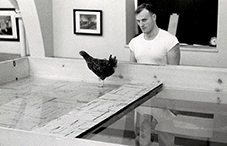

Most Psych 101 students recognize the iconic "visual cliff" images showing that young infants refused to crawl across an abyss-spanning plexiglass surface to reach their mothers. But babies weren't the only subjects studied by researchers Eleanor Gibson and Richard Walk at Cornell University. The two also tested cats, dogs, rats, lambs, turtles, cows, pigs—and chickens. Chickens, it turns out, might be adventurous where road-crossings are concerned, but they are more cautious when it comes to cliffs. Kept on the apparatus for a full 5 minutes, only seven of the 50 chickens tested were willing to cross the plexiglass-covered abyss by foot, while four flew over it.
How did humans stack up? Of 36 infants tested, only three braved the cliff, with the remainder stopping short or sounding the retreat with a cry to their mothers. These results demonstrated that human infants are able to perceive depth by the time they are able to crawl.
Taken in conjunction with evidence from testing nonhuman infants, the experimenters concluded that depth discrimination is indeed an innate ability. Although researchers continue to debate that point, the visual cliff experiments were a landmark in the development of depth-perception research that inspired further studies in perception, motor skill acquisition, emotional development and social referencing.
Charity Smith and Vanessa Facemire are graduate assistants at the Cummings Center for the History of Psychology at the University of Akron.