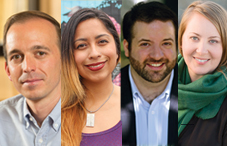

Psychology graduate students have made significant contributions to the lives and well-being of people who are socioeconomically disadvantaged. Here we highlight a few of the students working to change lives worldwide by supporting indigenous people, abused women and children, people who don't have access to psychotherapy and more.
Kirby Huminuik: Serving refugee and indigenous populations
 As co-founder of Partners in Rights and Recovery, counseling psychology student Kirby Huminuik worked collaboratively with human rights organizations in Mexico to support survivors of massacre, torture, sexual violence and other forms of abuse. The community- based organization partnered with local workers to develop a trauma-informed documentation process for human rights violations.
"Often human rights reporting takes a legalistic perspective, but there are ways to ask questions to avoid re-traumatizing the victim," says Huminuik, who is in her final year at the University of British Columbia in Vancouver. "By asking about how victims survived, for example, the aid workers learned how to conclude an interview with a sense of strength."
Huminuik is also a consultant for British Columbia's Refugee Readiness Program, aimed at helping Canada welcome the 25,000 Syrian refugees who came to the country in 2016. She developed a professional training workshop for mental health professionals that covered trauma, resilience and the challenges of forced migration. She also designed individual and group therapy program manuals for clinicians who work with refugees.
"There is very little funding for refugee mental health, and as professionals in this field we need to learn how to advocate and have a voice for this population," she says.
This year, APA's Committee on Socioeconomic Status honored Huminuik with its Leadership Award for her work.
Ian Gutierrez: Leveling the field for students
 Ian Gutierrez started thinking seriously about socioeconomic injustice when he represented the clinical psychology department in the Graduate Student Senate at the University of Connecticut. In that role, Gutierrez, a clinical psychology graduate student at the university, learned that graduate assistants would soon lose their state-provided health insurance in exchange for a more expensive, less comprehensive plan.
So, he joined a group of a dozen graduate students interested in forming a union to advocate for their rights. Gutierrez spent nights and weekends talking to students about the benefits of unionization. In 2014, the state of Connecticut formally recognized the University of Connecticut's Graduate Employee Union.
Soon after, he joined the union's bargaining committee— "the most interesting ‘class' I took in grad school," Gutierrez says. "Most interactions in school are very cordial, but when it came down to dollars and cents, things got heated. I learned how to persevere, compromise and negotiate a contract on behalf of 2,100 people."
The new contract includes a 3 percent annual wage increase, an $80,000 graduate assistant child-care fund, and up to eight weeks of maternity leave and three weeks of leave for nonbirth parents.
Gutierrez, chair of the American Psychological Association of Graduate Students for 2016–17, is focusing on socioeconomic issues that affect graduate students throughout the country, such as student debt, starting career salaries and paid leave for graduate student employees.
Gina Tillis: Building school connections
At a young age, Gina Tillis became increasingly aware that friends and relatives were dropping out of school in her disadvantaged community. Now as a graduate student in the School of Education at the Huston-Tillotson University in Texas, Tillis is using her psychology training to address the factors that lead some students to leave school.
In 2013, she designed and taught a seminar required for all first-year students at the university. The course focuses on teaching students to reflect on the ways their education influences how they view themselves and the world. The students also participate in a community- based project of their choice.
"The Freedom Project is geared toward transforming the way low-income, first-generation students experience their education," Tillis says. "As they progress through the seminar, they seem to be developing a stronger appreciation for the value of knowledge and how it can be an avenue to affect change in their communities."
Graham Danzer: Promoting honest dialogues
Graham Danzer, PsyD, grew up as a white male in a large, urban African-American community in Oakland, California, an experience that motivated him to pursue a career serving vulnerable populations. As he started working with patients, Danzer observed a disturbing trend: White therapists often seemed uncomfortable talking about their experiences with African-American clients. In training, he had learned that sharing honestly about personal experiences with people of color was a necessary first step toward developing self-awareness in the context of cultural sensitivity and competency.
"I felt that the majority of my training only superficially addressed pattern reactions between our ethnic groups," says Danzer. "Often, it seemed as though we avoided these conversations to avoid offending anyone."
In response, Danzer started conducting research on how to address racial differences and facilitated discussions at conferences where therapists openly talked about their struggles working with people from different backgrounds. To guide other clinicians and trainees with issues of race and ethnicity, he wrote "Therapeutic Treatments for Vulnerable Populations: A Training Workbook."
"It's critical for practitioners to consider both the individual and group contexts when there are racial differences," Danzer says. "Focusing only on the individual alone risks ignoring or at least downplaying a historically traumatic history that colors personal identity."
Lisette Sanchez: Providing care for Latinos
 As a counseling psychology graduate student at the University of Oregon, Lisette Sanchez was looking for ways to help at-risk Latino populations. She found her niche when she discovered Centro Latino Americano, an Oregon agency that provides services to economically disadvantaged Spanish-speaking people.
For the past three years, Sanchez has provided mental health services at Centro. Although her clients' initial presenting concerns may be similar to people in other settings—such as depression and anxiety—she says that they often face additional difficulties as a result of their marginalized identities.
"They may be dealing with struggles related to language barriers, low-socioeconomic status or immigration concerns," says Sanchez, who is bilingual. "I help them learn coping skills, self-care and how to access resources like group therapy or church communities."
She also mentors a Latina teen through Centro, discussing such issues as stereotypes, future careers, academic motivation and healthy relationships.
"As a first-generation college student, I remember how lost I felt, and it's rewarding to be able to provide support to my mentee because I've lived through that experience," Sanchez says.
Elizabeth Sauber: Supporting abused women and children
Elizabeth Sauber's interest in serving abused women started in high school after she was in an abusive relationship herself. Now, as a counseling psychology graduate student at the University of Maryland, Sauber develops and facilitates groups for children living at the Family Crisis Center in Prince George's County, a shelter in Maryland for abused mothers living in poverty.
She teaches the children about emotional regulation, and how to foster positive self-esteem, set boundaries and live a healthy lifestyle.
She also leads a team of undergraduate students enrolled in a service-learning course at the shelter, helping them to acclimate to the often-hectic shelter environment and encouraging them to share their thoughts and concerns about the experience.
Recognizing the importance of working with offenders, she recently co-facilitated an intervention group for men who mistreat women. Over a year, she taught them about the cycle of violence, the impact on their partners, and how to talk about their own hardships related to racism and oppression.
"Discussing the intersections of poverty, racism and violence was especially validating for the men," Sauber says. "It gave their pain visibility. For me, it highlighted the power of empathy and truly understanding the complexity of the human experience before jumping to conclusions."
Guillermo Wippold: Offering free services
 It always bothered Guillermo Wippold that low-income people couldn't afford psychotherapy. That's why as a counseling psychology graduate student at the University of Florida he began working at the Equal Access Clinic Free Therapy Night, a graduate student-run mental health clinic in Gainesville, Florida, that provides free services.
Now co-director of the clinic, Wippold treats patients who face substance abuse, housing difficulties, depression, anxiety and physical health conditions, such as HIV. A main goal of the program is to increase clients' access to community resources, so Wippold develops connections to nearby homeless shelters, food pantries, HIV/AIDS testing clinics and support groups. The clinic has been so successful that it recently moved to a larger facility a few miles away.
Wippold also participates in the African Methodist Episcopal Health-Smart Church Model Program, which promotes healthy living behaviors within churches. He trains church leaders to conduct workshops on a variety of key topics, from portion control to finding safe places in the community to exercise.