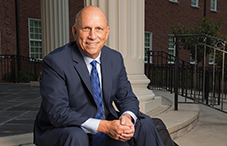

Antonio E. Puente, PhD, has come a long way since leaving Cuba and arriving in the United States as a small child in 1960 with just $300, a change of clothes and no knowledge of English. That background influences Puente's plans to strengthen APA's ties with Latin America and other regions during his presidential year. His other priorities include promoting psychologists' role in health care, celebrating APA's 125th anniversary and helping the association move past some difficult years to a bright future.
"The main reason I wanted to be president was because I was impatient with the status quo," says Puente, noting that two of his three children are also psychologists. "I can't imagine doing anything better as a father than making sure the future of psychology is strong."
As president, Puente, a psychology professor at the University of North Carolina in Wilmington, seeks to strengthen relationships with psychological scientists, find solutions to the shortage of internships and postdoctoral fellowships, and increase both APA's membership and the diversity of its members.
"Our demographics don't reflect the people we seek to understand and serve," he says.
Puente also wants to eradicate misunderstandings about the different roles played by APA and the APA Practice Organization. "Many APA members believe they're members of an association for psychologists, when in reality APA is an association for psychology," says Puente. While APA is a 501(c)(3) organization devoted to serving the public, he explains, the APA Practice Organization is a 501(c)(6) organization that advances and protects psychologists' ability to practice their trade. Both are critical to APA's and psychology's future, Puente says.
Another major priority is to get psychologists included in Medicare's definition of "physician."
"There are only two kinds of individuals in health care: physicians who ‘think' and technicians who ‘do,'" says Puente. By excluding psychologists from the "physician" category, he says, Medicare renders psychologists the only doctoral-level provider in the "technician" category. And that exclusion has wide-ranging ramifications. "Being put in the category of technician limits us in terms of payment, true parity and clear autonomy," says Puente.
Puente's interest in shaping health-care policy stems from his own experience as a neuropsychologist unable to get appropriately reimbursed for his work. To help change that, he became APA's representative to the American Medical Association's Health Care Professional Advisory Committee for the Current Procedural Terminology (CPT®) Panel in 1993. He eventually became the first psychologist to become a voting member of the CPT Editorial Panel and helped to introduce dozens of new reimbursement codes psychologists can now use.
A final priority for 2017 is incorporating anniversary celebrations into all formal APA activities throughout the year. "We should acknowledge that we've been here for 125 years, an unusual accomplishment for any organization," he says. "We have so much to offer."
Puente still has his private neuropsychology practice, where he provides both clinical services and forensic consultation on more than 100 death penalty cases with Spanish-speaking defendants. He also works to spread neuropsychology around the world. He has been president of APA's Div. 40 (Society for Clinical Neuropsychology), the National Academy of Neuropsychology and the Hispanic Neuropsychological Society, for example. As a visiting professor at the University of California, Los Angeles, he has been involved in helping to create a cultural neuropsychology initiative—a clinical, training and research program designed to respond to the diverse community of Los Angeles. And as a visiting professor at the Universidad de Granada, Spain, he has watched the intensive summer course in neuropsychology he launched in 1988 morph into an entire program in neuropsychology. "Now I'm teaching students of students," he says.
Since the 1980s, Puente has also been working to develop psychological testing materials appropriate for Spanish-speakers as well as for other languages and cultures. In addition, he founded the journal Neuropsychology Review and also edited a 33-book series on critical issues in neuropsychology.
Puente has been involved in health care since the beginning of his career, when he taught neuroanatomy at a medical school in Grenada and served as a clinical psychologist at Northeast Florida State Hospital, a psychiatric facility in Macclenny, Florida.
These days, in addition to teaching, he volunteers as the co-director of mental health services at a nonprofit multidisciplinary health clinic in Wilmington that serves uninsured, low-income patients. More than a dozen years ago, Puente's daughter was interpreting for Spanish-speaking patients at the clinic and urged him to volunteer, too. "I realized as I was translating for the physicians that many of their patients' problems were psychological," says Puente. "I asked if I could stop interpreting and start seeing patients." In 2004, Puente founded the clinic's mental health program.
No matter what role he's playing, Puente tries to start each day the same way: surfing. "I've been surfing all my life," says Puente, who checks surfing conditions at 5:30 every morning. "I hope to catch a few waves before I take on the task of being a psychologist."