


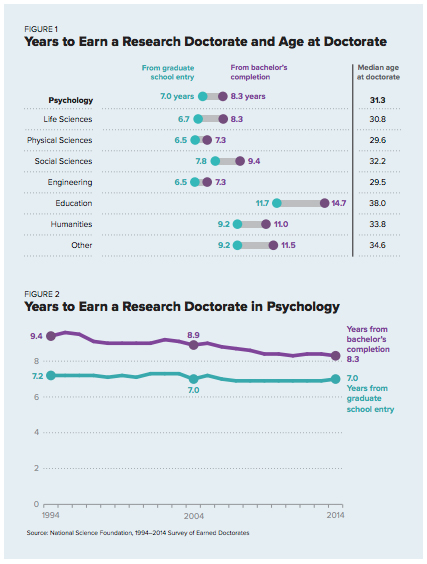
- Graduates who earned psychology research doctorates in the 2013-14 academic year completed their degrees seven years after starting graduate school, on average, and 8.3 years after completing their bachelor's degrees.1
- That's a shorter time than many other disciplines.2 Across all disciplines, graduates completed their doctorates 7.3 years after starting graduate school, and 8.8 years after completing their bachelor's.
- Median age at doctorate for psychology was 31.3, younger than doctorates in social sciences, education and humanities, but older than doctorates in life sciences, physical sciences and engineering.
- While the time to earn a psychology doctorate from the start of graduate school remained fairly stable throughout the past two decades, the time to earn a doctorate from bachelor's completion has declined (Figure 2). Graduates' median age also declined from 33.1 in 1994 to 31.3 in 2014.
By Luona Lin, MPP, Cathrin Green, BS, Karen Stamm, PhD, and Peggy Christidis, PhD
For more information, contact APA's Center for Workforce Studies.
1National Science Foundation, National Center for Science and Engineering Statistics. (1994–2014). Doctorate recipients from U.S. universities. Arlington, VA. Retrieved from www.nsf.gov/statistics/2016/nsf16300/archives.cfmopens in new window. A research doctorate requires the completion of a dissertation or equivalent project and is not primarily intended for the practice of a profession. Time to doctorate was defined as the median years it took for students to complete their research doctorates from the time they enter any graduate school or from the completion of their bachelor's degrees.
2Life sciences include agricultural sciences and natural resources, biological, biomedical sciences, and health sciences; physical sciences include mathematics and computer and information sciences; social sciences include psychology; other includes non-science and engineering fields not shown separately.