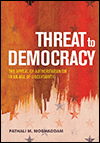

In the late 1970s, Fathali M. Moghaddam was studying intergroup relations in England when the Iranian revolution broke out. He immediately returned to his native country to join those pushing for greater openness, justice and democracy through teaching and writing in the popular press. Despite such efforts, Islamic fundamentalists used brute force to take over the country.
"There were bombings, assassinations, imprisonment, torture," Moghaddam says. "They terrorized the entire population, particularly women who had to go back under the hijab and move out of the public sphere."
By the end of 1979, Iran had become "a corrupt dictatorship again, with a religious cover," he says.
After watching his fellow citizens so quickly and violently lose their freedoms, and sometimes their lives, Moghaddam was driven to study the psychology of terrorism, dictatorship and democracy. Today, he is a professor of psychology at Georgetown University, editor of the APA journal Peace and Conflict: Journal of Peace Psychology, and author of 26 books, including "The Psychology of Democracy" and "The Psychology of Dictatorship." The Monitor asked him about current threats to democracy and what psychologists can do about them.
You have said that all countries are on a continuum from democracy to dictatorship. Where is the United States?
The United States has made some progress toward a fully developed democracy. However, like many other countries, the United States still needs to do a better job of educating citizens engaged with and supportive of democracy—this weakness has at times resulted in some backward movement. In the 1950s during the McCarthy Era, there was a backward lurch in which democracy was weakened. This was, of course, during the Cold War, and as psychologists know, such external threats can lead groups to become more conformist and obedient to ethnocentric, nationalistic and aggressive, bombastic leadership.
Since 9/11, the drumbeat of threat has been very strong in the United States and Western Europe. Although the number of people killed by terrorism is low compared to the more than 30,000 killed by firearms in the United States each year, the drumbeat of Islamic terrorism has meant that Americans are influenced to support ethnocentric, nationalistic, aggressive styles of leadership. This has led to backward movement in American democracy.
What else is behind the rise in nationalism?
It is also caused by the psychological reaction to what I have called "fractured globalization and sudden contact," leading to collective identity threat. Fractured globalization is summed up in the phrase "global economy, local identity." While our technological and economic changes have led to globalization as we know it, our identities have for the most part remained local. We can see this in Europe where most of the people don't see themselves as Europeans. We see the backlash with Brexit, Scottish nationalism, Basque nationalism, Quebec nationalism, the surge of Marie le Pen and the vote for Donald Trump.
Globalization has led to enormous, rapid movements of people. Modern transportation means that millions of people can move in a relatively short time. As a result, you get sudden contact and collective identity threat—groups coming into contact with others with whom they've had no experience and with no opportunity for the people of the host countries to adapt. The rise of nationalism, ethnocentrism and threatened identities are all based on perceptions of invasion and the resulting collective identity threat. In the United States, the election of Donald Trump has been based on this surge of perceived threat, and the executive order stopping people from Islamic countries from coming here is based on exaggerated perceptions of threat. Psychologists can counter this perceived threat by better communicating our research findings and making people aware that this fearmongering threatens democracy.
But the impact of sudden contact and collective identity threat is not limited to any one part of the world. The election of Donald Trump and the rise of Islamic radicalization and terrorism are psychologically the result of the same processes: globalization and sudden contact, resulting in huge collective identity threats. Just as authoritarian fundamentalist Muslims are determined to repulse American culture from Islamic societies, authoritarian nationalist Americans are determined to repulse Muslim culture from the United States. These ethnocentric forces are mirror images.
What else can psychologists do to promote democracy?
First, we can keep optimistic by looking at the long term. We have made tremendous advances. Look at the progress of women in higher education, for example. Until about 50 years ago, women were excluded from much of higher education. Now, women play a central role in higher education.
However, in the short term, we have to take strong positions and speak out on the basis of our research on the treatment of minorities, on torture, on women's rights and much more. On the treatment of minorities, for example, empirical psychological evidence has accumulated over at least the last half century on how implicit and explicit prejudice and discrimination against minorities and women detrimentally affects their performance and well-being, and harms all of society. Regarding torture, a great deal of evidence has accumulated showing that torture is not an effective means of extracting accurate information. To explore this issue, at the height of the Iraq-war interrogation debates, I participated in a meeting of highly experienced military interrogators and research psychologists at Georgetown University. The interrogators reported on the ineffectiveness of torture for getting at the truth (Peace and Conflict: Journal of Peace Psychology, 2007).
Public opinion is swayed by arguments, and psychologists have a great many facts and arguments to present about the current situation.
We also must make a concerted effort to educate more broadly. We have a duty to socialize citizens for democracy by making a more explicit link between psychology and democracy by writing, speaking up in forums, and talking to politicians about our research findings and experiences from practice as psychologists.
Do you remain optimistic about democracy?
We have to be optimistic, but we also need to keep in mind that democracy is something we have to fight for. There is no guarantee that historically democracy must win out. Militarily, apart from the United States, the most important powers are dictatorships. China, the rising economy in the world, is a dictatorship. Russia is a very strong dictatorship that does not plan to go away. So, we have a fight on our hands and we need to think of the long term.
All empires decline and the question is when will the American Empire decline and what will be the state of democracy after it does?