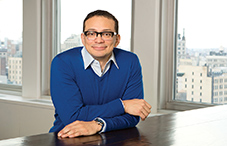

A native of Venezuela, Rainer Romero-Canyas, PhD, has witnessed the glaciers melting away from the tops of the Andes mountains as a result of climate change. Now he is using his psychology expertise to address such consequences of pollution. Based in the New York City headquarters of the Environmental Defense Fund (EDF), Romero-Canyas is one of 540 employees who work with organizations around the world to solve environmental problems.
What do you do at the Environmental Defense Fund?
In a basic sense, my job is to remind my internal colleagues that, like all behaviors, people's behaviors in relation to our environment are determined by a variety of forces, many of which are outside of our awareness.
For example, many people's thoughts about climate change are not based on scientific knowledge, but rather on standing with their "tribes," such as political parties or religious affiliations. I do original research in collaboration with academic partners to understand the best ways to communicate environmental issues to the public, business leaders and government entities and to promote environmentally responsible actions.
Could you give examples of your research?
One of the projects I'm particularly excited about is related to the fact that consumers will likely start paying a carbon tax on products in the future. EDF is working on ways to implement this without upsetting people. We run experiments online using panels of respondents to identify how to talk to people about carbon emissions and increase willingness to pay the tax. If consumers are buying a new computer, for example, would they prefer to see that they are paying a $5 carbon tax that will be used to plant a new forest to clean the air? Or is it better to raise the price of the computer and say the computer company is paying the tax?
I recently worked on a project focused on how to convey information to the public about the environmental implications of natural gas leaks. One of the issues was that people tend to think of dangerous explosions when they hear the term "gas leak," but we wanted them to focus on the environmental harm of smaller leaks over time. Methane is a powerful short-term greenhouse gas, so many small leaks contribute to warming the planet at a fast rate, faster than CO2. Using experiments, I helped my colleagues select colors on the gas leak maps based on my knowledge of human reactions to different colors. Our initial designers wanted to color the smallest leaks green, but our testing showed that this confused audiences because green is considered positive. We eventually settled on a yellow to orange spectrum. Our goal was to motivate cities to upgrade older gas pipes to decrease leaks.
Now I'm working on a set of interventions to promote compliance with conservation practices among fisherman in rural, developing parts of the world. I'm conducting behavioral experiments to find the best way to help fisherman understand the economic, ecological and social costs of overfishing. We designed surveys to learn about the community's beliefs about fishing and regulation in their town. Then we developed field experiments that used a game to simulate the types of rules that could be created to promote conservation. We're using the study results to develop interventions and campaigns on a larger scale for that area.
How did you get the training and experience needed to get your job?
I studied psychology as an undergraduate at Yale, where I focused on social and developmental psychology and neuroscience. After college, I worked for two and a half years as a research analyst in Venezuela, where I helped a group of retired professors instigate behavioral change in employees. For example, we partnered with oil refineries that wanted to increase employees' compliance with safety protocols. This experience taught me how to apply psychological science to industry settings.
When I returned to the United States, I started graduate school at Columbia University, where I worked with Dr. Geraldine Downeyopens in new window on research related to the fear of rejection and the need to be accepted as motivation for group behavior. Then I was a postdoc at Columbia, where a lot of my research was about identity and social connections, the strongest motivators for many of the decisions we make about environmental and political issues.
How did you find out about the position?
When I started looking for a job as a postdoc, I knew I wanted to work in a field or organization that had a clear goal of improving the lives of people in some way. I was open-minded about what this could look like—anything from education evaluation to poverty reduction efforts. Then I saw the job listing for the Environmental Defense Fund in my email inbox—I received it because I was on a listserv for APA's Div. 8 (Society for Personality and Social Psychology).
What is most challenging about your work?
When I started in 2012, I was the first person at EDF who had been hired to work primarily in social science and psychological approaches. A lot of my colleagues had lay theories of the human mind that were not consistent with psychology's deterministic way of looking at people. In general, people believe that they are in control of everything in their lives, so they can be resistant to ideas like the framing effect, social norms and other well-documented phenomena. As the only full-time staff member devoted to social and behavioral sciences, I was often stretched thin, but in the last year we hired a fantastic research assistant who has been working with me on a dozen projects.
Is there anything else readers should know about your work?
I believe society needs more rigorously trained psychological scientists to shape policy decisions made by leaders and governments. Social psychologists tend to do studies and produce knowledge but not always share it with the world. I can't think of a better time to do this because we are in the midst of significant transitions with the new president, Brexit and rise of populism around the world.