

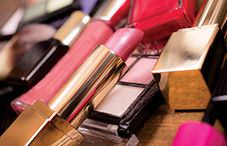

Every day, hundreds of millions of people across different countries and cultures apply makeup to their faces in an attempt to look more attractive. And they typically use makeup in much the same way.
"We wear eye shadow and lipstick, not nose stick and ear shadow," says Richard Russell, PhD, as associate professor of psychology at Gettysburg College. "There are a lot of ways people could be decorating their faces, but there's been this consistent way that makeup has been developing over the past several thousand years."
In a 2016 article in the Journal of Experimental Psychology: Human Perception and Performance, Russell and co-authors found a possible evolutionary reason for that consistency. In the study, the researchers digitally manipulated the contrast between facial features and surrounding skin in photos of white women, then asked study participants to rate how healthy the women seemed. Increased facial contrast—makeup's traditional goal—proved an important cue for assessing healthiness. In a 2016 study in Body Imageopens in new window, Russell and colleagues found that the presence of rosy cheeks and absence of dark under-eye circles also make people look healthier.
Makeup doesn't just affect perceptions of health, adds Russell. In a 2016 study in Perceptionopens in new window, he and co-authors applied digital makeup to photos of female faces, then asked participants to rate faces with and without makeup for various traits.
Men and women alike rated faces with makeup as more attractive. However, while men rated made-up faces as having more prestige (status granted by others), women rated madeup faces as having more dominance (status asserted by the person herself). Women experienced more jealousy toward women wearing makeup, the researchers found, and also viewed them as being more attractive to men and more promiscuous.
"We tend to think of makeup as a purely cultural phenomenon," says Russell. "Of course, there are cultural differences, but maybe it's also resting on some biological foundations." —Rebecca A. Clay