
Studying children in the lab is hard enough. Designing novel experiments and recruiting high-risk kids from unstable backgrounds to participate in those experiments? "If you want to think of the most difficult kind of human research to do, we've pulled it all into one package," says Seth Pollak, PhD, a professor of psychology at the University of Wisconsin–Madison.
Pollak launched his Child Emotion Research Lab in 1997, hoping to determine whether emotions are learned or innate. Over time, that interest evolved into two chief questions: What drives the emergence of emotions in children? And how do early life experiences affect the development of those emotions?
To get at those questions, some of Pollak's projects focus on typical emotional development. But a fundamental angle of his research is how adverse experiences might influence that development. "At the beginning, we were narrowly focused on the effects of child abuse. Then we started looking at child neglect. The past couple of years, we've folded in children who aren't maltreated, but are living in poverty," Pollak explains. As his participant pool has broadened, he's stayed true to a core mission, he says: "At the broad level, the lab has always been about using science to improve children's well-being."
Finding the sweet spot
 One important early line of research for Pollak was the Wisconsin International Adoption Project, which focused on children who spent time in orphanages abroad before being adopted by American families. Among the findings to come out of this long-term project, Pollak and his colleagues discovered that early neglect is associated with physical changes in the prefrontal cortex, which could explain cognitive deficits in neglected children (Child Developmentopens in new window, 2013). They have also shown that early deprivation affects some developmental processes more than others. Postinstitutionalized children show deficits in areas such as visual memory, attention and inhibitory control, but not in abilities such as auditory processing, planning and rule acquisition (Child Developmentopens in new window, 2010).
In a project launched more recently, Pollak collaborated with University of Wisconsin economist Barbara Wolfe, PhD, and their graduate students to study children living in poverty. They found that infants living in poverty had slower brain growth (PLOSopens in new window, 2015) and that children from lower-income households showed structural brain differences that were associated with lower scores on cognitive and academic achievement tests (JAMA Pediatricsopens in new window, 2015).
During those projects, the size of the lab's portfolio grew significantly, hitting a peak around 2008 when Pollak was juggling multiple large grants from the National Institutes of Health, while managing eight or nine graduate students, several postdoctoral researchers, numerous paid research staff and 50 or 60 undergraduates. "It felt like a sign of success that the lab was being so productive, but I found myself really unhappy," he says. "The lab got so big we had lab meetings in a large conference room. I didn't really know people, and I couldn't remember what they were working on."
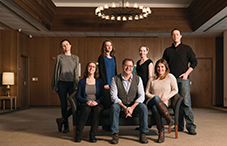
So, around six years ago, he began scaling back. These days he tries to maintain his lab with two or three grad students, a postdoctoral fellow or two, and around a dozen undergrads. "It's big enough that there's a diversity of ideas and room for debate, but we can really get to know each other," he says. "I feel like this is my sweet spot."
Fostering independence
While Pollak now has more time to devote to each of his students, he still gives them plenty of space to figure things out on their own. Many (perhaps most) psychology labs are built on an apprenticeship model: The principal investigator has a large, ongoing project, and new students are each given their own slice of that project to work on. Pollak does things differently.
When graduate students start in his lab, they create their own projects from scratch. Instead of handing them a dataset, he helps them spend the first few months honing their interests. "I support them more like a consultant to help them get at the question they want to study," he says.
When he talks about his students' experimental designs, his excitement is palpable. Giving students such freedom is a win-win, he says.
"I'm pushed to delve into new literature and explore new methods, and it keeps me from getting locked into questions that fit my most familiar method. But the students are getting to see how you can take an inchoate idea and turn it into an empirically tractable project," he says. "You can't beat intrinsic motivation when the going gets tough."
Pollak's current PhD students, Rista Plate and Brian Leitzke, and his postdoctoral researcher Madeline Harms, PhD, all say that the independence they're given is the lab's greatest strength—and biggest challenge. "It requires a lot of non-linear work to land on something that's new and interesting, and you don't always feel like you're moving forward," says Plate, who worked in Pollak's lab as an undergrad and is now in her fifth year of graduate work. "But all of that movement is really in service of coming up with something unique that you can really feel ownership over."
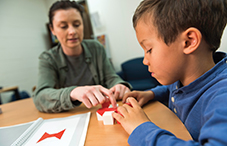
In Plate's case, that something is a computer-based learning task in which kids search for hidden treasure. As they play, the children integrate feedback from the game with suggestions (sometimes helpful, sometimes not so much) from other people. Children from high-risk environments often receive unreliable emotional feedback from the adults in their lives, Plate says. Eventually, she hopes this research model will help explain how the children learn to process that feedback.
Powered by questions
One downside to letting students and postdocs pave their own paths is that it can take longer to get projects off the ground—and to get papers published. "In a culture that requires a lot of papers, I think it's harder. On the other hand, I think what they end up doing is a lot of what a new professor does setting up a lab," Pollak says.
His students can also feel confident that they will be judged on their own merits, rather than those of their advisor. "No one who leaves our lab and goes on the job market is going to look like a cookie cutter of Seth," Plate says.
The lab's emphasis on independence has made the environment more cooperative, Pollak says. Because lab members all pursue different projects, there's minimal competition among them, so they feel comfortable asking for help dealing with setbacks. "It's a really supportive and collaborative culture," Plate agrees.
One reason the independent model works may be that the lab isn't wedded to any single question or method. Projects have ranged from basic mechanistic studies with fMRI to behavioral interventions. "This lab isn't focused on a specific methodology. It's focused on questions," says Leitzke, a sixth-year graduate student investigating whether computer-based games can help children with a history of abuse learn to overcome perceptual biases to more accurately recognize emotions in people's faces. "They are questions that we don't know the answer to. But because they're our own questions, it helps drive the passion."
Reaching out
While research is the heart of Pollak's lab, outreach is a fundamental piece of their work as well. Twelve years ago, when he began the international adoption project, he hired Barbara Roeber, a licensed social worker, as an outreach manager to help support the families involved in the study.
Roeber, who has a background in teaching children with emotional disabilities, recruits participants for research—a challenging task when those families often have trouble just meeting their basic needs. "We often have families come into the lab who have a great deal of stress, yet they're doing us a service by volunteering their time to participate," she says. So she connects them to social service agencies, community resources and mental health providers.
Pollak also makes a point to get out of the lab and spend time in the community. He regularly leads workshops and gives talks to schools, social workers, parent groups and family court judges. "I've always felt fortunate to have continuous NIH funding. Money from American taxpayers is supporting us, and I feel strongly that it's important to get out there and tell them what we're finding," he says.
Ultimately, all of those efforts, outside the lab and within, are done in the service of helping kids. "To be successful in my lab you have to be a good scientist, but there's no one in the lab that is just studying these kids to make a scientific name for themselves. Everyone genuinely is concerned about child welfare," Pollak says. "What binds us together is the belief that behavioral science can be used to improve children's lives."
Research foci
The Child Emotion Research Lab is exploring:
- Mechanisms of emotional development
- Effects of adverse early life experiences on emotion processing
- Neurobehavioral correlates of early childhood deprivation