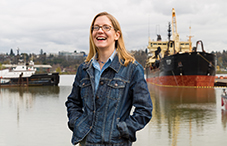

Each spring for the last two years, Erin Currie, PhD, climbed aboard the Training Ship Golden Bear, along with more than 300 engineering and navigation students attending the California Maritime Academy. During the course of the two-month journey—which takes them to such destinations as Barcelona, the Mediterranean and the Virgin Islands—the students learn how to pilot, navigate, repair and maintain a ship.
Currie was the sole mental health provider on the vessel, responsible for providing one-on-one health, academic and career counseling, as well as crisis response for students. The Monitor talked to Currie about her job, how she got it and what she does during the other 10 months a year.
What do you do on the ship?
One aspect of my job is helping students tackle difficult interpersonal dynamics that come up when living in immensely close quarters in a high-pressure academic environment. There may be as many as eight students sharing a bedroom and each of them has two months to show that they can perform adequately in this industry. One time, for example, an intense, competitive rivalry developed between two students who also shared a room.
One of the students was asked by a superior to see me after a verbal conflict erupted. We talked about strategies for managing conflict, including perspective taking and finding personal space on the ship to separate from the situation. I also reminded the student of the stakes involved: Letting this conflict interfere with academics could compromise the chances of passing the cruise.
The experience of being away from home for two months can also be difficult, especially when something stressful happens. There is no cellphone service or social media, and everyone is restricted to phone cards and limited email, so the normal support systems are not available. I've worked with students who experienced relationships ending or deaths in the family while on board. The ship is a primarily masculine environment and there is little private space or free time, which makes it difficult to deal with emotions like grief. I provide a private place, even if for a limited time, where students can express difficult emotions without worrying about social or professional consequences. We also recommend resources students can use to take care of themselves, like listening to music on an iPad, going to the gym or reading. We also talk about how to put on a professional face quickly once they are back on duty.
Do you do any teaching on the ship?
I do a training for the students about how to handle a mental health emergency at sea. I explain that if someone expresses serious intent to kill themselves, they don't have access to the police or 911 like they do on land. They need to be ready to handle this type of situation. For instance, I talk about how people in crisis can escalate when they feel like others are not listening to them. Simply asking how they are doing and hearing them out can go a long way.
How did you get the training and experience needed to get this job?
While I was earning a graduate degree in counseling psychology from the University of Utah, I did a practicum at the VA in Salt Lake City. My experience working with veterans is useful now because typically there are a number of students on the ship who are Navy veterans. Then I worked as staff psychologist at Metropolitan State University in Minnesota for five years, and I loved the variety involved in college counseling. I did individual and group therapy and a lot of outreach on campus. Then I moved to Portland, Oregon, when my partner got the job offer of a lifetime. After I moved, my former boss at Metropolitan State forwarded me the job announcement for the California Maritime Academy. She and I had shared a love for the character of the ship counselor, Deanna Troi, on "Star Trek: The Next Generation," so she thought of me when she saw the listing. It sounded like a fantastic opportunity because I was looking for work and love to travel.
What is the most difficult part of your job?
I'm living with all of my clients and colleagues, and it takes time to learn how to manage the balance between my professional self and casual, genuine self. We eat meals together, have movie nights and sometimes go on shore. The first summer, it took me the entire cruise to feel comfortable just being myself. The second summer, I really got to know my colleagues as they became more comfortable with me and vice versa.
What do you enjoy about your work at sea?
One of the things I like most is being approachable for people who might not otherwise talk to a mental health professional. People may not seek me out for counseling, but they might start a casual conversation while we are on deck watching a sunset across the water.
Once, we were going through the Panama Canal and one of the students came up to me and started talking about how exciting it was to see this. We discussed how it can be hard to be away from home, and the student shared that at one point in life significant thoughts of self-harm had surfaced. I normalized this experience and asked if the student had encountered any of those thoughts recently. The student hadn't, but wanted to continue the conversation in a counseling setting to process what had happened. During counseling, we talked about the student's past and what could be done in the future if the student got into that mental space again. We also worked on mental wellness strategies that can decrease the chances of that.
What do you do when you're not working on the ship?
I teach as an adjunct instructor at Portland State University in the psychology department and the public health education program. I also started my own consulting company, MyPsychgeek, and I help individuals with career development and businesses with team building. I've also started writing chapters for books such as "Game of Thrones Psychology," which focuses on the psychology behind the compelling characters.