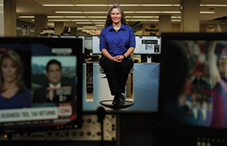

Laura Helmuth, PhD, was finishing her doctoral degree in cognitive neuroscience at the University of California, Berkeley, when she took a summer job that uncovered her knack for journalistic writing. She went on to a graduate program in science writing, and her expertise propelled her to top editorial positions at Science, Smithsonian, Slate, National Geographic and now The Washington Post.
Helmuth's training has given her an eye for the psychological component of a story, especially when she sees fear influencing public opinion.
What do you do at The Washington Post?
I help my team of 13 reporters and editors decide which stories to cover, how to cover them, and I edit their work. For example, I have a reporter who has been tracking the anti-vaccine movement, and there are psychological aspects to this belief system. President Trump and Robert F. Kennedy Jr. have spread misinformation about vaccines and claimed they are dangerous, but the movement is based in fear and conspiracy theory.
Recently, there was a measles outbreak in Minneapolis among the Somali refugee population, and I sent a reporter to a small Somali community there to talk to families affected by this. The Somali measles vaccination rate dropped from 92 percent to 42 percent in the last 10 years because the anti-vaccine movement has targeted this population. The Somalis are afraid that the MMR vaccine triggers autism, but now some of their children are in the hospital on ventilators because they have measles. I wanted to be compassionate toward victims in our coverage, rather than blaming them, so I talked to the reporter about the fact that people are not very good at evaluating risk. In this case, people are overestimating a nonexistent risk because they've probably seen kids with autism, but very few people in this country have seen anyone with the measles.
How else has your psychology background helped you?
I understand motivation, and in subtle ways this influences my ability to get good work out of people. I know it's difficult for writers to put their hearts into stories and get something back that's been carved up with red lines everywhere. This can be a traumatic process, so I always explain the things they did well, why I made a change and then invite them to improve the story.
Why did you decide to pursue journalism?
When I was in graduate school at Berkeley, I loved going to talks offered by different departments to learn about paleontology, astronomy, geology and all things science. One summer when my adviser was taking a sabbatical, I decided to take a mini-sabbatical of my own and got a job writing for a budget travel guide. I traveled to and wrote the chapters on Slovakia and the Czech Republic, and realized that writing was a lot of fun and came fairly easily to me. Later, at a Society for Neuroscience meeting, I saw people wearing press badges. I asked how they got those badges, and one of them mentioned the science journalism program at the University of California, Santa Cruz. I started sitting in on journalism classes at Berkeley, and took an excellent health reporting class. I loved it.
Toward the end of graduate school, my psychology projects were going well and I had a postdoc lined up continuing my research in cognitive neuroscience, but I decided I was more interested in being a generalist than a specialist. I enrolled in the science writing program at Santa Cruz, and after graduating I did a series of internships. As much as I enjoyed doing research, it was fine with me if someone else figured it out.
How did you come to work for the Post?
I had started a new job as an editor at National Geographic, which was a great place to work, but I got a call from The Washington Post and learned that they were looking for a science editor. It was my dream job because the publication has such a large, influential audience. Science hadn't been as much of a focus for the Post, and there was a lot of room for growth. I thought it would be a good challenge.
What is difficult about working there?
The unending race to keep up with the news. At previous jobs at Slate and Smithsonian magazines, I could be more choosy about what I covered because the pace was a bit slower, but at the Post everything is happening all the time. There are so many anti-science things going on, and we are trying to keep up and tell people what is true and not true. For example, Donald Trump has claimed that climate change is a hoax perpetrated by the Chinese, and his Environmental Protection Agency has removed its climate science information website.
What is most rewarding about your work?
It's thrilling to be at the Post because everyone here is on top of the news and it's mentally very stimulating. Sometimes as journalists we forget to enjoy our jobs because there is such a strong sense of mission. This morning, I had one of those moments when I felt like I was having influence in the world. Our story about the effects of the anti-vaccine movement among the refugees is being translated into Somali, and we hope it will be broadcast to the community of Somali immigrants in Minnesota.
Is there anything else readers should know?
As a person in the news business with a psychology background, I can say that both occupations are full of really smart, hardworking people who are not in it for the money. They have similar values about the pursuit of truth and independent thinking. We can work together, so if readers ever find out about something that an institution is doing wrong, they should consider leaking the information to me. The Post has a lot of different ways to investigate and cover things like this.
● To contact Laura Helmuth, send her an email at Laura.Helmuth@washpost.comopens in new window.