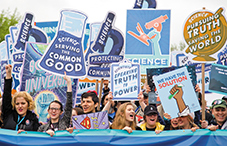

Psychologists have a long history of advocating for science and education funding and better access to mental health care. But this year, at a time when science funding—and science-based policy—is perhaps more imperiled than ever, more psychologists are making their voices heard.
The White House budget proposal for 2018, released in May, would slash $7.2 billion (21 percent) from the National Institutes of Health budget, $820 million (11 percent) from the National Science Foundation, and nearly $400 million from the Substance Abuse and Mental Health Services Administration, among many cuts that APA opposes.
Scientists are also concerned by the number of high-level science positions in the federal government that remain vacant. A June reportopens in new window in The Washington Post found that 85 percent of top science jobs at federal agencies remained unfilled (without even a nominee)—a far higher percentage than in previous administrations.
In April, more than 300 psychologists joined APA at the March for Science in Washington, D.C. Untold numbers more participated in satellite marches around the country. The march was the most visible indication of an uptick in interest in science advocacy among psychologists, according to Pat Kobor, senior science policy analyst in APA's Science Directorate. "Our members are very sensitive to the extent to which the administration is listening to scientists and basing decisions on data," Kobor says. "People are paying closer attention than they normally might."
With threats like these in mind, Cady Block, PhD, has found herself newly drawn to public advocacy. Block, a clinical neuropsychologist and assistant professor at the Ohio State University Wexner Medical Center, independently launched and ran the Twitter campaign for the Columbus, Ohio, March for Science, one of more than 100 satellite marches, which itself drew more than 5,000 participants.
Dawn Huber, PhD, an assistant clinical professor in the University of Missouri department of health psychology, helped organize members of the Missouri Psychological Association to participate in the march in Columbia, Missouri. For her, a highlight was joining with researchers from many other fields.
"People came together from really diverse places—physics, astronomy, biology," she says. "So, for me, it was a great opportunity for psychology to step up and say, ‘Hey, we're a part of this, too.'"
The challenge now, says Kobor, is to follow up on the enthusiasm generated by the march and channel it into continuing advocacy efforts.
"The march was so important for public awareness," she says. "To move the needle, you have to do the regular shoe-leather advocacy. You have to let policymakers know you pay attention and you care."
To that end, Kobor and other APA Science Directorate staff led a live and web-streamed advocacy training session before the march. APA's Office on Early Career Psychologists (ECPs) also held two advocacy training sessions over the summer with the Public Interest Directorate's Government Relations Office—a webinar in June on how to conduct visits with federal officials, and a postconvention event in August to connect interested ECPs with psychologists already involved in advocacy.
Interest in these kind of trainings is up among APA members, says Amalia Corby-Edwards, senior legislative and federal affairs officer in the Public Interest Directorate. Corby-Edwards recommends that those who want to stay abreast of the association's advocacy efforts should join the APA Federal Action Network for updates and action alerts.
Meanwhile, grassroots advocacy efforts are springing up at campuses as well. Will Adler, a graduate student in neuroscience at New York University, started a group called the Scientist Action and Advocacy Network (ScAAN) at NYU after the 2016 election. The group—mostly NYU psychology and neuroscience grad students and faculty—provides volunteer data analysis, literature reviews and other expertise for social justice groups that aim to influence policy.
"Many scientists, especially psychologists, hope that their research will have a positive impact on the world. But the process can feel slow, and sometimes scientists feel like that's someone else's job," says Adler. "We want to increase the role of scientists in policymaking directly."
In one of their first projects, ScAAN members wrote a literature review for an advocacy group that aimed to change a New York state policy that required all 16- and 17-year-olds to be tried in criminal court as adults. (The new law passed in April.)
Advocacy does not always come naturally to psychologists, says Huber—especially when it expands beyond advocating for research funding to include advocating more broadly for research-based public policy positions.
"Because of our theoretical training, psychologists can feel hesitant, or like it's inappropriate for us to publicly voice opinions in these matters. But especially in areas where we are relying on our expertise, it's really not a partisan issue," she says. "I work in pediatrics—if we can't speak up for kids, what can we speak up for?"
Psychologists are not the only ones to struggle with these issues. The march prompted a lively debateopens in new window among scientists over whether such advocacy could hurt their nonpartisan credibility with the public.
For many, though, that risk is worth taking—as scientists and citizens.
"As citizens, we all need to be engaged in our government, advocating for funding for education and health care, to solve social problems and all the other things we're involved in [through our work]," Block says. "Who better than psychologists and other scientists to be involved in the political process?"