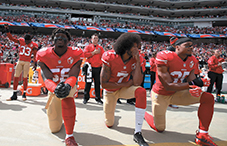

In August 2016, when San Francisco 49er Colin Kaepernick refused to stand for the national anthem to protest police brutality against people of color, he launched a pervasive, if controversial, movement. In the last year, thousands of athletes at various levels of sport—professional, semi-pro, college and high school—have joined him in kneeling during the anthem to call attention to this injustice.
Of course, Kaepernick was not the first activist athlete to use his or her platform to raise awareness of a social justice issue. Today's kneeling athletes continue the legacy of such greats as boxer Muhammed Ali and tennis star Billie Jean King.
But that activism can have consequences. Athletes may not only face public scrutiny, they may encounter backlash from their coaches and teammates, which could cost them playing time, their spot on the team or, for college athletes, their athletic scholarships. Kaepernick, for example, still hasn't been signed to any team, which some attribute to his activism.
"It's no secret that activism in the world of athletics is on the forefront of everybody's mind these days," says sport psychologist Kensa Gunter, PsyD, who is among the mental health professionals helping athletes navigate these issues.
Overall, college athletic departments have been paying more attention to athletes' mental health thanks to efforts by the National Collegiate Athletic Association (NCAA). In 2014, the NCAA published "Mind, Body and Sportopens in new window," a guide for understanding and supporting student-athlete mental wellness. In 2016, the NCAA followed up with its Inter-Association Consensus Document on Mental Health Best Practicesopens in new window. APA's Div. 47 (Society for Sport, Exercise and Performance Psychology) was one of the endorsing organizations for the consensus document.
Many teams in professional sports leagues, including the National Football League, the National Basketball Association and Major League Baseball also have mental health professionals on staff or on call to support athletes.
Helping to guide these efforts are new resourcesopens in new window on athletic activism for psychologists developed by Div. 47. These resources include a free webinar on helping athletes navigate social justice and activism, and a SportPsych Works fact sheet (Vol. 5, No. 4, 2017).
"As a division within APA dedicated to promoting ethical research and practice in sport, exercise and performance psychology, we felt it was important to state our support for athletes and other athletic stakeholders who choose to use their platforms to promote social change and also to provide educational resources that could be helpful to psychologists and the general public on how to best support them," says Div. 47 President Courtney Albinson, PhD.
To speak or not to speak?
Current events may inspire athletes to take a stand on an issue, but they're not always sure how to get involved, says Erica Tibbetts, a lecturer in exercise and sports studies at Smith College who contributed to the SportPsych Works sheet. In these cases, she helps athletes identify the aspects of their identity that they are interested in exploring, such as their race or gender, and determine the kind of activism that might be appropriate.
Not all athletes are comfortable with overt displays, such as kneeling during the national anthem. "But activism doesn't have to be grandiose," says Stephany C. Coakley, a Washington, D.C.-based certified mental performance consultant and co-presenter of a Div. 47 webinar on athletes and activism. "You can do it little by little: Write a letter, have a conversation or support someone who is affected by social injustice."
When athletes do speak out and aren't supported by teammates or coaches, the athletes may become frustrated and withdrawn, says Coakley. "Facing backlash reinforces that they can't be their true selves."
Tibbetts points out that backlash can also lead to detriments in athletic motivation and performance, as well as satisfaction. To cope with such backlash, she recommends that athletes connect with others who share their values, and who are engaging in similar types of activism as a way of bolstering their motivation.
In her work with teams, Tibbetts tries to head off conflicts by encouraging administrators and coaching staffs to facilitate conversations among players about team values and player activism. "Having a conversation about it can help the team come to a place where not everyone has to agree, but at least they are able to respect each other's choices," she says. Such conversations can pre-empt disagreements, and may also help players determine the possible consequences of their activism.
But while certain consequences may be expected—fans speaking out on social media, or teammates disagreeing—others can be a surprise. For instance, a student athlete in a small town may not predict that his or her principal or mayor would speak—either for or against—his or her activism. Even Kaepernick, who accepted the 2017 Sports Illustrated Muhammad Ali Legacy Award for his activism, could not have predicted how big his kneeling movement would become, says Coakley, so it's important for mental health professionals to do regular check-ins with athletes during individual sessions or group meetings to see how they feel about the aftermath of their activism. "You can ask, ‘Is this feeling like it's too much? Does it feel comfortable?'" Coakley says.
She always advises clients to do whatever makes them more comfortable, even if that involves pulling away from activism. Just having someone to talk through the options is key to helping athletes feel supported, and Coakley implores athletes and the teams that support them to ensure athletes have access to mental health services. "Activism sometimes can be a lonely place, and athletes shouldn't feel as though they need to deal with it alone," she says.