


- About 18 percent of U.S. adults1—an estimated 44.7 million individuals—reported having a mental disorder in the past year.
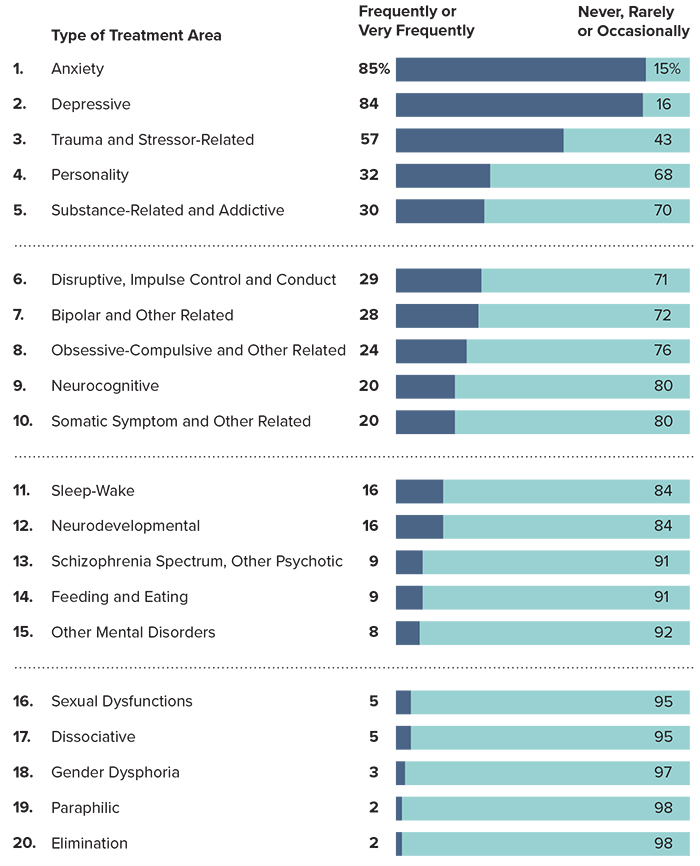
- Some are more common than others: About 85 percent of licensed psychologists reported that they frequently or very frequently provided services to patients/clients with anxiety disorders, and 84 percent frequently or very frequently provided services to patients/clients with depressive disorders.2,3,4 Trauma and stressor-related disorders (57 percent) rounded out the top three treatment areas.
- The three least frequently reported treatment areas were gender dysphoria (3 percent), elimination disorders (2 percent) and paraphilic disorders (2 percent).
Top mental disorder treatment areas
By Karen Stamm, PhD, Luona Lin, MPP, and Peggy Christidis, PhD
For more information, contact APA's Center for Workforce Studies at cws@apa.org.
1 Substance Abuse and Mental Health Services Administration. (2017). Key substance use and mental health indicators in the United States: Results from the 2016 National Survey on Drug Use and Health (HHS Publication No. SMA 17-5044, NSDUH Series H-52). Rockville, MD: Author. Retrieved from www.samhsa.gov/data/sites/default/files/NSDUH-FFR1-2016/NSDUH-FFR1-2016.htmopens in new window
2 American Psychological Association. (2016). 2015 APA Survey of Psychology Health Service Providers . Washington, DC: Author. Retrieved from www.apa.org/workforce/publications/15-health-service-providers
3 American Psychiatric Association. (2013). Diagnostic and statistical manual of mental disorders (5th ed.). Arlington, VA: Author.
4 The survey included treatment areas corresponding to DSM-5’s 20 disorder chapters (not all treatment areas are presented in this summary). In addition, the survey covered services provided to patients/clients with (a) medication-induced movement disorders/other adverse effects of medication, (b) other conditions that may be a focus of clinical attention (V codes) and (c) no mental or physical health diagnoses. Results referred to frequency of providing services in a treatment area in a typical week and included all practice settings. See reference 2 for more information.