
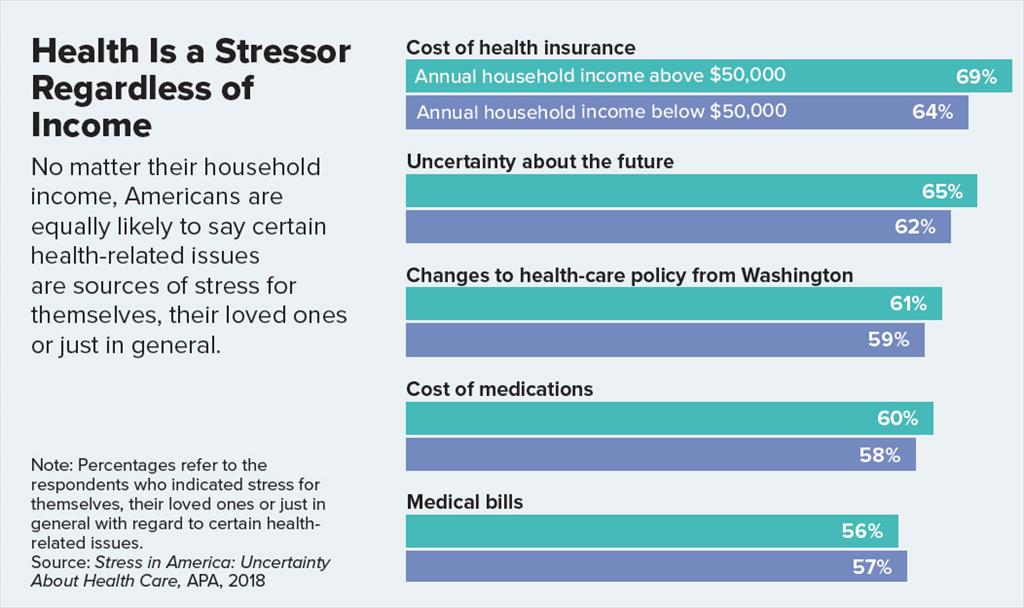
When asked about specific health issues that cause them stress, two-thirds of U.S. adults cite the cost of health insurance as a stressor for themselves, their loved ones or in general. This stress about the cost of health insurance seems to affect Americans at all income levels.
In addition, more than six in 10 adults (63 percent) cite uncertainty about the future in regard to their own health and that of others, as a source of stress.
Insurance costs and uncertainty about the future are just two of the numerous causes of stress surrounding health, according to the APA report Stress in America: Uncertainty About Health Care, based on survey data collected online by The Harris Poll. The report takes a deeper look at how health and health care are affecting the stress levels of Americans. Sixty percent of American adults say personal health concerns or health problems affecting their families are a very or somewhat significant source of stress. Sixty-four percent of those with less than $50,000 in annual household income cite health insurance costs as a source of stress for themselves, their loved ones or in general. However, 69 percent of Americans with annual household incomes of $50,000 or more also report stress from the cost of health insurance.
 The survey also found that uninsured adults report a significantly higher average stress level of 5.6 (on a 10-point scale, where 1 is "little or no stress" and 10 is "a great deal of stress") than adults who have health insurance (4.7).
"Given the uncertain fate of our nation’s health-care system, it is not surprising that the majority of those adults surveyed expressed concerns about access to health care and costs," says Arthur C. Evans Jr., PhD, APA’s chief executive officer. "If stress becomes chronic, it can lead to significant health consequences."
The survey also found a divide in the average stress levels among Americans living in urban, suburban and rural areas. More Americans in urban areas are stressed about the cost of health insurance for themselves, their loved ones or others in general (74 percent) than those in suburban (62 percent) and rural (64 percent) areas.
When it comes to stress regarding specific health-care issues, age is another factor where differences appear. A lack of access to mental health care is more likely to be a source of stress for millennials (56 percent) and Gen Xers (47 percent) than for baby boomers (27 percent) and adults 72 and older (20 percent). Reproductive health care access is another area where this divide is most evident, with the issue stressing millennials (55 percent) and Gen Xers (43 percent) more than baby boomers (25 percent) and older adults (14 percent).
Race and ethnicity also play a role in concerns about health care. Nearly two-thirds of Hispanic adults (64 percent) say they experience stress when thinking about themselves, their loved ones or people in general losing access to health-care services. In comparison, this issue was less likely to concern members of other racial and ethnic groups, though it was still reported as stressful by about half of respondents (i.e., 56 percent of Asian Americans, 51 percent of black Americans, 50 percent of Native Americans and 49 percent of white Americans).
To read the full Stress in America report, go to www.apa.org/news/press/releases/stress/2017/uncertainty-health-care.pdfopens in new window.
For additional information on stress, lifestyle and behaviors, visit the Psychology Help Center. Join the conversation about stress on Twitter by following @APAHelpCenter and #stressAPA.