skip to main content

Datapoint

APA Style leaf logo Cite This Article in APA Style
American Psychological Association. (2018, May 1). Datapoint: What jobs do psychology holders have? Monitor on Psychology, 49(5). https://www.apa.org/monitor/2018/05/datapoint

  • In 2015, 2.7 million people in the United States held a psychology degree as their highest degree.1
  • Among those with a doctorate/professional degree in psychology, the most common self-reported occupations were psychologists (41 percent), psychology post­secondary teachers (9 percent) and top-level managers, executives and administrators (4 percent).2
  • About 96 percent of psychology doctorate/professional degree holders and about 87 percent of psychology master’s degree holders worked in psychology-related jobs.3 These psychology degree holders engaged in a variety of work activities, including professional service, teaching, research, management, and sales and marketing.4
  • Psychology bachelor’s degree holders worked in a wide variety of jobs, including administration, management and marketing.
Top Occupations Among Psychology Doctorate/Professional Degree Holders, 2015

Top Occupations Among Psychology Doctorate/Professional Degree Holders, 2015

Work Activity for Psychology Doctorate/Professional Degree Holders, 2015
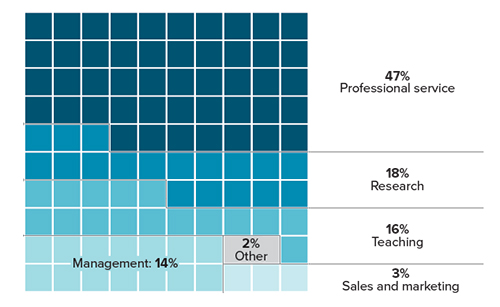
Work Activity for Psychology Doctorate/Professional Degree Holders, 2015

By Luona Lin, MPP, Karen Stamm, PhD, and Peggy Christidis, PhD

For an interactive version of this "Datapoint," including word clouds for psychology bachelor’s and master’s degree holders, visit the CWS Data Tool at www.apa.org/workforce/data-tools/careers-psychology. For more information, contact cws@apa.org.
Footnotes

1 National Science Foundation, National Center for Science and Engineering Statistics. (2015). National Survey of College Graduates Public Use Microdata File and Codebook . Retrieved from https://sestat.nsf.gov/datadownload/opens in new window . Approximately 1.8 million held a bachelor’s degree as the highest degree, 604,200 held a psychology master's degree as the highest degree, and 207,100 held a psychology doctorate/professional degree as the highest degree. These numbers are weighted estimates.

2 Occupations were based on principal jobs (jobs spent most hours during a typical work week). For a full list of occupations, refer to https://www.nsf.gov/statistics/nsf13302/pdf/tabb2.pdfopens in new window . For data underlying the table, refer to https://www.apa.org/workforce/data-tools/careers-psychology.pdfopens in new window .

3 Respondents were asked the extent their principal jobs were related to their highest degree: closely related, somewhat related, or not related. Psychology degree holders who reported "closely related" and "somewhat related" were coded as working in psychology-related jobs. Differences in relatedness of degree to job across levels of highest psychology degree are statistically significant at p<.001. Across all science and engineering fields, 74% bachelor's degree holders, 88% master's degree holders, and 96% doctorate/professional degree holders reported that their principle jobs are related to their highest degree.

4 Work activity was based on the activity on which the individual spent the most hours in their principal job. Research included applied research, basic research, design, and development. Other work activities included computer applications, production, quality management and work activities not otherwise specified.

Recommended Reading

Letters to the Editor