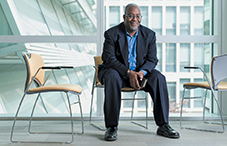

In a way, Jovier Evans, PhD, is a gatekeeper. As program chief of the Neuroscience of Mental Disorders and Aging Program at the National Institute of Mental Health (NIMH), Evans manages a portfolio of $25 million distributed among about 45 studies. Not only does Evans advise researchers on how to make their grant applications stronger, he recommends which should receive funding.
The Monitor talked to Evans about how he secured his job and his role in carrying out the organization’s mission of finding cures for mental illnesses.
What experience led you to this field?
When I started college, I was planning to pursue a career in medicine, but I was most interested in classes that focused on the brain and behavior. Then I discovered health psychology, which combined my interests in psychology and physical health. After studying clinical health psychology as a doctoral student at the University of Miami, I secured a clinical neuropsychology and geriatric mental health fellowship at the University of California San Diego. I really enjoyed assessing patients because it made me feel like a detective: I was trying to understand what was going on cognitively and behaviorally with patients who were dealing with conditions such as dementia, psychosis and head injuries.
After finishing the postdoctoral fellowship, I accepted a faculty position at Indiana University–Purdue University Indianapolis (IUPUI) that allowed me to conduct research in clinical neuropsychology and mentor undergraduate and graduate students. During my fellowship, I got to know Dr. Barry Lebowitz, the NIMH branch chief for adult and geriatric interventions, who was the NIMH program officer for the training grant that funded my work. He would come to site visits to meet with trainees and attend grant and research writing workshops. Through that experience, I became familiar with the role of NIMH staff.
After I had been on the faculty at IUPUI for five years, I ran into Barry at an NIMH workshop on funding opportunities. He was familiar with my neuropsychological research that showed cognitive measures could predict functional capacity in older adults with mental illness. I think he also saw that I was open and approachable to investigators and interested in helping researchers in their work. Barry encouraged me to apply for my current position.
Why did you decide to take the position?
I was intrigued because I was going up for tenure and it was a good time to think about career options. Working for the NIMH would give me an opportunity to learn more about the broader field of mental health and illness research, rather than becoming an expert focused on my narrow area of work. I was also interested in exploring the other side of the grant process. I took a two-year leave from my faculty role to try the job at the NIMH in 2004, and within a year I knew it was what I wanted to do longer term.
What is a typical day like for you?
An important part of my job is talking to investigators early in the application process. We discuss which review group would be the best fit for evaluating a proposal, and whether they should submit an application at all. More than 3,000 applications are submitted to the NIMH each year, and they are evaluated on factors such as public health significance, innovation and impact on the field. I listen to the grant reviews and give input to the senior leaders in our division and to the NIMH director about which proposals to fund.
Once a grant is awarded, I check on the progress to make sure it’s going well. I also spend a lot of time writing annual reports to Congress through the Department of Health and Human Services that describe current research efforts in different areas of science and any notable findings from the work.
What is the best part of your job?
I love talking to potential applicants about their work and helping them craft proposals that will be competitive. This gives me an opportunity to meet new, young investigators and to learn about areas of research that are outside of my expertise. It’s exciting to see studies that are exploring new neuroimaging methods for older adults and markers of accelerated or delayed brain aging that affect cognition, mood and function.
What is the least enjoyable part?
It’s difficult when I have to tell people their proposal didn’t do well in the grant review, or that we will not be able to accept an application because it doesn’t fit our funding priorities. I think people don’t always realize that Congress has a lot of influence over what we do, such as how much budget we have and where it is directed. This is a government job, so there are layers of bureaucracy.
What is unique about your job?
It feels like a privilege to be the one who gets to congratulate applicants who have been selected to receive grants, and often they go on to become very successful researchers. The collaborative care approach in primary care grew out of research that we supported in older adults. Other studies have led to new treatment approaches for older adults with depression. I love seeing the work we support lead to improvements in public health that affect people throughout the country.