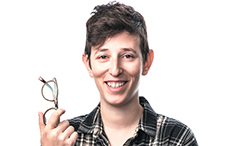

What happens when our internal and external worlds collide? That is the question that drives Diana Tamir, PhD, head of the Princeton Social Neuroscience Lab at Princeton University. Human experience exists at the intersection of two worlds, Tamir says. There’s our internal mental life, complete with our private thoughts, feelings and beliefs, and our external social world, brimming with other people. Tamir spoke to the Monitor about what goes on in the space between.
People like to talk about themselves. Why does that interest you as a researcher of social cognition?
Self-disclosure is a great confluence of the self and the social world. You’re revealing something about your internal self, but disclosing that information to other people. We find both the self and social aspects of self-disclosure are so rewarding that people will even forgo reward money for the opportunity to do it (PNASopens in new window, Vol. 109, No. 21, 2012). You can see that dual desire driving a lot of our actions in everyday life, and on the internet and social media.
You also study how we make sense of other people.
Yes. Often researchers who are interested in social cognition will look at how people respond to others in a particular moment—inferring somebody else’s thoughts from their facial expressions or making inferences about their behavior based on stereotypes. Making inferences in the moment is hugely important. However, I think that the biggest challenge people face in the social world is making predictions about others’ future thoughts, feelings and actions.
A lot of my lab’s work is trying to figure out what sort of information we use to predict what another person is going to feel or do next. In work with Mark Thornton, we’ve shown that people have really accurate models about the emotional transitions people are likely to make. So, if I know you’re feeling grouchy right now, I have a good shot at correctly predicting that you’re likely to feel gloomy or tense later, and not as likely to feel calm or pleased (PNASopens in new window, Vol. 114, No. 23, 2017).
My graduate student Zidong Zhao has recently tested people in dyads, asking them how their friends will feel in a particular moment. We’ve found that the longer you know a person, the better you are at predicting the emotional states they’re likely to experience.
You also study our ability to dream up imaginary worlds. What’s special about this skill?
The ability to imagine is probably one of the coolest things humans have in their mental toolbox. We can imagine hypothetical scenarios; we can plan for the future; we can think about other people’s minds. The catchall term for this is simulation. I’m interested in figuring out the cognitive processes that allow people to project themselves into that infinite landscape of thought.
There may be benefits to simulation. I’ve done some work with Adam Waytz, PhD, at Northwestern University and Hal Hershfield, PhD, at the University of California, Los Angeles, which shows that people who are more successful at thinking outside the here and now have a greater sense of meaning in life (Journal of Personality and Social Psychologyopens in new window, Vol. 108, No. 2, 2015).
There might also be implications for empathy. People often have an empathy gap—they are willing to evoke empathy for in-group members and people they are close to, but they fail to be able to do so for out-group members. If we can improve people’s ability to simulate the experience of others, then we might be able to expand the circle of people that they are willing to feel empathy for—and hopefully act to alleviate suffering.
How are you studying simulation?
In collaboration with Meghan Meyer, PhD, at Dartmouth College, we are studying people who excel at simulation to see what they are able to do that us normal folks aren’t able to do. We identified people who we thought would be particularly good at simulation, such as writers and actors, who create new worlds or embody new people for a living. We recruited both average people and those who have had objective success in creative fields and tested them on creativity measures. We also ran them through a series of simulation tests in the fMRI scanner, asking them to imagine simple scenarios, such as browsing a bookstore or sitting on a plane waiting to take off, either nearby (such as tomorrow, in New York City) or far away (100 years from now, or in Japan). Most people can think easily about tomorrow, but it’s much harder to think about 100 years from now. We’re finding that creativity is specifically associated with the ability to vividly imagine distant times, places, perspectives and hypothetical realities and that creative experts are able to engage differential neural resources to do so.
For those of us who aren’t actors or novelists, can we get better at simulation?
Yes. I’m interested in finding ways to enhance this ability. I don’t think we’ve found one method that works really well just yet. Reading is a top contender. In a recent meta-analysis, David Dodell-Feder, PhD, now at the University of Rochester, and I found that compared to reading nonfiction or not reading at all, reading fiction leads to a small but statistically significant improvement in social cognitive performance (Journal of Experimental Psychology: General, in press). And in a neuroimaging study we found evidence that reading recruits different subnetworks in the brain depending on whether people are engaging in simulation of physical scenes or of other people’s minds (Social Cognitive and Affective Neuroscienceopens in new window, Vol. 11, No. 2, 2016).
Our analysis suggests that simulating social content, in particular, is the more likely route by which fiction could enhance readers’ social cognition.
Overall this work tries to tie together multiple levels of analysis of social cognition, from the basic social rewards that drive people to interact to the cognitive and neural mechanisms that equip us to do so—and to do so successfully.