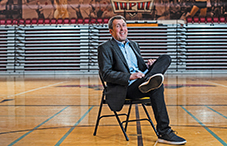

Tom Paskus, PhD, gathers and analyzes data that shed light on the health, well-being and academic progress of student athletes. As principal research scientist at the National Collegiate Athletic Association (NCAA) headquarters in Indianapolis, Paskus and his team of 17 researchers produce this information for the college leaders who craft policies for the nation’s high school and college athletes.
In one recent effort, research by Paskus’s team led to changes that seek to ease stress on student athletes: The team found that college athletes were significantly troubled by the increasing scholastic and athletic demands on their time. In response, colleges created new policiesopens in new window that require coaches to give athletes more time off to visit their families and added flexibility during the season to enable athletes to devote more attention to academics and other activities.
“I enjoy using my quantitative skills to improve the lives of student athletes because a good college experience can set a positive lifelong trajectory,” says Paskus, who was the first person in his family to earn a college degree. “I would never have had the opportunity to-go to college if not for the doors cross-country and track opened for me.”
The Monitor asked Paskus about his job and how he became interested in quantitative psychology.
What does your job entail?
Each year, the NCAA gets high school and college transcripts from more than 100,000 athletes and tens of thousands of survey responses about student well-being. Colleges in the NCAA are required to submit athlete academic data each term, and prospective NCAA students in high school must submit information about their classes, GPA and test scores before they can be certified with the NCAA.
My job is to analyze that data and translate it for college presidents, athletic directors, coaches, faculty and student athletes. I love analyzing this information and sharing the findings, which can open a national dialogue in a matter of weeks or months that leads to policy changes.
For example, our data are now showing that the eligibility rules for athletes who have transferred from one college to another need to be reviewed. Currently, athletes in certain sports are required to sit out a year before they can compete at their new schools. That requirement was created to give transfer students time to adjust to the school while maintaining their academic standing. But we are finding that certain high academic achievers may not need to sit out for a year, so we recommended that NCAA members study our research on transfers for their discussions on whether these students should participate in sports right away.
We’ve also done research related to whether athletes are more susceptible to high-risk behaviors such as binge drinking. Despite prohibitions on substance use in practice and games, almost half of all college ice hockey and baseball players use spit tobacco, which is a huge health risk. We’ve also found that student athletes in certain sports, such as gymnastics, are overusing prescription painkillers. We’re using the data to try and educate coaches and administrators in those sports about the problem.
What are some of the challenges you face?
There are a lot of passionate debates in college athletics, and it can be challenging to conduct research in such circumstances. For example, one debate is over whether athletes are getting preferential academic treatment on campus. Some argue that advising systems try to keep athletes eligible with methods like steering them to certain majors, but then they fail to graduate. The other side argues that higher percentages of student athletes are first-generation college students who are more likely to come from disadvantaged backgrounds, and they graduate at higher levels than nonathletes with similar backgrounds.
Another challenge we face is reporting data on social media. We can post the results on Twitter or other forms of social media, which is mostly fun because we get to interact directly with coaches, students and parents who would not normally be exposed to the data. But at the same time, this opens the door for inaccurate depictions of the data, or even questions about NCAA staff integrity.
What experience led you to this field?
I majored in psychology at Dartmouth College, and after graduating I started doing full-time research on schizophrenia with a local center in New Hampshire that was studying mental illness. I was drawn to Jack McArdle’s work at the University of Virginia because his projects involved longitudinal data analysis with practical applications, including one about how cognitive processes change as people age. Before I committed to Virginia, McArdle invited me to spend an evening learning more about his work, and I saw that he was analyzing high school and college transcript data from the NCAA to determine which academic variables best predicted college graduation among student athletes. At the time, the NCAA required high school athletes to score above a certain minimum on the SAT or ACT, but McArdle’s work suggested that students with poor test scores could still succeed in college when their grades were high enough. This research eventually led to the sliding scale that is now used by the NCAA that allows higher grades to compensate for lower test scores, and vice versa. I liked how these data were being used to help athletes in practical ways, and I decided to enroll in the doctoral program at the University of Virginia.
McArdle invited me to join several NCAA research projects focused on developing methods to study how data on athletes’ social experiences, grades and courses could be used to predict whether they graduated from college.
After completing my doctorate, I continued working with the NCAA as a postdoc. I started exploring how a broader range of factors could predict graduation from college, such as reading and math skills, substance use and an athlete’s social experience on campus. Two years later, I decided to try academic life as a faculty member at the University of Denver and taught graduate-level statistics courses and introduction to research design through the school’s College of Education, but I continued consulting for the NCAA on similar projects.
After five years, as I was compiling my materials for tenure review, the NCAA approached me about the research director position. I wrestled with whether I should leave before going for tenure, but I couldn’t pass up the opportunity to manage some really exciting national projects. In 2005, I started working for the NCAA.
What characteristics does a psychologist need to do the work you do?
Perhaps surprisingly, a love for athletics isn’t necessary for this job. We’re looking for people with strong analytic and communication skills. Many people don’t realize our research staff’s level of technical expertise, and I think university faculty and administrators are often surprised when they go to an NCAA committee meeting and hear about our work.
Our data are also relevant for college testing organizations and admissions offices that are trying to understand the predictors of college retention. For example, I’ve shared findings about which core high school courses lay the foundation for academic success in college.
We’re also collaborating with the College Board and ACT to review their latest concordance study, which is used by every college admissions office and high school in the country to provide the best estimated comparison between the SAT and ACT in the admissions process. I enjoy making a contribution to educational questions that go beyond those related to student athletes.