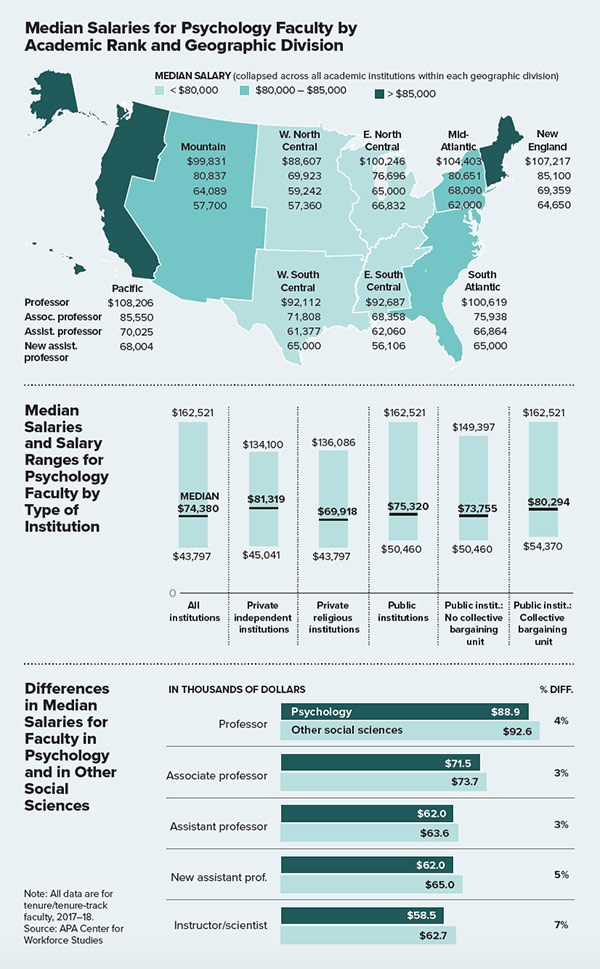
Tenured psychology professors in the United States earned a median salary of $88,977 during the 2017–18 school year, according to the most recent psychology faculty salary report from APA's Center for Workforce Studies (CWS).
The report is based on data from a College and University Professional Association for Human Resources (CUPA-HR) survey of 238,698 full-time faculty at 696 U.S. colleges and universities.
Tenure-track associate professors earned $71,586, tenure-track assistant professors earned $62,031 and tenure-track instructors earned $58,509. Among non-tenure-track full-time faculty, salary medians ranged from $75,940 for professors to $50,652 for instructors.
That's less than professors in most other STEM and social science disciplines, and the numbers haven't budged much in recent years, according to lead author Peggy Christidis, PhD, a senior research officer in the CWS. "The report provides a valuable and comprehensive resource for individuals in a myriad of work settings and career stages," says Jim Diaz-Granados, PhD, executive director of APA's Education Directorate.
This year's psychology faculty salary report found that:
- Salaries mostly stayed put. Median salaries did not increase much between 2016–17 and 2017–18. In fact, salaries didn't even keep up with inflation in some categories. For example, faculty at baccalaureate institutions that award only undergraduate degrees saw inflation-adjusted pay decreases, on average, of between 2 percent and 3.7 percent depending on their academic rank.
- Geography matters. Faculty in the Pacific region (Alaska, California, Hawai'i, Oregon and Washington) earned the highest median salaries. Faculty in the West South Central region (Arkansas, Louisiana, Oklahoma and Texas) and West North Central region (Iowa, Kansas, Minnesota, Missouri, Nebraska, North Dakota and South Dakota) earned the least (see map).
- Collective bargaining gets results. Tenured and tenure-track faculty who work at public institutions with collective bargaining units, or unions, earned almost 9 percent more on average than those at public institutions without collective bargaining units. The difference was even greater for faculty without tenure: Non-tenured faculty earned almost 15 percent more at schools with unions.
- Private independent schools pay more. Across all academic ranks, private independent colleges and universities paid higher salaries than public colleges and universities or private religious ones. For example, tenured professors at private independent institutions earned a median salary of $98,637. Those at public institutions earned $88,906 and those at private religious ones earned $84,827.
- On average, psychology faculty earn less than their peers in other social science and STEM fields. Psychology faculty generally earned less than faculty in other social sciences (a group that includes political science, economics, sociology, anthropology and geography). Depending on their type of institution and academic rank, psychology faculty earned between 0.3 and 11.1 percent less than their social sciences peers. Psychology faculty also earned less on average than faculty in other STEM fields such as engineering, computer science, biological and biomedical sciences, and physical sciences, but more than professors of education.
- For women and minorities, there has been progress in some areas but not others. During the 2017–18 school year there were more women than men among psychology faculty early on the career ladder—62 percent of tenured/tenure-track assistant professors and 55 percent of associate professors were female. However, men still outnumbered women 56 to 44 percent among full professors. At all academic ranks, tenured/tenure-track women earned just slightly less than men. Female full professors earned a median of $88,848 compared with $90,934 for men, female associate professors earned $70,908 compared with $73,188 for men and female assistant professors earned $62,004 compared with $62,671 for men.
Meanwhile, racial- and ethnic-minority faculty remained underrepresented in psychology departments, particularly higher on the career ladder. Just 17 percent of tenured/tenure-track associate professors and 11 percent of full professors were racial or ethnic minorities, even though these groups make up almost 40 percent of the U.S. population. However, racial- and ethnic-minority faculty earned slightly more on average than their white peers—between 4 and 8 percent more depending on academic rank.
To read the full report , go to www.apa.org/workforce/publications/18-faculty-salary .