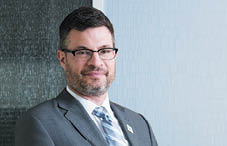

Veterans account for 14.3 percent of all deaths by suicide among U.S. adults, yet they represent only 8.3 percent of the population. Among the people committed to reducing those numbers is Matt Miller, PhD, who has served as director of the U.S. Department of Veterans Affairs Veterans Crisis Lineopens in new window since July 2017.
Launched in 2007, the service has more than 500 phone responders, who to date have answered over 3.5 million calls and sent emergency services to more than 93,000 people. The Crisis Line expanded to add an anonymous chat service in 2009 and text messaging in 2011.
The Monitor talked to Miller about how he got the job.
How did you first get interested in psychology?
As an undergraduate I studied psychology and business administration at Michigan State University.
I had taken an introductory psychology class as a freshman and found it interesting, so when I had to select a major, I thought, "Why not start here?" I then went on to complete a master's and a PhD in counseling psychology, also at Michigan State. I was interested in vocational theory, vocational development and what leads to occupational satisfaction.
In 2001, as my PhD was coming to a conclusion, I chose to pursue an internship with the U.S. Air Force.
What was it like to move from university life to the Air Force?
It was exciting! That year exposed me to a variety of roles associated with being a professional and licensed clinical psychologist. I had rotations in health psychology, neuropsychology, in the emergency room and performing assessments within the ER setting, as well as in outpatient mental health and what's now known as primary-care mental health integration.
How long did you stay in the Air Force?
After the internship, I owed the military three years and was given a list of possible bases and installations, ranging from large military treatment facilities to very small installations with just a clinic.
A few weeks later, I was sent to Vance Air Force Base in Enid, Oklahoma, where I would be the only psychologist and in charge of mental health for the whole base. I could not have had a better assignment from a career perspective. The base is a joint services undergraduate pilot training base, and I led mental health services for active-duty service members and their families. I headed suicide prevention, family advocacy, substance use treatment and critical-incident response services. That's really where I got my first taste of the integration of business and management skills and practices with the provision of psychology. I learned about managing access to care, about productivity and about managing staff. I thoroughly enjoyed the experience.
After those three years, why did you choose to leave the military?
During my last year, a friend and colleague had died by suicide and I found that I needed to step away and reflect. So, I did that for a few years. I worked in a variety of roles, including working in a group practice setting in psychology.
Then one day in 2011 I was watching the news and heard about the issues that the Department of Veterans Affairs [VA] was facing with veteran suicide and I was compelled to rejoin the mission and assist in any way possible. I hopped onto USAJOBSopens in new window [the federal government job site] and looked for leadership positions in mental health in the VA. I applied for a position as chief of mental health at the VA in Saginaw, Michigan, and was selected.
What was it like to be back in a military setting?
It was wonderful to feel I was contributing to the mission overall. During my second year in Saginaw, the central office of mental health operations started running site visits to different VA locations to help with adherence to what was called the mental health handbook. They would send a team of four people to every VA site and perform a consultative visit, going over the handbook and helping sites to explore what they were doing well and maybe points of improvement.
I volunteered to go on one visit and ended up enjoying it so much I did numerous visits.
From 2014 to 2016 I was also studying for—and was awarded—a master's in public health at the University of Michigan. Meanwhile, I was asked by the acting director if I would be interested in applying for the role of deputy chief of staff at Saginaw. I saw that as a good challenge, and mission-oriented, and so I applied for and stepped into that role.
In 2017 you became director of the VA Crisis Line. How did you get that job?
I was directed to my current role by friends and colleagues in the VA who encouraged me to consider applying for the position. I researched the role and the history of the Crisis Line and decided that it represented an incredible opportunity to meaningfully contribute to suicide prevention in the VA. With my background in the military and experience of the impact of suicide I knew how important the Crisis Line is to veterans, and that my skills and background could help to improve the service.
After submitting my application materials via USAJOBS, I engaged in two levels of interviews. Interview questions focused on experience in leading people, in leading change, risk-management best practices, business acumen within the context of clinical operations, public health perspectives applied to clinical care, and public affairs and communication. This is a management role, but there is a strong overlap between management and psychology. It's really important to understand principles within our field, principles of evidence-based psychology, principles and concepts of change, how people change and how to facilitate that change. Then you need to integrate all that into management principles and philosophy and a broader understanding of the dynamics within health care.
I'm proud to say that this is the nation's largest integrated suicide prevention program and a key source of support and referrals to additional resources.
Contact the Veterans Crisis Line at www.veteranscrisisline.netopens in new window or (800) 273-8255, press 1.