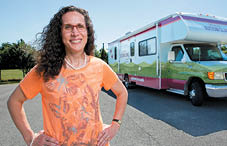

When psychologist Angela Scarpa, PhD, learned in 2003 that her 23-month-old son had autism, she sought out the best care possible. But finding it wasn't easy: She had to drive several hours from her home in Blacksburg, Virginia, for an evaluation by an autism specialist in Charlottesville, and the nearest evidence-based treatment center was more than an hour away.
That experience led her to develop a creative solution to help other families with similar needs: She transformed a recreational vehicle into a traveling treatment facility for kids with autism and their families. Launched in June, the mobile unit builds on the work of Scarpa's existing brick-and-mortar facilities: an autism clinic and research center opened, respectively, in 2005 and 2012 at the Virginia Polytechnic Institute and State University (Virginia Tech). The traveling clinic has held two open houses and is now providing services to several families in rural Virginia.
"My journey with my son has inspired me to reach out to the families who are going through this same experience and find a way to help," says Scarpa, an associate professor of psychology at Virginia Tech.
Scarpa is among a number of psychologists and other mental health professionals who are deploying mobile units to address the mental health needs of people in geographically isolated areas by taking treatment straight to those they serve. The need is large: Americans in rural areas may have to travel up to several hours for mental health services, with the result that many mental and behavioral health issues go undiagnosed and untreated. In 2014, the U.S. Department of Health and Human Services reported that underserved areas were short by 4,000 mental health professionals (The American Journal of Psychiatry Residents' Journalopens in new window, Vol. 11, No. 10, 2017).
Besides children with autism, other populations benefiting from these services include migrant agricultural workers and combat veterans and their families, who often have trouble accessing care due to lack of transportation, health insurance or both. Below are some examples of what goes into funding, launching and running these traveling treatment units.
Empowering families
The Mobile Autism Clinic, Virginia Tech
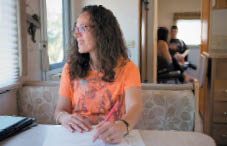 Scarpa's form of treatment transportation is a 2004 Winnebago Spirit RV, which she purchased in 2016 thanks to a $99,784 grant from the Malone Family Foundation, a Colorado-based nonprofit focused on education and medical research. The money enabled her to transform the vehicle into what she calls the Mobile Autism Clinicopens in new window, or MAC, a full-fledged treatment facility with a waiting area and treatment room, along with a bathroom and kitchenette. Under Scarpa's supervision, three clinical psychology PhD students from Virginia Tech administer services—including social skills, language development and behavior management—to patients and their families. In addition, the MAC's rural outreach coordinator, Jennifer Scott, MPH, connects with communities in rural southwest Virginia.
To better serve families in the area, Scarpa's team conducts research through a series of focus groups with local parents and health-care providers, assessing the availability of services, the feasibility of incorporating technology into treatment plans and any barriers to providing care. For example, the researchers ask parents what type of training is most important for their children and which delivery format they prefer (face-to-face, electronic or both). The team also asks providers about the needs of each community, such as the age range of local children with autism and how frequently treatment sessions should be held.
The MAC makes weekly visits to communities in rural southwest Virginia and hopes to provide about 20 hours of autism services each month. Services offered include evidence-based behavioral and cognitive interventions for autism—such as pivotal response treatment, a type of applied behavior analysis that aims to improve communication and social skills—and a stress- and-anger-management program that teaches emotion-regulation skills to young children with the condition. Scarpa will continue to use a combination of these and other methodologies depending on what the focus groups reveal about specific needs of families in the area.
The ongoing research, funded by a $19,686 grant from Virginia Tech's Policy Strategic Growth Area stakeholders group, aims to find ways to modify traditional autism interventions for the target population and to use technology to improve access to autism services. Scarpa has partnered with Virginia Tech colleagues in the departments of public policy and computer science to devise technological, or "telehealth," solutions that could enable the MAC to reach even more patients in remote areas.
MAC staff members also track outcomes such as parents' knowledge of how the interventions work and their efficacy at home.
"A big part of what we do is thinking about family resilience and empowerment," says Scarpa, adding that research shows the most effective interventions are those that actively involve caregivers and are used daily. "We want to leave parents with the skills they need so that they can continue the work with their children, even when we're not around."
Serving farmworkers
Maine Mobile Health Program
Originally an offshoot of a traditional brick-and-mortar clinic based in Augusta, the Maine Mobile Health Programopens in new window, or MMHP, now operates solely from four mobile units, providing both medical and behavioral health services to the state's thousands of migrant and seasonal farmworkers. The clinic opened more than 20 years ago, and in 2004 it became a self-sufficient federally qualified health center and transitioned to exclusively offering mobile services.
"Because we work with such a dispersed population and the harvests are so far apart from each other, mobile health is the logical solution," says Lisa Tapert, MPH, executive director of MMHP.
A typical patient may have traveled with his or her family from Mexico, Honduras or Haiti to Maine to harvest blueberries, broccoli or Christmas trees. He or she usually lacks health insurance, transportation and English fluency. Tapert says these workers are key contributors to both the state and U.S. economy and require access to reliable health care.
The four RVs reach up to 40 patients each day, traveling hundreds of miles across the state. One to two clinicians and one behavioral health provider—a bilingual clinical psychologist or social worker—staff each unit. Every patient is screened for depression and substance use, and those who test positive are referred for services in Creole, Spanish or English. In 2017, about 7 percent of patients received behavioral health treatment, primarily for depression or anxiety.
"For us, the follow-up care that happens after the initial visit is critical," says Tapert, adding that this often involves multiple sessions—either in the RV or off-site with a specialist—and a combination of face-to-face and phone contact. "It's not enough to do a screening or a test. Each patient becomes part of our health center population and we're responsible for helping them get additional care that they might need."
The majority of funding for the clinic comes from federal community health center grants, which support federally qualified centers that provide care for low-income populations across the country. Some patients have health insurance, allowing MMHP to bill for reimbursement. MMHP also receives additional donations from private foundations such as the Maine Health Access Foundation.
This year, MMHP is expanding its services to better accommodate the needs of Maine's agricultural workers. New efforts include offering behavioral health services for children of farmworkers, researching substance use disorders within the community and developing a telehealth program.
"Substance use disorders in particular are a huge federal priority at the moment," Tapert says. "It's important for us to assess what the needs are in these communities so we can provide appropriate care to our patients."
Assessing needs in the communities
VA Mobile Vet Centers
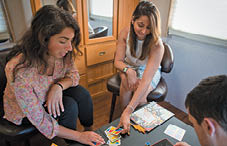 The most comprehensive mobile mental health units are run by the Veterans Health Administration (VHA). Mobile Vet Centers, or MVCs, serve combat veterans as well as active-duty service members and their families who need help making the transition from military service back into civilian society. Along with 300 brick-and-mortar vet centers and more than 1,000 community access points, 80 MVCs serve the Lower 48 states, Hawai'i and Puerto Rico. Together, the mobile units and stationary vet centers make up the Readjustment Counseling Service (RCS).
"The vehicles help us assess the needs of communities in the region," says Mike Fisher, chief officer of RCS. "We pick locations that are distant from our existing brick-and-mortar facilities, provide initial services to those communities and try to determine what the demand is like for long-term care in those areas."
For example, a trip in a mobile unit may reveal an area with a large unserved veteran population, and as a result, staff may work with community partners to secure a local space where regular services can be provided.
All MVCs are staffed with an outreach specialist and, in some cases, social workers, marriage and family therapists or clinical psychologists to provide counseling services and information about veterans' benefits, including disability compensation, pensions and health care. In fiscal year 2017, more than 264,000 visits occurred at MVCs and access points outside of traditional vet centers. Services include therapy for those suffering from post-traumatic stress disorder, traumatic brain injury and depression, as well as marriage or bereavement counseling. The RCS and its mobile units do not provide diagnoses or prescriptions; rather, providers refer patients to the VHA for crises or serious ongoing problems such as suicidal ideation or chronic substance use.
In Kentucky, RCS outreach specialist Jeff Weems travels in a combined truck and motor home equipped with two private counseling rooms, telehealth functionality and a foldout big-screen TV. He recently visited the Serenity Center, a food pantry in Shelby County where veterans gather each Wednesday for a community meal.
His primary purpose is to meet veterans and ascertain their needs—something that he did during this visit by parking and rolling out the big screen on the side of the vehicle, where he queued up "Shakey's Hill," a documentary about the 1970 American incursion into Cambodia. A crowd of veterans soon gathered to watch the film, a favorite because of its focus on soldiers' personal stories.
This laid-back approach is central to his success with veterans and service members, Weems says.
"We don't wear white coats, we don't hand out medications, we're not here to give you a diagnosis," he says. "We just want you to come in, put your feet up on the coffee table and talk about whatever's going on.
Reaching the once unreachable
Mobile Crisis Services, Woodland Centers
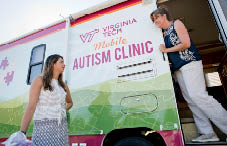 The mobile units deployed by Woodland Centers, based in the town of Willmar, Minnesota, make calls 24 hours a day, seven days a week, responding to mental and behavioral health crises in the state's 5,200 square miles of rural territory. Funded by a grant from the state's Department of Human Services, the organization launched its mobile crisis service in 2008, and in 2016 it expanded the program into a 24/7 operation that accommodates both youth and adults.
Woodland Centers' goal is to reach people before serious mental or behavioral health crises occur and lead patients to visit emergency rooms.
"Transportation is a huge issue for people in these remote areas, so getting to our traditional clinics can be a problem," says Ashley Kjos, PsyD, the organization's chief executive officer. "Mobile services are extremely helpful because we can go out to people's homes, evaluate the situation and make recommendations from there."
The mobile team, composed of 50 on-call employees stationed throughout the service region, answers about 35 calls each month. Responders are mostly bachelor's-level mental health practitioners, each with at least 2,000 hours of supervised mental health experience and 30 hours of crisis training. Licensed psychologists and master's-level clinicians provide additional supervision and guidance.
More than a third of the centers' calls respond to people reporting suicidal ideation, says Kjos, while a quarter involve behavioral outbursts, which tend to be family disputes such as kids refusing to follow directions or running away from home. Another quarter is split evenly between anxiety and depression calls, while a handful involve other issues such as self-harm or psychotic behaviors, she says.
As a result of the interventions, 68 percent of the organization's patients remain at home and need no additional care. While most calls are made to homes, a small portion take place in hospitals, jails and schools. And because practitioners deliver services on-site wherever they are requested, Woodland Centers staff use company cars for transport rather than specialty RVs.
While the model has proven effective, Kjos wants to make it even more so by finessing the mobile staffing model so that it can cover their service area more efficiently and reduce time spent on the road.
"When we say it will take us an hour to get there, they sometimes retract the request," she says. "We're reaching people who may have never been able to receive services before," she adds, "and we want to make sure we can effectively treat them before they're in a serious crisis state."