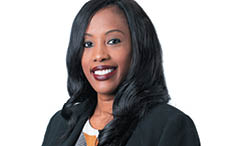

Ashawnda Fleming, PhD, is the new chief executive officer of the American Psychological Foundation (APF), the grant-making foundation that funds early career psychologists and graduate students who are using psychology to help solve society’s most pressing problems and improve people’s lives.
Fleming has more than 18 years of nonprofit management experience, most recently serving as executive director of the New Jersey chapter of the Hetrick-Martin Institute, an organization that provides free, wraparound services for LGBTQ youth and straight allies. Before that, Fleming was chief development officer for Prevent Child Abuse–New Jersey and served as a development consultant to national nonprofits, including the Make-A-Wish Foundation and the First Candle/SIDS Alliance.
Fleming comes to the job after the retirement of Elisabeth (Lisa) R. Straus, APF’s first executive vice president/executive director. During Straus’s 27 years at APF, she led the foundation’s growth from $950,000 to more than $18.5 million. The Monitor asked Fleming to describe APF’s work and her plans for expanding its reach.
What is the difference between APF and APA?
APF administers grants to students and early career psychologists who are conducting research on key social issues. The foundation’s revenue is derived from individual gifts and investment income. The vast majority of APF donors are APA members. This year will be the first that we give away $1 million in grants. Last year, we gave 117 grants—our average grant amount was $7,185.
APA, on the other hand, is a scientific and membership organization that works to advance the creation, communication and application of psychological knowledge to benefit society and improve people’s lives.
How does the foundation support student and early career research?
Seventy percent of our endowment is earmarked for grants for specific purposes based on agreements we have with donors. Some grants are geared toward cancer research, while others support high school or college psychological academic programs, for example.
Our Visionary Grants enable us to drill down on four priority areas: vulnerable populations, preventing violence, understanding the connection between behavior and health, and understanding and eliminating stigma and prejudice. APF also allows APA divisions and other groups in psychology to give grants and scholarships with us.
Why is this work important?
We support psychological careers, which in turn furthers psychological research. In fact, we change lives. For example, I recently had a chance to meet with Dr. Arielle Baskin-Sommers, who is a Pearson Grant recipient and assistant professor at Yale University. Dr. Baskin-Sommers developed an assessment tool that elicits data to help determine why antisocial individuals engage in risky behaviors. She has used that information to create and test a remediation training program.
What are your plans for taking APF to the next level?
Next year, our goal is for our assets to exceed $20 million for the endowment, which is significant because APF had thought it would not reach that goal until 2020. So far, we’ve been heavily funded by individuals—that’s our core foundation. However, the corporate community also has a social responsibility, so we will be doing more outreach to them.
What brought you to APF?
I wanted to make a larger impact on mental health, and raising money for important research is one way to do that. I first became interested in mental health when I was in college and my younger brother was diagnosed with bipolar disorder. I saw my family really struggle with getting resources for him, so I decided to go to graduate school at St. Thomas University in Miami to get a master’s in marriage and family therapy so I could help families that were going through what we did.
After practicing for a couple of years, I decided to earn my doctorate in sociology at American University while managing a research initiative funded by the National Institutes of Health at Georgetown University. Once the research study ended I began working at Second Genesis, a substance use and mental health provider in the Washington, D.C., metropolitan area. During that time, my executive director, Cathy Martens, took me under her wing and taught me about fundraising. That gave me the experience I needed to land a position as chief development officer for Prevent Child Abuse–New Jersey. After three and a half years there, I was recruited to be executive director of the Hetrick-Martin Institute of New Jersey, which is the nation’s largest provider of direct services for LGBTQ youth.
When I saw the announcement that APF was looking for a new executive director, I knew it was a perfect fit for me. I literally reached out to the recruiter with an email saying, "This is who I am. This has been my life’s work. Let’s talk."
What should psychologists do if they want to support APF?
They should call us. If they want to sit down and learn more, we can certainly talk on the telephone or do Skype or in-person visits. But the most important thing is just to reach out. There are no silly questions, there’s no gift too large or too small. And even if folks are at a place where financially they cannot contribute, there are always ways to be involved. We’re always looking for folks to help us review the grant applications. Whatever your skill set might be, you can assist.
To learn more about APF, go to https://ampsychfdn.org/donate/. To talk to Dr. Fleming, call (202) 336-5843 or email her at afleming@apa.org.