
Angel Mak first saw the importance of integrating more psychologists into primary care in 2010 when her grandmother was diagnosed with dementia. While a physician prescribed medication to slow the disease, nobody talked to Mak or other family members about how the condition would dramatically change her grandmother’s behavior.
"We didn’t understand why she would cry at certain times and scream at other times," says Mak. "We took her to the doctor regularly, but the health-care system wasn’t equipped to provide the family with resources or support to deal with such a complex disease."
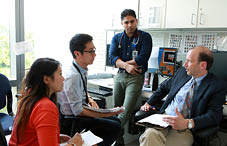
The experience cemented Mak’s desire to specialize in geropsychology through Yeshiva University’s Ferkauf Older Adult Program (FOAP) in New York, which offers an integrated-care practicum that pairs psychology trainees with medical residents as they treat older adults in primary-care settings. Mak is now a fourth-year clinical psychology student in the unique program, where psychology trainees learn about the physical side of care, while medical residents get a better understanding of the mental health challenges that can develop in older adults.
"Our trainees bring an expertise in the complex interplay between medical and psychological factors, which becomes even more important as people age," says Richard Zweig, PhD, who directs FOAP and is a professor in Yeshiva’s Ferkauf Graduate School of Psychology. "Many syndromes experienced by older adults are the result of interactions between biological, psychological and social issues." A primary-care doctor, for example, may notice that an older patient is not effectively managing his or her diabetes, says Zweig. A geropsychologist can evaluate the patient to identify any mental health conditions that may be affecting the patient’s ability to manage diabetes and develop a treatment plan that takes this into account.
FOAP is one of a small number of programs that offer specialty geropsychology training in the United States, and one of an even smaller number that specifically provide clinical training in integrated care for older adults. In light of projections that one in five Americans will be 65 or older by 2030, these graduates are poised to help meet the increasing demand for mental health providers who are trained to work alongside physicians and other members of a health-care team for older patients.
Aligning patient and provider goals
Training and job opportunities for geropsychologists are available in a wide variety of settings, ranging from the Department of Veterans Affairs (VA) and community clinics to nursing homes, primary care and rehabilitation. After receiving her FOAP training, for instance, Jennifer Ho, PsyD, completed a geropsychology internship at the VA Palo Alto Health Care System in California, where she learned how to work as part of a care team for patients in a spinal cord injury clinic. Now she’s completing a palliative care fellowship at the VA’s hospital in Palo Alto, where she conducts assessments and recommends treatments.
If a patient is having difficulty following through with the team’s recommendation to move to assisted living, for example, psychologists can perform evaluations to determine if cognitive impairment or mental illness is interfering with his or her decision-making process.
"In some cases, there is no impairment and the patient simply has a high value on autonomy," Ho says. "Psychologists can talk to these patients about how to adapt to assisted- living environments in ways that increase their sense of autonomy." That might include teaching patients effective communication skills to assert their needs with staff or helping them problem-solve to achieve the quality of life they desire.
Another integrated training program is Rush University Medical Center’s health psychology program in Chicago, which offers a six-month rotation for psychology interns. The program focuses on patients who are rehabilitating from strokes, amputations, cardiac or orthopedic surgery, and other conditions. Interns conduct cognitive and mental health screenings on all patients and share their findings with the health-care team, whose members include physiatrists, nurses, psychologists, dietitians and chaplains, as well as physical, occupational and speech therapists.
"One of the biggest barriers in rehab is when the patient’s goals don’t align with the staff’s goals, and we can help everyone get on the same page," says Erin Emery-Tiburcio, PhD, who expanded psychologists’ roles on care teams at Rush. For example, patients with a trauma history may refuse certain types of care because they feel afraid, and psychologists can coach providers how to explain what they are doing to help the patient feel safe, says Emery-Tiburcio, an associate professor of geriatric and rehabilitation psychology at the medical center.
Working with older adults has been rewarding because "they bring so much life experience and wisdom about their own problems, and they are generally open to engaging with psychologists," Emery-Tiburcio says. "There are a lot of ideas about older people being less willing to engage, but this has not been my experience."
One of the life experiences they bring more frequently than younger patients do is grief related to the loss of a loved one. Geropsychologists can determine whether a patient is capable of setting aside that loss to focus on rehabilitation, and, if not, work with the team to identify activities that will help him or her grieve while also regaining function, Emery-Tiburcio says.
Another important way students are learning to apply geropsychology skills is helping caretakers cope with their responsibilities. When one of Mak’s patients scored low on neuropsychological and cognitive functioning tests, for example, she asked the patient’s wife how she was doing. "She broke down in tears because no medical provider had asked her before," Mak says.
Probing further, Mak discovered that the wife was experiencing symptoms of depression because she blamed herself for her husband’s dementia and had little time to care for herself. Mak helped the woman include other family members in the caregiving responsibilities and enroll her husband in an adult day program. Over time, the wife’s appetite and sleep improved and she started returning to pleasurable activities, such as spending time with friends and family.
Shifting hospital culture
Despite the high need for and advantages of this work, many challenges remain in implementing effective integrated geriatric care, says FOAP’s Zweig. It’s difficult to find psychology graduate students who are interested in geropsychology because few have been exposed to the rewards of working with older adults, he says. "I’m seeing more interest in the older adult program’s specialty training than was the case 16 years ago when the program started," he says, "but not enough to meet the growing demand for services."
What’s more, hospital and primary-care cultures themselves have been slow to embrace geropsychologists as full team members, says Leilani Feliciano, PhD, director of clinical training at the University of Colorado, Colorado Springs. Third- and fourth-year geropsychology students in the integrated-care rotation at the Peak Vista Community Health Centers in Colorado, for example, report having open slots in their schedules because primary-care providers are not accustomed to using them.
"Whenever new providers join the hospital, we need to talk to them about how we can benefit their patients and the team," Feliciano says.
That said, when physicians experience geropsychologists’ expertise, they tend to get hooked because they see improved outcomes, says Feliciano. One primary- care provider recently asked a geropsychology student to see a woman in her 60s who refused to have mammograms. The student listened to the patient and learned there was a history of breast cancer in her family and that the woman’s sister and mother had had mastectomies. She was afraid that talking about her fear and having a mammogram would lead to the same fate. After sharing her concerns with the student, the woman said she’d consider having a mammogram and meeting with the student to work on coping strategies for the upcoming appointment. In the end, that visit turned a frustrating appointment for patient and provider into a collaborative and productive meeting.
Facilitating such transitions is a common task for geropsychologists in integrated care. "We need to be taking a holistic approach because mental and physical health go hand in hand," Feliciano says. "Geropsychologists are critical members of care teams for the underserved, often overlooked older adult population, and demand for their services will only increase as integrated care becomes more common."
For more information about training opportunities in this field, visit the Council of Professional Geropsychology Training Programs’ website: https://copgtp.orgopens in new window.
The Monitor’s "Adventures in Integrated Care" series explores the work psychologists are doing as members of interdisciplinary teams. If you have a story to share, contact editor Sara Martin at smartin@apa.org.