

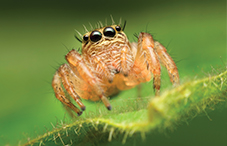

Focus on one task too long, and performance suffers. That so-called “vigilance decrement” occurs whether you’re writing a manuscript, doing your taxes—or hunting flies.
William Helton, PhD, at George Mason University, usually studies sustained attention in people. Recently, he teamed up with animal behavior researcher Ximena Nelson, PhD, at the University of Canterbury in Christchurch, New Zealand, to investigate whether jumping spiders also experience a dip in performance when they work too long without a break.
Jumping spiders are active hunters with a sophisticated visual processing system. To explore their attention, the researchers tethered the arthropods to an apparatus that measured their movement as they turned to look at moving dots on a screen (a stand-in for insect prey).
Like humans, spiders’ performance decreased the longer they focused on the task (Quarterly Journal of Experimental Psychologyopens in new window, Epub ahead of print, 2018). Spiders, like people, also experienced a faster drop-off in performance when the task was more cognitively demanding (Animal Cognitionopens in new window, Vol. 21, No. 6, 2018). “We’re finding eerily similar results in spiders that we see in people,” Helton says.
Some researchers have suggested a vigilance decrement occurs when people daydream during a demanding or monotonous task. “That explanation isn’t as believable in spiders,” Helton notes. A better explanation, he believes, is that animals have some cognitive resource that gets burned up over time.
Another piece of the puzzle: Unlike spiders and people, dolphins can work for days without a drop in performance, as naval research has shown. Notably, dolphins have a unique brain system that allows half of their brain to sleep while the other half stays alert. That system allows them to keep swimming and breathing during sleep—and might also allow them to toggle to the refreshed side of the brain when their cognitive fuel runs low.
Unfortunately for humans and spiders, there is no backup brain hemisphere waiting in the wings. “It seems that something about nervous systems means they can’t sustain their activity indefinitely,” Helton says. “They need a break.” —Kirsten Weir