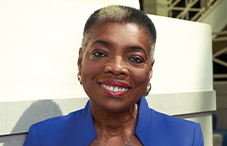

We can learn so much from the pioneering spirit of Dr. Olivia Hooker, who died in November at age 103. The oldest living survivor of the Tulsa Race Riot, Dr. Hooker was just 6 years old when in 1921 a group of white individuals, believed to be Ku Klux Klan members, burned and plundered “Black Wall Street,” leading to the deaths of as many as 300. Not only did Dr. Hooker survive that violent attack, her strength and resilience led her to be the first black woman to enlist in the Coast Guard, to earn a psychology doctorate at the University of Rochester and to become a distinguished psychology professor at Fordham University, esteemed for her research on the learning abilities of children with Down syndrome.
Yet it’s one of her lesser-known accomplishments that provides us with a compelling example of how psychological science can help us heal divides and become a more caring and inclusive society: When Hooker learned about women in an upstate New York jail who had been cast aside, labeled as having severe learning disabilities, she used her psychological training to re-evaluate the women’s abilities. That enabled these women to pursue additional education and better jobs and to become more integrated into society.
Dr. Hooker’s efforts in this area demonstrate how psychological science can help us overcome the human tendency to divide people into groups of “us versus them.”
Today, many Americans are experiencing societal divisions based on fear. Hate groups, often centered on a community of people with immutable characteristics around race and religion, have been on the rise. Decades of psychological science can help society understand this fear, including research by John Dovidio, PhD. Along with his colleagues at Yale University, Dovidio explored the tendency of humans to form in-groups to feel a sense of belonging and security. Out-groups can spark fear and insecurity—a fear that can sometimes make us want to destroy, control or at least separate from the “other.”
If we want to live in an inclusive, strong and caring society, then we can turn to the expertise of psychological scientists in APA to tell us how to do it.
I call on applied scientists, academic researchers and experts in multiculturalism to step up and continue to show us how to turn out-groups into in-groups. Remember: Exclusion is easy, but inclusion is power.