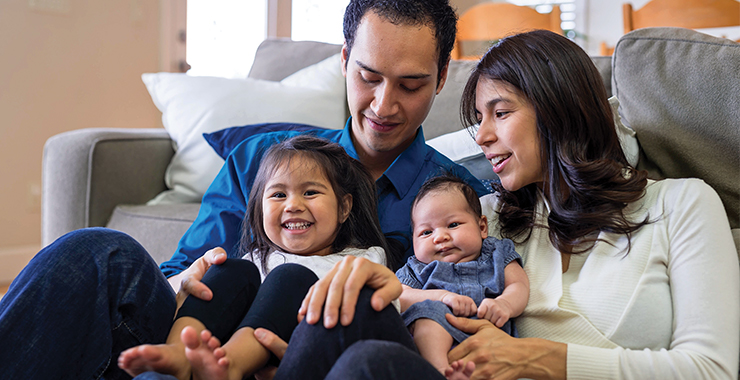
Look through most of the literature on parenting and child development over the past several decades and you’ll find studies on how mothers affect their children in such areas as behavior, reading and math abilities or interpersonal relationships. What you won’t find is much mention of the role fathers play in raising children. Likewise, you’ll struggle to find research based on anyone who isn’t white and middle class.
“We have this whole science of child development that pretty much ignores 50 percent of parents and is based on a really narrow slice of families,” says Natasha Cabrera, PhD, professor and director of the Family Involvement Lab at the University of Maryland, College Park (UMCP). “Not only is it unfair, we’re depriving ourselves of the chance to really describe how families work.”
Cabrera became acquainted with the skewed nature of family research statistics while serving three years as a federal policy analyst, in between earning her PhD and launching the Family Involvement Lab. Now, by investigating a wide diversity of parenting and family dynamics, she has identified unique attributes of fathers that can boost children’s emotional, language and problem-solving skills.
She has also begun to document how positive aspects of low-income, minority and immigrant families can help to offset what could otherwise be a debilitating lack of resources. “The lab takes a unique approach to studying family interactions by focusing on the strengths of families rather than just their weaknesses or the challenges that they face,” says former graduate student Jenessa Malin, PhD.
Now, Cabrera and her team are leveraging those findings to develop novel interventions that improve parenting skills. Also, through a stream of blog posts, briefing reports and invited talks in communities, the research team is sharing its findings with a wide range of audiences, including parents and policymakers. “Our goal is to take out the really science-y jargon, discuss research results clearly and succinctly, and explain the policy implications,” says graduate student Catherine Kuhns.
Family first
Cabrera’s first job, in fact, was in policy. Soon after completing her PhD in educational psychology at the University of Denver in 1995, she became pregnant, so instead of applying for academic jobs, Cabrera took a more family-friendly position evaluating Head Start programs for the National Academy of Sciences in Washington, D.C. After 18 months there, she landed a fellowship in the demographic and behavioral sciences branch of the National Institute of Child Health and Human Development (NICHD).
Working on the agency’s large surveys, “my eyes really opened to how dramatically family demographics were changing, and how big the ‘missing men’ problem was becoming,” Cabrera says, referring to the general lack of fathers included in psychology research.
She began organizing meetings and working groups for NICHD with top scholars in the field to figure out how to broaden representation in child development surveys. These surveys become the basis of huge open-access data sets, such as the Early Childhood Longitudinal Study-Birth Cohort (ECLS-B), now used by dozens of research labs across the country.
Soon after, she decided to pursue a faculty position at UMCP, where she then opened the Family Involvement Lab. One pressing research question was the effect of absentee fathers. Working with University of Cambridge psychology professor Michael Lamb, PhD, she found that children with absent fathers don’t do as well as those with involved fathers for many reasons—not just because they have fewer resources. Those reasons include lack of a co-parent, family stigmatization resulting in social isolation and the psychological distress of abandonment (Child Development, Vol. 71, No. 1, 2000opens in new window).
To dig further into fathers’ contribution to family life, Cabrera launched a small-scale study with a few dozen low-income African-American families that sought to gather specific details of family interactions by video recording moms and dads at home, playing and talking with their kids. (The experience showed her firsthand one reason why fathers aren’t well represented in parenting literature: It took three years to find 50 fathers willing to take part in the study.)
Cabrera and her team looked for indications of fathers demonstrating sensitivity, such as comforting crying toddlers or helping children struggling with a toy.
Upon reviewing the sessions, however, Cabrera noticed that fathers spoke differently to their children than mothers did: They talked in complete sentences, as if they were talking to adults. At first, she thought that was insensitive to the children. But when she analyzed her data, she discovered that the fathers’ language skills were actually better predictors of kids’ language skills than those of the mothers (Cognitive Science, Vol. 41, 2016opens in new window). “The language that dads use is really linguistically challenging,” Cabrera says. “Dads also use a lot more ‘Wh’ questions—Where are you going? Why are you doing that? These questions force kids to express themselves better because sometimes dads have no patience with gibberish, whereas moms do.”
Cabrera and her team have gone on to observe that fathers’ playfulness is also associated with children’s vocabulary skills. In addition, her team has found that the association between mothers’ playfulness and children’s vocabulary and emotional regulation was enhanced when fathers engaged in more pretend, creative play (Infant Mental Health Journal, Vol. 38, No. 6, 2017opens in new window).
Identifying strengths, developing tools
Cabrera has also conducted research comparing the learning trajectories of racial and ethnic-minority populations—with surprising results.
Many studies that have compared white, black and Latinx kids don’t control well for socioeconomic status. So, Cabrera and her team did a study in which all the participants were poor. The study tracked math, reading and social skills among white, black and Latinx low-income children from kindergarten to third grade.
In terms of math and reading, kindergarten-age white kids did better overall than black kids, who performed better than Latinx kids. But in terms of social skills, Latinx kids did better than the others. “Latino kids come to school, they’re quiet, they’re cooperative, they follow the rules, and these qualities matter,” Cabrera says.
In addition, the team found that by third grade, Latinx kids in the study did better in all domains than black kids despite facing similar or even more difficult circumstances.
“We thought, ‘Why is that? Black parents have more education, read more to their kids, make more money and are rarely undocumented.’” Cabrera suspects the reasons come from several factors that separated black and Latinx families in the study: Black kids were spanked more and were more likely to live in single-parent households (National Research Center on Hispanic Children and Familiesopens in new window, 2017). Cabrera thinks racial discrimination, disproportionately experienced among black children, may also play a significant role.
Cabrera is now working on an intervention project called Baby Books 2. With support from NICHD, she is working with University of California, Irvine, colleagues Stephanie Reich, PhD, and Greg Duncan, PhD, to study the effectiveness of embedding easily digestible educational information—on such topics as child development, injury prevention and optimal parenting—into baby books.
In another effort, the lab has partnered with New York University psychologist Catherine Tamis-LeMonda, PhD, and University of Pittsburgh psychologist Melissa Libertus, PhD, to explore how mothers and fathers influence the development of math and spatial skills in toddlers from English- and Spanish-speaking families of varying socioeconomic status. Supported by a grant from the National Science Foundation, the “Everyday Learning” project draws data from two home visits in which children play math-infused games with each parent and the researcher. Cabrera says the observational study is inspired by previous studies showing that lower-income households rarely engage their kids in math talk, such as counting aloud or talking about shapes and patterns. Her goal is to identify parental characteristics—math ability, attitudes toward math, belief in the importance of learning math—that explain variations in the delivery of math-related learning in the home, and to use this knowledge to develop an effective intervention.
Cabrera is also investigating how being an immigrant in the United States influences parenting. There wasn’t much research on this area, she says, so she had to start from scratch by holding focus groups and asking immigrant parents what it’s like to rear a child in the United States. So far, the researchers have found that children in immigrant families with very little income and social support do better than expected in certain domains, including the development of social skills (National Research Center on Hispanic Children and Families, 2017opens in new window).
“We think this may be because immigrant families are more likely to be two-parent families,” Cabrera says. “They also report a lot less conflict and depression, despite the lower levels of parent education and income.”
Student experiences
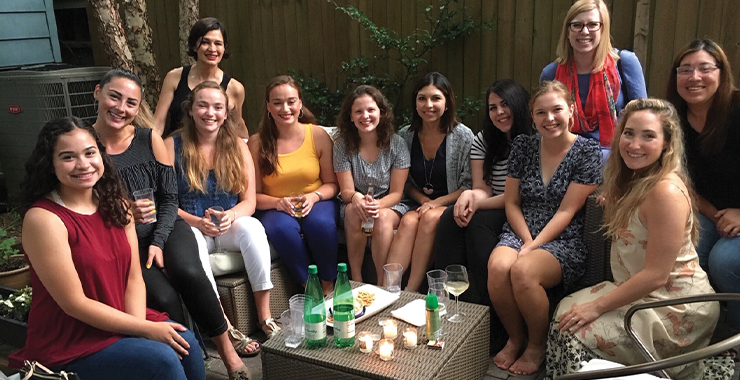
Like Cabrera, some of Cabrera’s students have, upon graduation, gone on to work as policy analysts with government agencies and nonprofits such as Child Trends, and half of her current students want to follow the same path. “Natasha’s time at NICHD really opened a lot of doors for us, in terms of having connections beyond academic faculty members, and we often are collaborating with all kinds of people in the field,” says graduate student Avery Hennigar.
An example of one such collaboration is with Temple University social work professor and noted fatherhood researcher Jay Fagan, who runs the Fatherhood Research and Practice Network. Fagan specializes in evaluating the curricula of programs that aim to increase the parental engagement and parenting skills of low-income fathers. Cabrera often arranges for students less interested in an academic career path to team up with Fagan to get a broader type of research experience.
Her students have also benefited from accompanying Cabrera to the several talks and panel discussions she’s invited to by fatherhood program organizations each year, especially faith-based programs that offer services for men who may not be engaged with their families. “Rather than messages of support, low-income fathers often hear that if they don’t financially support their kids, they can’t possibly be good dads,” Cabrera says. “Hearing me tell them that science says that they can contribute in other important ways provides an important feeling of validation.”
Cabrera’s students have also gained experience in compiling their research on families into policy briefs and blog posts for governmental and nonprofit organizations such as the National Research Center on Hispanic Children and Families and Child Trends. In addition, Cabrera has participated in panels about parenting for the National Academy of Sciences and the U.S. Department of Health and Human Services and presented her research to the National Center for Family and Marriage Research, among other groups.
“I don’t think my students should be like me,” Cabrera says. “I really want my students to choose their own path for contributing to the field.”
“Lab Work” illuminates the work of psychologists in research labs. To read previous installments, go to www.apa.org/monitor/digital and search for “Lab Work.”