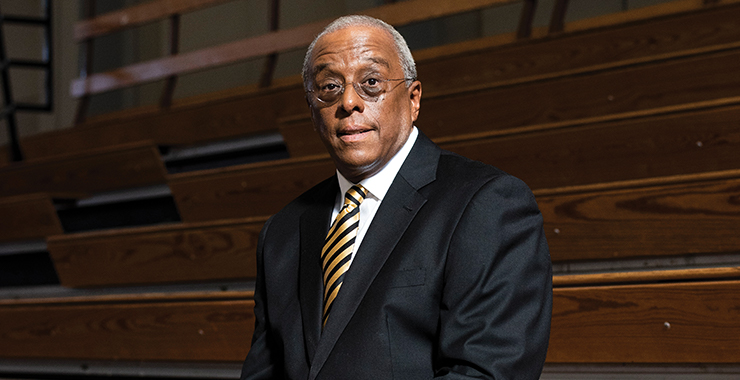
"Irrespective of one’s sport or occupation, mental health and wellness should always be at the table of conversation,” says William D. Parham, PhD, ABPP. “This is not a unique problem of basketball. We’re addressing a human condition.”
That deep appreciation of mental health and wellness is among the many strengths Parham brings to his position as inaugural director of the National Basketball Players Association’s (NBPA) new Mental Health and Wellness Program. Believed to be a first in professional sports, the program will serve as a resource for all NBPA members.
Parham, a counseling professor in the School of Education at Loyola Marymount University in Los Angeles, has worked with professional and collegiate athletes throughout his career, including with the National Basketball Association (NBA), National Football League, USA Soccer, USA Tennis and the USA Olympic women’s volleyball team. He spoke to the Monitor about his plans for the program, his drive to change the national conversation around mental health and wellness, and how he got this position.
Why did the NBPA launch this initiative?
The most recent stimuli were the public sharing of personal stories by a number of marquee NBA players, including Kevin Love of the Cleveland Cavaliers, DeMar DeRozan of the Toronto Raptors and Kelly Oubre of the Washington Wizards, who have come forth with their struggles including depression and anxiety. Player disclosures of their struggles with mental health challenges is not new. I suspect that recent resurfacing of identity reclamation movements—such as #MeToo, Black Lives Matter, Colin Kaepernick and more—provided some impetus to come forth.
When these kinds of stories become public, it triggers conversation. The NBPA listened to the collective voices of their players and decided to launch the program to address the mental health and wellness challenges of the players they serve.
What are the aims of the program?
The program team consists of myself and Keyon Dooling, a retired NBA star and NBPA Player Wellness Counselor who had courageously shared his storyopens in new window of surviving childhood sexual abuse.
Our goal is to make this the preeminent comprehensive mental health and wellness program in professional sports. We have a five-part plan to do this. The first is to create a directory of licensed clinicians, mostly psychologists but also including psychiatrists and social workers, in each city where there’s an NBA team.
Part two is developing a 24-hour crisis line that players can access for mental health issues. Part three is a mental health and wellness literacy program aimed at educating players on mental health issues and the resources that are available to them. Related to part three, we’re developing a comprehensive website with mental health and wellness resources.
Part four is building relationships with players. Keyon and I are establishing touchpoints with players throughout the year and developing other ways of communicating with the athletes through social media. Part five involves strengthening our relationships with the media, as they are absolutely key in capturing and communicating the essence of the narrative we want to advance.
How did you get the job?
I have consulted for the NBPA and NBA for many years in various roles, including as a consulting psychologist for the Los Angeles Lakers. I’ve also consulted with many elite-level sports and organizations. In each of these roles, my advocacy for the mental health and wellness of athletes was always quite clear. With this background and experience, my name surfaced when the mental health and wellness initiative was being considered. After being interviewed, I was offered the position. I feel fortunate to be at the helm and I’m very passionate about the program.
What issues are the players dealing with?
Players are dealing with a wide spectrum of issues. At one end of the continuum are the day-to-day expected challenges common among athletes, including, but not limited to, going to practice, managing their diet, nutrition, sleep and circadian clock disruptions due to frequent traveling. The accumulation of these during-season daily hassles can wear on an athlete, but it’s not necessarily significant enough to interfere in their lives in any appreciable ways.
Moving up the scale further are challenges that are becoming problematic and beginning to interfere in an athlete’s life. Examples might include family problems, interpersonal relationship stressors, managing finances, and sport injuries that preclude athletes from participating in the very activities from which they draw enormous emotional strength. The other end of the spectrum are athletes whose struggles with depression, anxiety, post-traumatic stress disorder, to name a few, feel disabling and significantly interfere with their day-to-day functioning. Our approach is to acknowledge the whole continuum of mental health and wellness challenges.
I will add that many athletes perform at an elite level despite carrying significant baggage. I believe if they have safe places to drop some of that baggage and talk about their life’s challenges, real change can happen and intrapersonal healing can begin. Athletes who feel good about themselves and about the direction in which they are headed, set the dominoes of success in motion. Improved individual performance spreads to heightened team performance that then spreads to improved performance among other teams, which then begets more exciting competition, more coverage of the increased levels of competition, ultimately leading to more fans, more tickets, more merchandise sales and more money in the owner’s pocketbook. In brief, investing in an athlete’s mental health and wellness pays handsome dividends for everybody involved.
What will success look like?
Success goes beyond creating a comprehensive mental health service and mental health literacy program. We’re seeking to change the national conversation about mental health. This conversation is connected to, but separate from, performance psychology.
The mantra we use is, “The person before the performer.” Success is not only about the degree to which players utilize readily available services. We’re developing, for example, multiple indicators of program success, including tracking the number of visits to the website, use of mental health and wellness apps, utilization of the 24-hour crisis line, and utilization of clinicians in our network.
Success, however, will also be measured by the degree to which we influence a real change in the national conversation. We’ll monitor media coverage to see if mental health and wellness conversations relative to athletes are happening with greater frequency and within larger person-centered contexts. Currently, the narrative of mental health/mental illness is framed within the four-border contexts of taboo, stigma, shame, and a Pandora’s box of deficiencies and deficits. We want to assist in the reconstruction of the borders within which the picture of mental health/mental illness rests. Our ongoing work will be to assert that acceptance, honor, pride and a treasure chest of yet untapped talent represent the four borders that frame mental health and wellness.
How did you become interested in sport psychology?
It has been said that the best way to find yourself is to lose yourself in the service of others. My career as a psychologist has afforded many opportunities for self-discovery, positioned me to serve others, and allowed me to have a front row seat relative to witnessing the genius that people bring to life situations and challenges for which they need to find solutions. Athletics has been an arena wherein I have witnessed awe-inspiring success of athletes whose journeys through life and sports have helped them to discover much about themselves. I often feel like I was called to psychology and sport, and infusing both areas has not been disappointing.
I will add that I’ve always been enamored by the artistry and sheer wonder of athletic movement, especially when witnessed in venues of competition, across sports, where athletic performance can be fully expressed. The complex and inextricable interrelationship between mind, body and spirit has always caught my attention and triggered my curiosity. In short, the person delivering the performance, sometimes in spite of their personal and quite burdensome life challenges, has captured my attention. Helping athletes unlock an inner strength, often hiding in plain sight even from them, has kept me in the game throughout my career.
Do you have any advice for psychologists interested in working in this field?
I often suggest, first, that aspiring psychologists establish their North Star goals. I ask two questions, “Where do you see yourself 10 years from now?” and “If your day was exciting and pleasing, what would you be doing?” Once they can see their vision as clear as crystal, everything else related to their career pursuit will fall in place.
I invite psychologists who are interested in working in the field to have a passion for what they are doing and remember that it is all is on the plate of service.