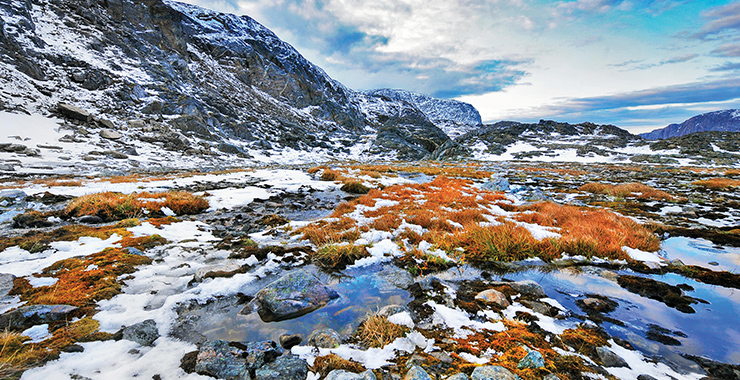
"Inuit are people of the sea ice. If there is no more sea ice, how can we be people of the sea ice?"
"There’s nothing [that] makes me more depressed than to see the place—dust lifting off the place. It’s really terrible. … I can’t stand the place blowing away."
Those two statements come from opposite ends of the earth, but they resonate with shared grief. The first is from a resident of Nain, a town of fewer than 1,200 people in Nunatsiavut, the self-governing Inuit region in northern Labrador, Canada. The second is from a family farmer in the Australian Wheatbelt, a drought-stricken rural area outside Perth.
The two speakers may have little in common on the surface. But both are people whose lives, livelihoods and identities are intimately tied to land that is now shifting under their feet because of climate change.
Those shifts have dire economic and health consequences, including lost farms in Australia and decreasing sea ice and disrupted hunting and traveling in Nunatsiavut. But in a paper in Nature Climate Change, social scientists and health researchers Ashlee Cunsolo, PhD, and Neville Ellis, PhD, make the case that in both communities, residents are facing more than practical hardships. They also share another, largely underappreciated, threat—"ecological grief," or mourning for the land itself, similar to the mourning that a person would feel for a lost loved one (Nature Climate Change, Vol. 8, 2018opens in new window).
Cunsolo is director of the Labrador Institute at Memorial University in Goose Bay, Laborador, Canada, and a contributor to the 2017 APA/ecoAmerica report "Mental Health and Our Changing Climate: Impacts, Implications and Guidanceopens in new window." Ellis is a research fellow at the University of Perth in Australia and a contributing author to the recent Intergovernmental Panel on Climate Change (IPCC) "Special Report on Global Warming of 1.5°C." Cunsolo had spent years working with the residents of Nunatsiavut, and Ellis with farmers in the Wheatbelt, when the two researchers met at a conference on ecological health in 2015.
"There was this amazing light bulb moment where we realized that the Inuit people [in Canada], and the non- indigenous farmers [in Australia] had nearly identical quotes and experiences," Cunsolo says.
In the paper, Cunsolo and Ellis lay out their argument that ecological grief is an expectable reaction to climate change and, as climate change worsens in the coming years, it will become more common. In response, they say, researchers and policymakers should take into account ecological grief when tallying up the worldwide effects of climate change and considering how to mitigate them. Those effects may be most apparent in highly vulnerable communities like those in the Arctic or Australia. But the rest of us will not be immune.
"Years ago, in 2009, The Lancet identified climate change as the biggest public health challenge of the 21st century," Cunsolo says. "I think there’s an increasing recognition that mental health is part of that."
A loss of tradition
Cunsolo began working with residents in Rigolet, another town in Nunatsiavut, more than a decade ago, when she was a graduate student in health geography and rural studies at the University of Guelph in Ontario. She was called in to assist with a project led by the Rigolet Inuit Community Government on the effects of climate change on health in the community. Cunsolo quickly found that when she talked to the residents, they were as likely to discuss the emotional burden of climate change as they were to mention physical health impacts.
"One hundred percent of people mentioned at least one form of mental or emotional impact, and many said it was the biggest thing," she recalls. The project set her on a new path, changing much of her research focus to look at these mental health effects. Over the next several years, she and local residents developed a community-based research program to better understand what Rigolet’s residents were experiencing.
They conducted detailed interviews with 115 people (out of the town’s approximately 300 residents), and also started a digital storytelling center so that residents could create audio and video records of their experiences with a changing climate (see EcoHealth, Vol. 9, 2012opens in new window, for more on the methods).
One example: Rigolet is inaccessible by road—residents can enter and leave only by plane, boat in the summer months and, in winter, snowmobile over sea ice. They also travel over sea ice to reach traditional hunting areas, but as the climate warms the sea ice has become less reliable each year.
After two years of working in Rigolet, Cunsolo expanded her work to four other small towns in Nunatsiavut and eventually created a documentary film, "Attutauniujuk Nunami/Lament for the Land," about the changes these communities are facing.
It’s these changes in travel, hunting, livelihoods, cultural continuity, and connection to family and community, Cunsolo explains, that can cause ecological grief: the loss of the physical place itself (the ecosystem and the landscape that their Inuit ancestors have known for centuries), the loss of the traditional knowledge that goes with that landscape (understanding where and when the sea ice appears each year and where it is safe to travel, for example), and the anticipation of further change and losses.
"It’s hurting in a lot of ways," one older resident from Hopedale, Nunatsiavut, told the researchers. "Because I kinda thinks I’m not going to show my grandkids the way we used to do it … it’s hurting me big time. And I just keep that to myself."
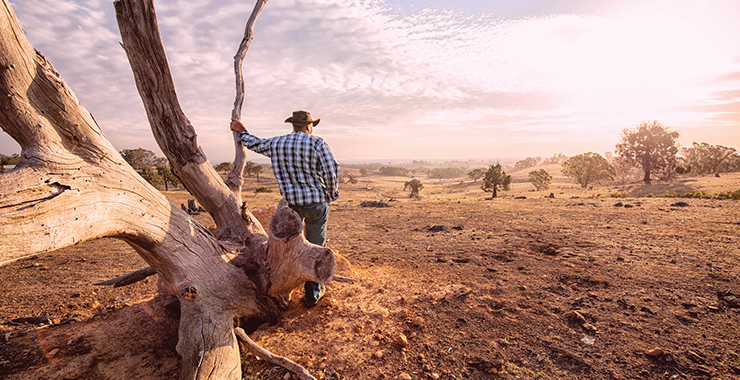
Meanwhile, in Australia, Neville Ellis encountered similar thoughts in his work with Australian farmers, many of whom are watching farms that have been in their families for three or four generations turn to dust.
The area, Ellis says, has lost 20 to 25 percent of its winter rainfall in the past two decades, and has increasing salinity in the soil, rendering it increasingly unfit for profitable farming. "An area the size of Tasmania has turned to salt," he says. Ellis conducted detailed interviews with 22 family farmers and 15 mental health professionals and others in the area (Social Science and Medicine, Vol. 175, 2017opens in new window).
Like Cunsolo, he found residents grieving the land itself and their ancestral connection to it, and their quotes are recounted in the Nature Climate Change paper.
"[Losing the farm] would be like a death. Yeah, there would be a grieving process … I think if we were to lose it, it would be like losing a person," one farmer told him.
Preparing for the future
The idea of ecological grief—mourning for the natural environment—is not entirely new. The environmentalist Aldo Leopold described the emotional pain of environmental losses in the 1940s, Ellis says. And Ellis and Cunsolo were also both inspired by the work of Glenn Albrecht, PhD, an environmental philosopher (and Ellis’s thesis adviser) who coined the term "solastalgia"—mental distress caused by environmental change, a kind of "homesickness" without leaving home. But outside of ecology, ecological grief was until recently a little-known idea.
However, Cunsolo says that over the past year or two she has seen increasing interest from the public in the mental health effects of climate change. "More people are either experiencing it or talking about it," she says, noting that when The Lancet released its widely covered annual countdown report on climate change and health in 2018, the journal included more coverage of mental health impacts—and that the media and public responded with more interest.
In psychology, meanwhile, there has long been an awareness of and research on the mental health effects of climate change (see the 2017 APA/ecoAmerica reportopens in new window for a broad overview)—everything from whether temperature changes cause an increase in mental health symptoms to how to help communities cope after disasters like hurricanes and flooding.
But the idea of ecological grief specifically—mourning for a lost environment—has not been explored as much, says Thomas Doherty, PsyD, a clinical and environmental psychologist in Portland, Oregon.
"There’s still a gap between the clinicians and the environmental psychology researchers," Doherty says. "And the challenge with ecological grief is that it falls right into that gap."
Doherty, a clinician and researcher, wants to help fill it. He has writtenopens in new window about how to adapt models used to treat traditional bereavement to treat environmental grief as well—focusing on the tasks of grieving, but also rebuilding one’s life under changed circumstances.
"It’s fascinating to think about how we apply what we know about grief to climate change," he says.
And though Ellis and Cunsolo’s work focuses on already threatened communities, they and Doherty believe ecological grief is becoming more and more relevant to the rest of us as well.
"[Ecological grief] is not exclusive to people who have multigenerational attachments to a particular place," Ellis says. "The most recent [IPCC] report makes it very clear that without immediate action we’re heading far past 1.5 degrees of warming. And if we get there, climate change impacts won’t just be happening on far-flung shores, it’ll be happening on our doorstep."
In the meantime, for those who do live in the most vulnerable places, there is no time to waste. Cunsolo has continued to work with the communities in Nunatsiavut and across the North to explore the mental health effects of climate change, and now, to build practical strategies and tools to address them. The My Word: Storytelling and Digital Media Lab, for example, continues to operate, staffed by local resident-researchers. And Cunsolo is working with Rigolet and a team of students and researchers to build a community health monitoring appopens in new window that will allow residents to more easily track the environmental changes they see, and their reactions to them.
At one point, at a national meeting, Cunsolo recalls, a resident of Rigolet took exception to the idea that others view Inuit as the "canary in the coal mine" when it comes to experiencing climate change. "She said, ‘You shouldn’t say that about Inuit, because canaries were expendable. We’re not expendable. You don’t want to wait until we’re gone to do anything.’"