A disagreement with your co-workers leaves you rattled, and on the way home you nearly have an accident. You walk into the house and realize you forgot to stop at the market to pick up dinner. As your frustration mounts, your partner comes through the door and with a hug and a few words lifts you up. You've found the strength to get through the end of a bad day.
Explaining this simple phenomenon—the power of human connection—has been a central focus of the Virginia Affective Neuroscience (VAN) Laboratory at the University of Virginia (UVA).
High-quality social relationships have long been known to reduce stress and to be associated with longer, happier and healthier lives. But the neurophysiology underlying these links has remained elusive. Over the past quarter century, James Coan, PhD, psychology professor at UVA and director of the VAN Lab, has been synthesizing and expanding upon what he's learned in the labs of world-class experts in the fields of brain plasticity, social relationships and functional brain imaging to better understand this mechanism.
"A baseline assumption your brain has is that you'll be around people and have social relationships," says VAN Lab graduate student Sara Medina-DeVilliers. "Anytime we don't have people to rely on and we're confronted with stress, our body and our brain have to use more resources to meet goals and confront various sources of stress. We're trying to figure out how that works."
One big clue has come from Coan's discovery that merely holding a loved one's hand offers protection against the stress of an impending electric shock. Coan and the members of the lab have gone on to demonstrate this hand-holding effect across a variety of social relationships, including romantic partners, close friends, and parents and their children.
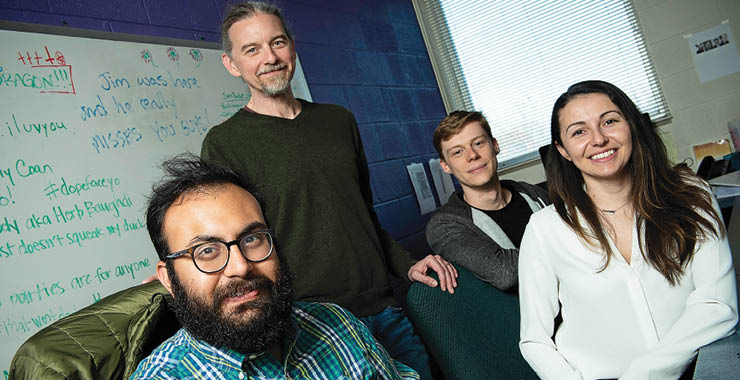
Coan and the rest of the lab—including two graduate students, two undergraduate students and a lab coordinator—are now using EEG and fMRI to examine the neurophysiology of social relationships and their potential impact on health and well-being, with specific experiments directed at depression and immune system disorders such as lupus.
"There's great power in social relationships," Coan says. "Interventions to support healthy, loving relationships have real potential to prevent and treat a wide variety of medical and psychological maladies."
Now, Coan is disseminating his findings by writing a book about his research on social relationships, hosting a podcast, and writing op-eds for The Washington Post and other outlets on the harm being done by the Trump administration's policy of separating children from their parents at the border. "This is something I feel very passionate about," he says.
Extra credit
Before training with some of the leading researchers in psychology, Coan wasn't sure he would even go to college. Neither of his parents attended college, and he spent his early 20's installing and repairing roofs in his native Spokane, Washington.
But when he grew bored with that job, Coan enrolled in community college and soon transferred to the University of Washington (UW). In his first quarter there, he found himself in a class taught by cognitive psychologist Elizabeth Loftus, PhD. At the time, in the early 1990s, Loftus was well known for her research on the misinformation effect, in which post-event information interferes with the memory of an original event, leading to inaccurate memories and in some cases even false memories of events that never took place. She would go on to provide contentious testimony in hundreds of criminal cases—including the O.J. Simpson, Ted Bundy and Oklahoma City bombing trials—about the malleability of eyewitness testimony.
As an extra-credit assignment for Loftus's course, Coan used a novel methodology of his own invention to implant false memories in his 14-year-old brother—convincing him that he had gotten lost in a shopping mall when he was 5 years old.
The research, later refined with Loftus and published in the book "Implicit Memory and Metacognition," caused a sensation. By the summer of his first year at UW, Coan had been featured in The New York Times science section and New York magazine. "The experiment changed my life," he says. "Everyone has imposter syndrome at some point, but I had imposter syndrome squared, because of my background. This study completely changed my whole view of myself and of what was possible."
After graduating, Coan went to work as a lab coordinator for UW psychologist John Gottman, PhD, who ran the Newlywed Apartment Lab, which the media had dubbed the "Love Lab."
"We brought in couples several times a week and goaded them into fighting with each other while videotaping them and recording EKG and galvanic skin response data," Coan says. Using this data, Gottman and Coan built a model that predicted with greater than 80 percent accuracy which couples would divorce within the first five years of marriage (Journal of Family Psychologyopens in new window, Vol. 14, No. 1, 2000).
After three years running Gottman's lab, Coan entered a doctoral program at the University of Arizona with neuropsychologist John Allen, PhD. Coan and Allen demonstrated that different sides of the frontal cortex could be activated by asking subjects to make facial expressions associated with different emotions (Psychophysiologyopens in new window, Vol. 38, No. 6, 2001). Coan and Allen later found that differential activity in the right and left sides of the frontal cortex in the resting brain—referred to as frontal brain asymmetries—was associated with depression risk (Journal of Abnormal Psychologyopens in new window, Vol. 119, No. 3, 2010).
Coan's work on frontal brain asymmetries caught the attention of Richard Davidson, PhD, a psychologist at the University of Wisconsin–Madison who had been one of the first to describe the phenomenon years earlier. Davidson invited Coan and Allen to write a chapter for a volume summarizing the state of frontal brain asymmetry research. Impressed by the chapter, Davidson offered Coan a postdoctoral research position in his lab in 2003. At the time, the lab was blossoming into one of the leading fMRI psychology labs as Davidson was just beginning a seminal collaboration with the Dalai Lama on studies of the neuroscience of meditation. "It was a very exciting time and was the start of a big change in my career," Coan says.
Lending a hand
After getting up to speed on fMRI, Coan began thinking about how to deploy such a powerful tool. Inspired by the work on romantic relationships that he had done with Gottman years before, Coan designed his hand-holding study. "I only had enough money to run about 15 subjects, and I thought, 'At the very least I better make sure that the effect is large,'" Coan says. "So, I selected a homogenous, all-white, middle-class sample of people in just absurdly happy relationships." The effect he saw was striking—in women who held hands with their spouses there was a strong attenuation of specific brain structures that mediate behavioral threat responses, meaning that the women felt more secure with their partners. In addition, Coan found the effect varied as a function of self-reported marital quality (Psychological Scienceopens in new window, Vol. 17, No. 12, 2006).
Soon after the hand-holding study was published, Coan joined the faculty at UVA and launched the VAN Lab, where he sought to replicate the study with a larger, more socioeconomically and racially diverse pool of participants. But because the UVA psychology department had no fMRI facilities, Coan had to scrounge for time on fMRI scanners in other departments. "We have a fantastic facility and multiple faculty who do fMRI now, but at the time it was a pretty lonely situation," Coan says. He found the hand-holding effect was just as strong in this diverse population, and his lab went on to document the effect in mother-child relationships as well (PLOS ONEopens in new window, Vol. 7, No. 12, 2012).
A few years later, in a collaboration with Susan Johnson, the developer of emotionally focused therapy (EFT) for couples, Coan recruited 22 couples who were very unhappy in their relationships and found that hand-holding did not protect them against the threat of shock at all. But after roughly 20 weeks of EFT, a type of therapy that is strongly focused on repairing adult attachment bonds, a significant hand-holding effect emerged in those couples (PLOS ONEopens in new window, Vol. 8, No. 11, 2013).
Coan and his students are also using the hand-holding paradigm to explore the link between social relationships and physical health. In 2017, they showed that the degree to which their hand-holding manipulation decreased stress-related activity in the hypothalamus, as measured by fMRI, predicted subjects' general health at a later time (Psychosomatic Healthopens in new window, Vol. 79, No. 6, 2017). "Of course, that was something that was speculated about for a long time by [psychologist] Janice Kiecolt-Glaser and others," Coan says, referring to the proposed benefit of reducing hypothalamus activity to prevent it from dumping harmful levels of cortisol into the bloodstream. "Our study was the first time that anyone's ever seen that happening in vivo in the brain."
Perhaps influenced by his time in Davidson's lab, Coan, with support from the Mind and Life Institute, a nonprofit organization in Charlottesville, Virginia, has begun to explore the health benefits of the social aspects of group meditation. His team in the VAN Lab also recently secured a large grant from the Alliance for Lupus Research to use fMRI to investigate whether a popular mindfulness-based stress reduction method that emphasizes the maintenance and quality of social networks can limit the severity and frequency of lupus flare-ups.
While Coan's previous work has shown the positive effects of receiving social support, graduate student Medina-DeVilliers's doctoral research centers around EEG experiments with pairs of nurses and doctors exploring how giving support to the point of burnout can be harmful. Also riffing on the hand-holding paradigm was a project in which lab member Erin Maresh, PhD, now a postdoctoral researcher at the University of Arizona, showed that social anxiety and self-involvement interfere with the hand-holding effect.
Another interest of the VAN Lab is the effect of early social experiences on the developing brain. Former graduate student Marlen Gonzalez, PhD, now an assistant professor in human development at Cornell University, led an fMRI study that found people who grow up in distressed, high-crime neighborhoods tend to respond to potential rewards with increased activity in the nucleus accumbens and decreased activity in the prefrontal cortex (Developmental Cognitive Neuroscienceopens in new window, Vol. 22, No. 10, 2016). This result suggests the brains of people in this population have been shaped to seek potential resources more intensely than people who grew up with more resources.
Speaking up
The media attention generated by Coan's discoveries led National Geographic television to ask him to serve as an expert on several episodes of the educational series "Brain Games" in 2014–15, in which he explained the psychology of concepts such as intuition and compassion.
Since then, Coan has branched out to other media. Since 2017, he has produced a roughly monthly podcast called "Circle of Willis,"opens in new window in which he interviews psychologists and other behavioral scientists studying a wide range of topics. The podcast originally grew out of his desire for a platform to discuss the replication crisis in psychology, but it quickly branched out. It took another turn last summer, when the Trump administration began separating children from their parents at the U.S. border.
Coan, shocked and wanting to do something, produced an episode of the podcast with experts who discussed what psychological research says about the effects of separating children from their parents. "It sort of went viral," he says. "I was told members of Congress and people at the U.N. listened to it." Before long, The Washington Post asked Coan to write an op-edopens in new window on child separation. He went on to write more op-eds and blog posts and co-authored a lengthy amicus briefopens in new window on the topic with other researchers and professional societies for the U.S. 4th Circuit Court of Appeals. "My whole research program is about how our health and happiness depend on being embedded within trusting social networks, and there's nothing more representative of that than the relationship between a young child and their parent," he says.
Getting so deeply involved in fighting the Trump administration's child separation policies took a toll, Coan says. The stress of the situation may have contributed to his severe heart attack last September. "I was just working night after night, not taking care of myself at all," he says.
Coan has since slowed down. But he's keeping his mind on public outreach, refocusing his energy on writing a book summarizing his findings on social relationships and developing a new podcast series. "These past couple years have made me wake up to the reality that the work that I and my colleagues do really can make a difference in our social lives and our policy," Coan says. "We just have to put in the effort."
"Lab Work" illuminates the work of psychologists in research labs.